Book review: Snowflake by Louise Nealon

Snowflake is a coming of age story set in Ireland about a young woman called Debbie who is naive, vulnerable and determined. The novel is Louise Nealon’s debut.

Debbie lives on a dairy farm in Kildare with her mentally ill mother, Maeve, who writes down dreams and takes to her bed for long stretches of time. She tells Debbie she doesn’t know who Debbie’s father is. Her mother’s younger boyfriend, James, also lives with them.

When we fall asleep, we go to a place where words dissolve and become meaningless, like rain dropping into the ocean. As soon as rain hits the ocean it is no longer called rain. As soon as a dreamer enters a dream there is no longer the dreamer. There is only the dream.

Debbie’s uncle Billy lives in a caravan out the back of the farm house. He drinks too much but he is also the constant and stability in Debbie’s life. He wants her to have more from her life than the farm. He teaches her everything he knows and pushes her to go to college, which she does, commuting to university in Dublin.

We look at the sky as though it depends on us to hold it up there

At university Debbie is befriended by Xanthe, more sophisticated and worldly than Debbie and fascinated by Debbie’s farm life.

Told in first person, present tense the story rolls through Debbie’s first eyeopening year at university. We experience her relationships with those around her and her relationship with herself. She fears she may share her mothers illness — she dreams other people’s dreams. The exploration of mental illness is handled well and sensitively with humour.

Snowflake encompasses a strong sense of both place and character from which the well paced story emerges. The title of the novel is a nod to, and attempt to take ownership of the term sometimes used to describe millennials who are often seen as oversensitive and lacking resilience.

Book review: How to Kill Your Family by Bella Mackie

I wrote this a week ago, but decided publishing a review of a book called How to Kill your Family on Christmas Eve was in poor taste, particularly as my dad reads this blog (for the record the thought has never crossed my mind).

Kelly decided that I was her new best friend, and worse, a trophy cellmate. At breakfast, she will bustle up to me, linking arms and whispering to me as if we are in the middle of a confidential discussion. I’ve heard her talking to the other prisoners, her voice dropping to a stage whisper, as she intimates that I’ve confessed all the details of my crime to her. She wants leverage and respect from the other girls, and if anyone can provider her with it, the Morton murderer can. It is immensely tiresome.

Grace Bernard is writing her memoir from a jail cell in Limehouse prison. She was locked up for a murder she did not commit. Her memoir confesses to murders that she did commit. By age 28 she had killed six members of her own family.

Helene was kind, but she was hardly a great intellect, and had a fairly basic level of insight. Her favourite shows were all on ITV, if that makes it at all clearer.

She was raised by a single mother who died of cancer and exhaustion when Grace was a teenager. Whilst her mother was dying Grace discovered that her father was a business tycoon and owner of a well known fashion label. He had abandoned her mother and wanted nothing to do with Grace. Grace spends her remaining teenage years plotting revenge.

How to Kill Your Family is a story of class, family, betrayal, rejection and retribution. Dark and at times brutal, yet told with a hilarious wry humour.

Kelly asks if I want to talk anything over, tilting her head in what I image she thinks is a sympathetic gesture. She knows my final appeal is due any day now, and her recent forays into group therapy seem to have convinced her that she has a bright future in counselling. I have to stifle the urge to explain that the vest therapy that Harley Street has to offer wouldn’t help me much, so I doubt that Kelly’s offer of trying to contact my inner child will suddenly fix whatever she imagines might be wrong with me. Besides the fact that Kelly is an undeniable moron, I think talking is overrated.

The character of Grace is a little reminiscent of Villanelle from Killing Eve. Grace is smart, sarcastic, cunning, meticulous, judgemental and conniving. Yet despite her psychopathic tendencies and twisted view of the world, you can’t help but like her.

A great read for when you a looking for some light-hearted dark humour.

Happy New Year, may 2022 be kind to you. See you out the other side.

Book review: The Airways by Jennifer Mills

The first thing that struck me about The Airways is that it was beautiful to read (or listen to in my case). The first time I listened to this book I was so taken by its mellifluousness that I had to visit it a second time for the story. The melody and rhythm of the prose adds to the unsettling, immersive and discombobulating story that explores boundaries, consent, survival, trauma and violence.

I had a body once before. I didn’t always love it. I knew the skins my limit, and there were times I longed to leave it. Days I wanted to claw my way out of the earth, out of this shell. To become something else, something as yet unseen, untethered. To take flight.
I knew better than to wish for this.

Non-binary Yun is murdered just outside their Sydney share house. Their presence leaves their body and inhabits the living by entering their airways. Yun’s ex-housemate, Adam, is socially awkward and creepy. He has a compulsion. He likes to watch people whilst they sleep, he used to watch Yun. Adam goes to Beijing to escape his past, convincing himself he is a good guy and has done nothing wrong. He picks something up on the subway.

Minds are illegible; they read the body. Wet cold prickles under the back, the shirt too thin. Bacteria hitches a ride in the air, clings to a hair in the nostril. They move, are moved, into these discomforts, go where there are openings. (Do they open things?) The body coughs, its whole length poised and racking. The eyes leave the stars and return; the body sits up, relaxes. The joint held aloft. They are in the fingers where the burn will meet the skin. In sweet smoke.

The stories of Yun and Adam swirl around each other shifting between Sydney in a share house of young people in the mid 2000, and Beijing a few years later where Adam has moved to reinvent his life. The story is told from the point of view of Yun’s consciousness or ghost that has the ability to move between bodies as if inhabiting them. They are seeking revenge.

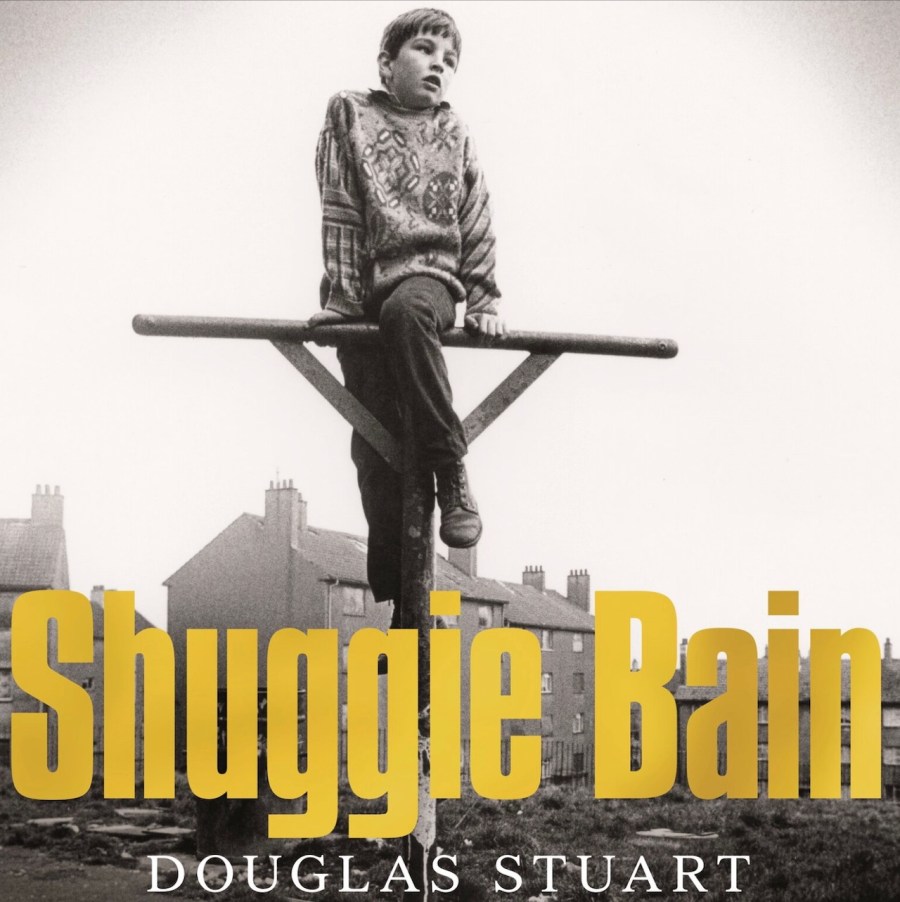
Book review: Shuggie Bain by Douglas Stuart

Beautifully sad and stark and longlisted for this years Booker Prize, Shuggie Bain is an uncensored story about poverty, addiction and abuse in Scotland in the 1980s. At sixteen Shuggie Bain lives alone in a grotty bedsit in Southern Glasgow and works at a supermarket deli. Shuggie Bain is Douglas Stuart’s debut novel and it tells the story of how Shuggie got there.

Agnes Bain lives in a high-rise council block with her second husband and three children all crammed together in her mother’s flat. Her husband is a philandering abusive taxi driver who takes advantage of her when she is at her most vulnerable and eventually abandons her.

She had loved him, and he had needed to break her completely to leave her for good. Agnes Bain was too rare a thing to let someone else love. It wouldn’t do to leave pieces of her for another man to collect and repair later.

Agnes descends further and further into poverty and addiction, the only constant her children and her heroic ability to get up every morning and face the world looking her best. Shuggie is the youngest, he does not fit the mould of Glaswegian masculinity, and finds himself as the sole carer of his mother as a young teenager in the post-industrial wasteland of a pit town.

She was no use at maths homework, and some days you could starve rather than get a hot meal from her, but Shuggie looked at her now and understood this was where she excelled. Everyday with the make-up on and her hair done, she climbed out of her grave and held her head high. When she had disgraced herself with drink, she got up the next day, put on her best coat, and faced the world. When her belly was empty and her weans were hungry, she did her hair and let the world think otherwise.

Agnes descends into addiction, failing repeatedly to save herself, or to be saved by Shuggie, a prissy, precise misfit of a kid who loves his ma. He tries repeatedly to help her but fails. He is coming of age in a Scotland that is descending into its own tragedy of unemployment, industrial collapse and recession. He is too gentle for the hostile world he lives in, but he is also strong and a survivor.

I really do not think I can live here. It smells like cabbages and batteries. It’s simply impossible.

The story has a whiff of Oliver Twist and Trainspotting in that it turns an unflinching lens on poverty, yet reading it does not cause a spiral of descent into despair because there is also love and kindness. And an endearing young boy who steals a girls My Little Pony toy because he is drawn to its pastel colouring and lush mane. You know that despite the torment and challenges of his young life, he is going to make good. Highly recommended.

Flames are not just the end, they are also the beginning. For everything that you have destroyed can be rebuilt. From your own ashes you can grow again.

Book review: Close Your Eyes by Rachel Abbott

Close Your Eyes is book 10 from the Tom Douglas series by Rachel Abbott. It’s my second cultish psychological thriller in a month.

Douglas finds himself investigating the murder of the wife of a successful tech businessman. Martha, who works for the businessman, is entrusted with taking care of all his financial affairs so she knows where the bodies are buried. She does a disappearing act with her young son soon after the killing and becomes a prime suspect in the murder investigation.

Told from the points of view of Martha and Douglas, there is a gradual unfolding of both the investigation and Martha’s past. The underlying themes of the novel are coercive control and psychological abuse using cults as a vehicle.

Words can manipulate to create a false sense of shared values, close down debate and coerce obedience. The language of cults aims to make people feel simultaneously unique and connected with each other, separate from ‘others’ and dependent on the leader to such an extent that life without them feels impossible. Cults engender both devotion and financial commitment (or abuse depending on how you view it) to create an environment ripe for exploitation.

To drift from the path of the cultish group’s expectations means exclusion and isolation, feeding on people’s fear of being an outsider. Mental manipulation convinces people to behave in ways that are in conflict with their former integrity and sense of self. The same methods can be successfully applied whether it’s a religious cult, a commercial cult, a conspiracy theorist group, a political or racist cult, or a toxic intimate relationship. And for dissidents, it’s off with their heads, either metaphorically of literally.

As Martha’s backstory unfolds we discover why she is such a secretive person and why she did a runner when the police turned up. The plot of Close Your Eyes is well crafted and sets a good pace. With carefully placed red herrings and blind alleys. The story gradually unfolds in a way that is disquietingly claustrophobic and discomforting.

Close Your Eyes can be read as a standalone, so don’t feel you have to start at book one if you don’t want to, though I doubt you’d be disappointed if you did.

Book review: The Pretty Delicious Cafe by Danielle Hawkins

I don’t generally consider myself a romance reader but the current state of the world demanded something light.

The Pretty Delicious Cafe by Danielle Hawkins is set in a small New Zealand seaside town with abundant food, twin telepathy, a hippie mung bean mother, an unhinged stalker ex-boyfriend, and a hero love interest.

Lia and her best friend Anna, who has food issues and is about to marry Lia’s twin brother, run a cafe in a seasonal seaside town. The busy season is about to arrive when a new good looking man rolls into town. Lia is attracted to him but is also trying to deal with an ex-boyfriend who isn’t taking ‘it’s over’ well.

I listened to the audio book whilst making sourdough and then gardening. The story sets a good pace and has quirky, likeable characters (except for the crazy ex). It’s a feel good eccentric romantic comedy that’s got plenty of laughs and will make your mouth water for boysenberry cheesecake. Luckily the end of the book has a catalogue of recipes from the cafe you can try out.

Book review: Sorrow and Bliss by Meg Mason

Sorrow and Bliss is one of those books that straddles commercial and literary fiction. The story made me laugh out loud one moment and cry the next. 

First novels are autobiography and wish fulfilment. Evidently, one’s got to push all one’s disappointments and unmet desires through the pipes before one can write anything useful.

Food writer, Martha, is reflecting on her life soon after separating from her husband and about six months after finally getting an accurate diagnosis and treatment for a mental illness that has plagued her for all of her adult life. She reflects on the the two decades that have passed since ‘a little bomb went off’ in her brain at seventeen.

Everything is redeemable, Martha. Even decisions that end up with you unconscious and bleeding in a pedestrian underpass, like me. Although ideally, you want to figure out the reason why you keep burning your own house down.

Martha’s telling of her life is deadpan and comically tragic. She is not a particularly likeable character, yet she becomes an endearing narrator as the reader comes to understand her struggle with her own behaviour and identity.

Everything is broken and messed up and completely fine. That is what life is. It’s only the ratios that change. usually on their own.

Sorrow and Bliss is a love story set in London and Oxford. It is a novel about mental illness and it’s effects on sufferers and those who love them, including their uniquely dysfunctional middle class families. 

After that, Nicholas got up, stretched, and told me I could have his spot because he just remembered a girl he need to make amends with because his final act before rehab was putting a nine iron through her windscreen after taking more than his recommended daily intake of methamphetamine. ‘Which I discover is non. Back shortly.’

Various doctors, psychologists and prescriptions have failed to help Martha. She and those around her fall back on the belief that she is simply too sensitive, and a bit difficult. Martha searches for answers, knowing that something isn’t right. Her experience exposes the fallibility of the medical profession that often gets things quite wrong, and through doing so can change the course of a persons life in ways that can be quite damaging.

Suffering is unavoidable, the only thing one gets to choose is the backdrop

Interestingly Martha’s illness is never named. I found this both liberating and frustrating. It forces the reader to understand her issues purely from her perspective on the world and the lived experience of her illness. It also frustrated that very human drive to label and categorise things.

I was the victim, and victims of course are allowed to behave however they like.

Book review: Pig Island by Mo Hayder

Grisly. A faith healing cult on an isolated island divided by a fence and inhabited by wild pigs, the preacher gone mad and isolated away from his flock with his disabled daughter on one side, the rest of the faithful on the other. A story starts circulating on the mainland that a half human-half animal creature has been seen wandering the island.

Everyone hates him. Me – I think I can see the sun shine when he bends over.

Journalist Joe Oakes is invited by the Psychogneic Healing Ministries to visit the island in order to debunk the myth that a devil is running around. The cult members don’t realise that Joe has history with the mad minister. Years previously he wrote an article under a pseudonym calling the minister a sham healer. 

What unfolds is a gruesome, page turning thriller with a twist that will make your skin crawl. If you can’t stomach a bit of graphic violence it may not be for you. It may also give you nightmares.

Pig Island is the fourth novel by Mo Hayder, the pen name for Beatrice Bastin who died recently from complications of Motor Neurone Disease. Pig Island was nominated for a Barry Award for Best British crime novel and a CWA dagger.

Hayder wrote ten thrillers, earning herself the title of ‘queen of fear’. There is also another due out in 2022 written under the name Theo Clare:

Jack Caffery series

  • Birdman (2000)
  • The Treatment (2001)
  • Ritual (2008)
  • Skin (2009)
  • Gone (2010)
  • Poppet (2013)
  • Wolf (2014)

Stand-alone novels

  • Tokyo (2004), also published as The Devil of Nanking (2010)
  • Pig Island (2006)
  • Hanging Hill (2011)

Writing as Theo Clare

  • The Book of Sand (2022)

Book review: Memorial by Bryan Washington

Benson and Mike’s relationship has never been easy and now it’s in a rut. Their fights with words and fists end in sex. Each is unsure about what their relationship is or where its going. Memorial is a modern story of the relationship between two gay men – one Japanese, one a black man – and their relationships with their families.

That loving a person means letting them change when they need to. And letting them go when they need to. And that doesn’t make them any less of a home. Just maybe not one for you. Or only for a season or two. But that doesn’t diminish the love. It just changes forms.

Sexuality, race, class, trauma and grief are the subjects of Memorial by Bryan Washington.   The story is written in three parts across two locations – Houston and Osaka – and told from the perspective of the two men.  

You’re taking up space in another human’s brain, she said. You’re a foreign entity. A parasite. That’s a lot by itself.

Memorial opens from Benson’s perspective. His partner, Mike has decided to go back to Japan to see his dying father. Mike’s mother, Mitsuko, who Benson has never met arrives to stay the day before Mike leaves. Benson finds himself sharing a house with a Japanese woman he doesn’t know in a predominately black neighbourhood in the throes of gentrification. Mitsuko is disappointed that her son has run off to be with her ex-husband just as she arrives and resists Benson’s attempts to draw her out.

He came out of my body. He’s a homosexual. He left his mother with a stranger. I’ve already got everything I need to know.

Mike arrives in Japan and takes up residence with his estranged, dying father, Eiju, who runs a bar and pretends nothing is wrong. Mike communicates via sporadic text messages with Benson and equally sporadic conversions with his father.

There are a lot of spaces in this novel. The unanswered questions and awkward silences between characters draw your attention to what is not said, revealing that there is as much, if not more meaning in the unspoken than the spoken. A beautifully written insight into the ordinary life of men.

Book review: Edie Richter is Not Alone by Rebecca Handler

Rebecca Handler’s debut novel Edie Richter is Not Alone explores Alzheimer’s and the impact of euthanasia on families. Edie, her mother and sister care for their father/husband with early onset Alzheimers. When he no longer recognises her and stops eating Edie decides to suffocate her father without telling anyone.

After Dad’s diagnosis, Mom started labeling things and let Dad grow a beard. She went to a baby store and bought plastic child-protection locks for the kitchen. Just so he won’t stab me, she said, as I wrestled with one of them, trying to get a corkscrew out from a drawer. You remember Tanya from my walking group? Her mother attacked the cleaning lady and they had to move her into a home. 

After the funeral Edie and her husband, Oren, relocate from San Francisco to Perth, Australia. The story unfolds with dark humour as Edie explores her new home and is incrementally undone by her dark secret. She murdered her own father. Eadie’s behaviour becomes increasingly unpredictable and outlandish. The story is a well crafted, if discomforting, study of a woman unravelling due to her own lack of insight into her very complicated grief. Oren scrabbles around in fruitless frustration trying to penetrate her emotional defences and help.

I thought that life was about moving from one thing to another, all the previous things falling down behind you, but I was beginning to see this was not the case at all. That in fact every action, every thought, and every word uttered, they all stayed with you and formed a sort of jumbled collage

I found this novel morbidly compelling, a little voyeuristic and viscerally uncomfortable. It is a study of a woman’s mental and emotional disintegration resulting from her inability to open up to others about what pains her the most. She pushes away those closest to her and behaves in such appalling ways that she infuriates others who begin to believe she really is either bad or mad. As Edie becomes more and more isolated her realtionships and inner life fray. Eventually something has to give. 

A challenging, engaging and thought provoking read.