
Book review: I See You’ve Called in Dead by John Kenney

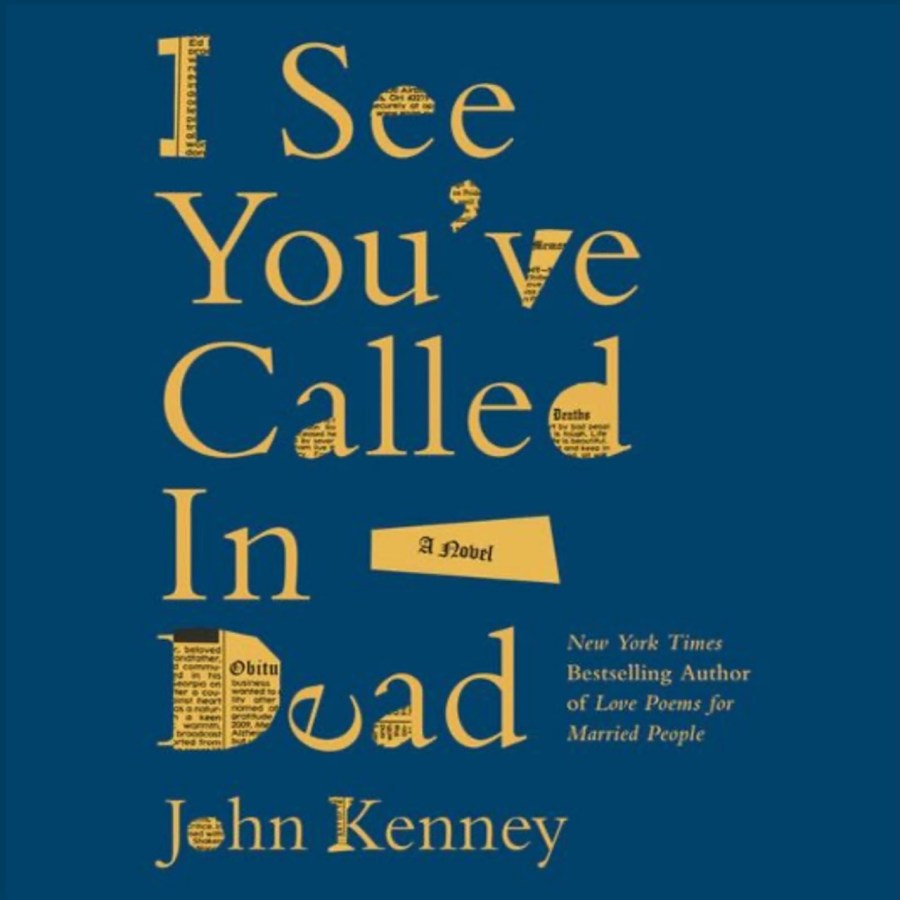
I found I See You’ve Called in Dead by John Kenney hilarious in a laugh out loud way.

One advantage for the dead is that they never have to read your writing.

Bud is a middle aged obituary writer, struggling in the wake of a failed relationship and lack of purpose. On top of all that his recent performance review highlighted a long list of failures – including significant errors in his published work. In one obituary he incorrectly wrote that an 80 year old woman had died by throwing herself off a bridge. What would her grandchildren make of that, his boss asks.

Are we ever fully honest with someone else? I don’t mean to suggest outright lies, but do we really express those quieter, deeper feelings? Those amorphous, hazy things, core things that even we struggle to admit to ourselves. Do we share everything?

Drunk and feeling sorry for himself one night, Bud writes his own obituary and accidentally publishes it to the web. When his company discovers the issue they want to fire him. A legal glitch prevents them – they cannot fire a dead person.

What would you write if you had to write your obituary? Today, right now. What comes to mind? What memories, days, moments? What people and experiences? I realize, at first glance, that the idea of writing one’s own obituary while still alive may sound morbid. It’s not, though. I promise you. It’s a needed reminder of who you are, of what truly matters. Because it’s your life and there’s still time to write it. Before I have to.

While the company tries to sort out Bud’s work situation so they can fire him, they suspend him from work. Bud starts going to the funerals of strangers in a bid to seek meaning in his own life. 

Life prevails. How strange and wondrous. In the midst of death, life prevails, calls to us, begs us, says, Come, please, don’t you dare waste this precious gift.

I See You’ve Called in Dead is a wacky character driven, satirical tale about life, death and purpose.

We do not know where death awaits us: so let us wait for it everywhere. To practice death is to practice freedom.

Book review: The Blind Assassin by Margaret Atwood

Booker prize winner, The Blind Assassin by Margaret Atwood, has a layered and complex narrative. 

The only way you can write the truth is to assume that what you set down will never be read. Not by any other person, and not even by yourself at some later date. Otherwise you begin excusing yourself. You must see the writing as emerging like a long scroll of ink from the index finger of your right hand; you must see your left hand erasing it.

An old woman called Iris Griffen reflects on her own life, and her sister Laura’s suicide. The sisters came from a wealthy family, with Iris married off to her father’s business rival in order to rescue the family fortunes after a series of incidents threaten to send him broke. Iris is determined to document her story before she dies, with the hope of it facilitating a reconciliation with her estranged granddaughter Sabrina. 

This is how the girl who couldn’t speak and the man who couldn’t see fell in love.

Iris’s telling of her life is interspersed with chapters from her sister’s novel, The Blind Assassin, published after she drove off a bridge to her death. The book made her posthumously famous, giving her a cult like status. The Blind Assassin is about two anonymous lovers having a secret affair. 

Should is a futile word. It’s about what didn’t happen. It belongs in a parallel universe. It belongs in another dimension of space.

A third narrative is introduced by the anonymous man telling lover a science fiction story about a blind assassin and a sacrificial virgin who fall in love against the odds. A fourth narrative exists in newspaper and magazine stories from the 1930s and ‘40s.

The best way of keeping a secret is to pretend there isn’t one.

The pieces of the disparate narratives are masterfully bought together in the final pages. The Blind Assassin is a bleak but beautiful tale about lies, coverups, gender, class, family tragedies and the unreliability of memory. 

If you knew what was going to happen, if you knew everything that was going to happen next—if you knew in advance the consequences of your own actions—you’d be doomed. You’d be ruined as God. You’d be a stone. You’d never eat or drink or laugh or get out of bed in the morning. You’d never love anyone, ever again. You’d never dare to.

Book review: Platform Decay by Martha Wells

Platform Decay by Martha Wells is #8 in The Murderbot Diaries series. The latest instalment was published in May this year. I’m a big fan of this series and you can find reviews about other books on this blog. The protagonist is a Security Robot, or SecUnit, who has managed to hack his own governor module, giving him control over his own actions. As a result he goes on a journey of self actuation. Perfect in this age of AI!

There was nothing I could do about it now, so I watched episode 487 of Sanctuary Moon and tried to pretend none of this was happening.

Over the course of the series, Murderbot has been on an emotional maturing journey – from being horrified by humans and socially anxious (All Systems Red), running away from any mention of emotions (Network Effect) to PTSD (Systems Collapse). In Platform Decay, Murderbot has installed a repaired risk assessment module and a mental health module that provides regular emotion checks. 

Emotion check: If we ran into any human murderers they had better be heavily armed, because I am in a bad fucking mood.

Murderbot is on a rescue mission with another SecUnit named Three to extract Dr. Mensah’s family, including children – ick. Things go a bit pear shaped and becomes way more complicated when a dying enemy asks SecUnit to save their five person crew as well.

Yes, getting one group of humans out and then going back for another go would be exponentially more risky for me and the chances that I would (a) fail, and (b) get dismantled and my parts redistributed in a corporate factory with my organic tissues melted and thrown away like so much garbage were high. (I didn’t want to look at those numbers but the pings from risk assessment were increasingly urgent.) (You know, I think I liked risk assessment better before I tried to fix it, when I knew for sure it was full of shit.)

Murderbot’s internal monologues and external quirks are as dry, hilarious and endearing as ever, and there is plenty of hi jinx and action. Platform Decay is a fun, fast paced novella.

Emotion check: Having someone else support your bad decision feels kind of good.

If you are interested in becoming acquainted with Murderbot I recommend you start with book #1 All Systems Red as you will probably get hooked.

Book review: The Passenger Seat by Vijay Khurana

The Passenger Seat by Vijay Khurana is a story about what happens when bored, discontented, testosterone fuelled boy-men who have grown up with distorted prescriptions for masculinity are left to their own devices and go rouge. It is both disturbing and compelling. 

When two men say hello on the street, one of them loses.

Adam and Teddy have a friendship built on competition, oneupmanship and risk taking in their search for identity in a small town on the west Coast of Canada. They have just finished high school. Adam lives with a father who has banned talk of his mother, and the boy gets much of his advice on life, including how to manipulate girls, from books and podcasts. Teddy has a girlfriend, but is unsure about the man he wants to be. Both want to be seen and to be witnessed.

The road though! Endless becoming, a colour palette always and somehow never changing, grey to green to brown to blue to other, occasionally red, very occasionally yellow, whoosh, repeat, repeat, something comes the other way with headlights on, the beauty of headlights in daylight, fence, field, these lane markings like perforations maybe, as if the road or the whole world could unzip any moment now, if there were such a thing as a moment when you’re driving, which Teddy realizes there isn’t. It’s just one long stretch. The road and its contradictions: boredom and excitement, you sit still but you’re moving, there’s a good kind of silence even with the engine noise and the German metal Adam has them listening to. Teddy’s mom used to call this sitting and thinking time. But all Teddy wants to think about is how the world keeps rushing toward them then dropping harmlessly into their wake. 

The boys hatch a plan to go on a road trip and drive as far as they can. They do not tell their families. When they stop so Teddy can buy a gun, we become certain this trip will end badly. They drive on in the sweltering van – unwashed, tormented by insects, fuelled by energy drinks and chips during the day, and bourbon at night. When they chance across a young couple on the side of the road and make a fatal decision, the reader knows there is no going back and we descend into the young men’s inner worlds as they unravel without remorse.   

Both start unconsciously paring their sentences, seeing how minimal they can make them and still be understood

The Passenger Seat is a skilfully crafted debut novel infused with menace and fear. Its sparse prose holds the reader in tension from the outset and leaves them with a lingering discomfort. 

Book review: The Last Binding trilogy by Freya Marske

I picked up the first book in The Last Binding trilogy (A Marvellous Light) and was sucked into the magical Edwardian world so deeply that I totally binged on book two (A Restless Truth) and three (A Power Unbound). Freya Marske has set her stories in England where the population is divided into (secret) magicians and non-magicians, political intrigue is rife, and hot queer romance is in the air (content warning if gay sex makes you queasy this trilogy may not be for you!). 

On the contrary, stories are why anyone does anything.

The secret magical population are upper class land owners whose powers are drawn from their relationship with the land. Even their houses are infused with sorcery, and there’s a government office whose purpose is to keep magic out of the view of the general non-magical public. The first instalment revolves around the unmagical Robin and the magical Edwin who are thrust together after an administrative error. They go in search of an ancient contract that threatens all the magicians of England. There are murderous mazes, faceless enemies, family tensions, runes and magical visions.

Of course I’m on your side. You complicated my life,” Robin said warmly. “You woke me up. You’re incredibly brave. You’re not kind, but you care, deeply. And I think you know how much I want you, in whatever way I can have you.

Book two takes place on a passenger ship and revolves around Maud, Robin’s sister who is accompanying an elderly magician to help her brother get to the bottom of the ongoing magical contract conspiracy. When the old lady dies, Maud teams up with Violet, another passenger, the controversial magical actress who agrees to help her try to identify the murderer.  This book includes marauding zoo animals, hijinks, emotional angst, steamy ladies, and helpful gentlemen – including writer-thief, Alan Ross, and Lord Hawthorn who knows a lot about magic, but no longer has any. It turns out the old ladies parrot is hiding something important.

Good to see you, Edwin, old chap. Don’t give my regards to your family. I never liked any of them.

In book three we are back in London with the whole crew. Centre stage are Robin, Edwin, Violet, Maude, Lord Hawthorn (Jack), and Alan all trying to track down the last contract before magical mayhem and catastrophe break out. Jack’s twin sister’s death as a child has a direct link to the magical subterfuge that has haunted the entire trilogy and comes to a head in A Power Unbound. Initially Alan is only in it for the money, until sparks start flying with Jack. Book three has big magic – in people and tetchy houses, ghosts, a magicians version of a shoot out, and some of the most explicit, well crafted sex scenes I’ve ever read.

I suggest a daring stealth adventure, and you have to ruin it by telling me it’s going to involve books

A fun, raunchy, bingeworthy three book fantasy-crime read with whimsical prose and a feel of quality fan fiction to it. I was a little disappointed when the ride ended. 

Book review: Second Place by Rachel Cusk

Long listed for the Booker Prize in 2021, Second Place by Rachel Cusk is about M, a middle aged writer with a past. While the details of that past are never fully explained to the reader, it remains in the forefront due to M’s fears, insecurities and inner demons. The story is narrated as a letter from M to a person called Jeffers. 

Some people write simply because they don’t know how to live in the moment and have to reconstruct it and live in it afterwards

M is an anxious woman who lives on an isolated marshland property with her second husband, the easy going Tony. There are two residences on the property – one, a cottage reserved for guests. M invites famous artist, L, to stay. She hopes to become his muse and that he will be inspired by the landscape.

Why do we live so painfully in our fictions? Why do we suffer so, from the things we ourselves have invented?

At first L says no, but then an unspecified event that leaves him in financial difficulties leads him to accept. M had imagined him a soulful visionary artist, but finds him a narcissistic and disagreeable individual. L arrives with a wealthy, beautiful and uninvited young woman called Brett in tow. L is not the man M was expecting and the two are immediately at odds. 

I’m not the kind of woman who intuitively understands or sympathises with other women, probably because I don’t understand or sympathise all that much with myself.

Justine, M’s twenty one year old daughter and her boyfriend Kurt, a pretentious aspiring writer also come to stay. What follow is a study of the group dynamics, told through M’s eyes.

You get tired of reality, and then you discover it’s already gotten tired of you.

Second place explores power dynamics, gender, motherhood, marriage, aging and art. The carefully crafted, exquisite language of the book is melancholic and unsettling.

Book review: Past the Shallows by Favel Parrett

Set in Southern Tasmania, Past the Shallows by Favel Parrett is about three brothers – Joe, Miles and Harry. Miles and Harry live an impoverished life with their abalone fisherman father. The boys mother died in a car accident and their father is a violent drunk. Young adult Joe has left home, but not town, after an altercation with his father. The ocean itself is almost a character – ever present, desolate, and isolated.

Water that was always there. Always everywhere. The sound and the smell and the cold waves making Harry different. And it wasn’t just because he was the youngest. He knew the way he felt about the ocean would never leave him now. It would be there always, right inside him.

Thirteen year old Miles feels trapped working with his father on the fishing boat. Harry who is around eight years old doesn’t have to work the boat as he suffers from sea sickness. He spends much of his time alone until he befriends an old man called George who the local children are afraid of due to deformities. 

There were things that no one could teach you – things about the water. You just knew them or you didn’t and no one could tell you how to read it. How to feel it. Miles knew the water. He could feel it. And he knew not to trust it.

Miles wishes he could leave home or go surfing with his friends. He also feels a sense of responsibility toward his younger brother, to protect him from their father. It is this relationship between Miles and Harry that is the central spine of the book and it is their voices we hear.

Harry picked up an abalone shell, the edges loose and dusty in his hands. And every cell in his body stopped. Felt it. This place. Felt the people who had been here before, breathing and standing live where he stood. People who were dead now. Long gone. And Harry understood it, right down in his guts, that time ran on forever and that one day he would die.

Past the Shallows is a coming of age story written in spare, lyrical prose, about the brother bond, grief, family violence, and the struggles of ordinary life.

Book review: Clean by Alia Trabucco Zeran

Domestic literary thriller, Clean, by Chilean author Alia Trabucco Zerán and translated into English by Sophie Hughes, explores domestic labour, class, and inequality. The entire story is narrated by Estela from an interrogation cell she is being held in by police and focusses on events that took place in the house in which she was employed as a nanny.  

By now you’re probably wondering why I stayed. … My answer is the following: Why do you stay in your jobs? In your poky offices, in the factories and the shops on the other side of this wall?

It becomes immediately apparent that the seven year old daughter of her employers drowned. The question of whether it was intentional or an accident is the central question of the novel.

I never stopped believing I would leave that house, but routine is treacherous; the repetition of the same rituals — open your eyes, close them, chew, swallow, brush your hair, brush your teeth — each one an attempt to gain mastery over time. A month, a week, the length and breadth of a life.

Estela began working for a wealthy doctor/lawyer couple as a live in nanny at their Santiago home just as they were having a baby. She worked there for seven years.  She lived in a small room behind a sliding door off the kitchen. Mara, the mother is neurotic and the father, Cristóbal is a mildly sadistic disciplinarian. The child, Julia, was obstinate and her parents blamed Estela for anything wrong with their child, whilst taking credit for all that was right. The couple take Estela for granted and frequently gaslight her. The family disfunction drives much of the tension in the novel, along with the question of how the girl drowned.

I kept thinking about the girl, … about her chubby, idle hands, always ready to pop those nails into her mouth, for them to be destroyed by her teeth. I never bit my nails. My mama didn’t either. I suppose for that you’d need to have your hands free.

The character of Estela is defined almost entirely by her role in the novel. We do not find out what she looks like, only what she does – cook, clean, make the beds, wash the clothes, look after the household and the child. Outside the house social, economic and political unrest are brewing as protests and public disturbances increase. Estela’s primary act of rebellion is to befriend a stray dog, take care of it and keep it secret from the other inhabitants of the house. Its discovery triggers the unfolding of the climatic events of the story.

This is just the way life goes: a drop, a drop, a drop, a drop, and then we ask ourselves, bewildered, how we’ve ended up soaked to the bone.

The treatment of Estela is a microcosm of the societal  dysfunction outside the house resulting from the imbalance of power between the wealthy and the poor in Chile. The story in Clean is a claustrophobic, slow moving car crash of the domestic lives of the inhabitants of the house. 

Book review: Elegy, Southwest by Madeline Watts

Elegy, Southwest by Madeline Watts is set during the deadly 2018 Californian Camp Fires that burnt for weeks and destroyed a number of communities, leaving the state in a blanket of smoke. The relationship between Eloise and her husband Lewis flounders during a road trip. They are following the Colorado River across California, Nevada, Utah and Arizona. 

Climate change isn’t like war, because you can’t see it happen… And it’s also incredibly slow until it’s incredibly fast.

Eloise is undertaking academic research on the river and its likely demise in the future due to climate change. Lewis who works for an art foundation is struggling with the death of his mother from cancer and smoking a lot of weed. He is inconsolable.  

I wanted to be across the literature. As though by studying the canon of death I would be able to anticipate the future… I was reading for you, for when you fell apart.

Eloise grapples with her husbands detachment as they drive across the desert. She decides to keep her suspicion she is pregnant from him as she feels him distancing from her. The story is told from the future when Eloise is sifting through events and searching for resolution after Lewis is gone. 

Afterwards, you told me it was part of what you loved most about those weeks.

The cover of Elegy, Southwest is beautiful. The story is a cinematic, meandering, slow burn about personal and environmental decay and the grief that accompanies those deteriorations.

Book review: The Silent Listener by Lyn Yeowart

The Silent Listener by Lyn Yeowart is a disturbing psychological thriller (trigger warning) set across three timelines – the 1940s, 60s and 1983.

His room smells like the orange blankets have licked up the dying odours from his body and are slowly releasing them into the air, and the semi-darkness reminds me of the day I hid in here and saw a snake on the bed, about to attack me.

In 1983, Joy Henderson returns to her family’s remote dairy farm in rural Victoria to nurse her dying father, George. From the outside George was an upstanding community member and church elder. To his children he was a mercurial sadistic abuser who used the word of god to punish them. 

If the hovering Christ saw one of them break a rule, he floated down to whisper in their father’s ear, and then it would start. The thump on the table, … the screams of eternal hell and damnation, his hot red face not ten inches away from the sinner’s.

The 1940s timeline tells the story of how George met Joy’s mother Gwen and swept her off her feet. They married quickly and he whisked her off to his isolated rural dairy farm and enforced all his ‘rules’. The couple had three children – Mark, Joy and Ruth who died in an unfortunate accident. 

Joy knew she should feel sorry for Ruth, but the truth was she felt a familiar white tremor of jealousy

Joy is 11 years old in the 1960s when her friend and neighbour Wendy disappears. The police investigation fails to solve the mystery and Wendy is never seen again. Joy’s father prays with Wendy’s parents.

Pain is a gift because it makes you angry. Angry at the ones who hurt you. Angry at the world. And angry people fight.

Upon her return to the farm, Joy grapples with her childhood trauma and vengeful feelings toward her father. She talks to her sister Ruth who is also there and goads her on to entertain revenge. She manages to get George to confess to Wendy’s disappearance, then finds him dead the following morning.

the moment he dies, the room explodes with life

When George dies, the circumstances are suspicious – he has a belt tied around his neck – and Senior Constable Shepard investigates. He was also involved in the search for Wendy years before. 

We’re all liars… It’s not a question of whether we lie or not, it’s a question of what lies we choose to tell. And to whom.

The Silent Listener is about domestic violence, religious hypocrisy, trauma and survival, the unreliability of memory, mental illness, and the duel personas of abusers. Yeowart casts the characters in vivid colour through this confronting, carefully plotted and twisty tale.