I have written a couple of blogs about spoken word. My first spoken word event was for a local festival in the town I live in a little over a year ago – Poetry and Prose at the Pub. I decided to do it to challenge myself – it was an introverts nightmare. Nervous as a long tailed cat in a room full of rocking chairs, I read up on tips for delivery and practiced for hours, the dog listening patiently in the background. I delivered my piece, script in shaking hand, to a local audience of about thirty people, and to my releif it went down well.
My second spoken word outing was at the Terror Australis Readers and Writers Festival in Tasmania, last year. This time I delivered my piece freestyle, having learnt it off by heart. My best tip for remembering a script is to record yourself reading your work and play it back over and over, and practicing delivery until you nail it. At Noir at the Bar in Cygnet there were about seventy people in the audience.
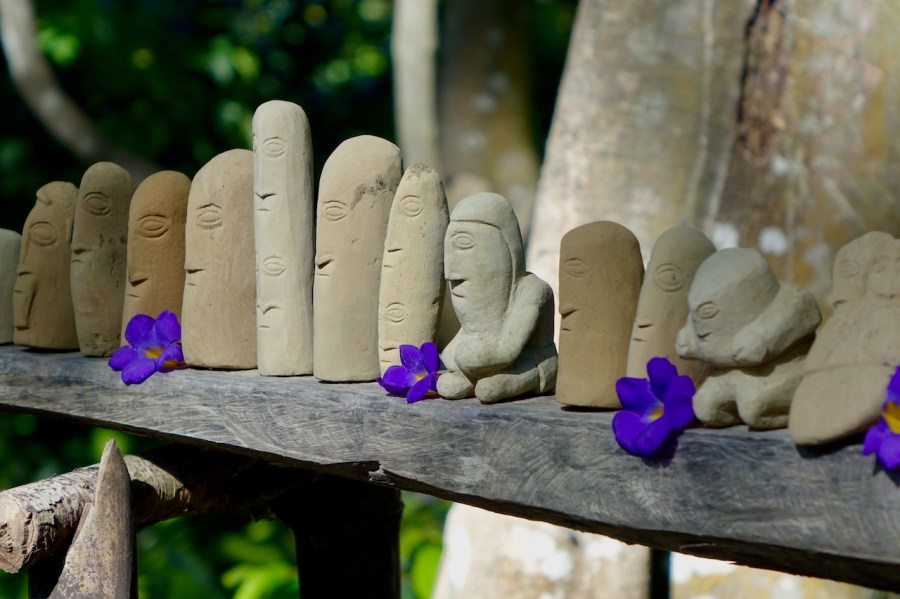
The Artistic Director of Terror Australis tracked me down a couple of weeks ago and asked me to record my spoken word piece Feet of Clay for a Facebook live event she’d started hosting called BookLove Tuesdays. Feet of Clay combines my dual interests of poetry and crime fiction and tells a story of ambition, love and jealousy in the pottery world. It’s a bit creepy, but I hope you enjoy it.
I would love to write an entire novel using this rhythmic style one day – although I think it would be hard to keep this type of cadence up for an entire manuscript – a challenge for another time perhaps!
What are some of the things you have done to challenge yourself or your writing?
Nothing like a bit of noir to make you feel better about your own circumstances…
He and Maddie should simply disappear from the Gold Coast. The gaudy city masqueraded as paradise, but sometimes it was hell on Earth.
Gary Braswell is a ball scratching Gold Coast car salesman, a chain smoking compulsive liar with drinking and gambling habits, and he’s not averse to a bit of illicit drug taking either. His act now, worry about consequences later approach to life have left him in debt to a loan shark, Jocko, whose hired muscle is the worst kind of ex crim. Gary thinks his luck has turned when a wealthy Russian couple buy four cars from him that enable him to pay back his debt to Jocko, but Jocko wants Gary to run a little package to Bali for him as a late payment penalty. If he refuses Gary’s wife will be paid an unwanted visit from Jocko’s muscle.
When it came to heterosexual couples and serious vehicle purchasing Mr usually did the talking and Mrs the listening, and sometimes the eye-batting, lip-licking and hair-twirling. There were rare exceptions, about as rare as Gary tipping the first try scorer. He imagined the ‘work’ the woman referred to might be pole dancing or selling pot.
While Gary’s trying to work out what to do, his wife goes to stay with her mother for her own safety. Meanwhile Gary gets a new job as a real estate salesman chasing bigger returns with his bullshit, and his best mate agrees to help him hatch a plan to get him out of his pickle with the help of the federal police, some of whom are as dodgy as Jocko’s muscle. Of course Gary just ends up in deeper shit involving dodgy money laundering Russians, and his life spirals more and more out of control on sex, drugs and booze.
Snot dripped from his nose. He placed a hand to his forehead. Temperature seemed normal, but his arsehole was red raw. And if that wasn’t enough, the itchy balls were back.
Blair Denholm’s novel published by Clan Destine Press is quintessentially Australian noir with plenty of Aussie expletives. Denholm, who has an interesting past himself, crafts a protagonist who is wholly unlikeable, but redeemed for the reader by his habitual haplessness and a huge dose of gaudy humour. I’m just glad I’m not Gary Braswell’s wife, Maddie.
Gary’s bag of excuses was empty. He stared at Foss and gathered his thoughts. Suddenly his arms and legs started to jerk like Peter Garret at a Midnight Oil concert. In one rapid motion he collapsed and curled his body into the foetal position. He pulled his arms in by his sides and, unseen by Foss, pinched the soft skin on the inside of his bicep, and launched into a juddering, rocking motion. He grunted out primal-sounding noises which soon escalated into unearthly wailing.
Sold is not for the faint hearted, or those who are queasy about body fluids – it’s no cosy mystery – but it is a fun romp of a read if you like a walk on the wild side, and it could make your isolation seem not so bad after all. The sequel, Sold to the Devil is due out soon.
Where to begin when you sit down to write for the first time in three weeks and the world is a completely different place to what it was last time you faced a blank page? And how does one reclaim a creative space embattled by a mountain of work priorities driven by a virus taking an extraordinary toll on humanity?
In the grand scheme of things I am incredibly fortunate in these uncertain times – I have a stable job and I can now work from home, I am holed up in a comfortable house surrounded by hilltops, forests and the constant chatter of bird life, I have a garden to potter in and grow a lot of my own food, and a person and a dog who I am happy to be locked up with. I am also a natural introvert, so am not overly distressed by the idea of staying home for six months, after all I voluntarily did exactly that for 12 months only a little over a year ago when I took time off to write.
So what is it that leaves me a little discombobulated? There is of course the great sadness experienced when reading the news about the toll the virus is taking on the world, the shock at how this situation exposes the fragility of our globally interconnected economic and social systems, the fear that this even event will not be enough for us to find a different way to live in relation to nature, and for the well-being of people I care about. It is perfectly normal to feel a little shell shocked in the early period of a crisis of this scale, regardless of how well protected from it you might feel individually.
A situation such as this requires a significant mental shift as well as a physical reorganisation, and a willingness to embrace a new normal. The last three weeks have been a work whirlwind – we had 100 people we needed to try to reorganise to be able to work from home. This took a mammoth effort from myself and colleagues. We also have thousands of stakeholders we needed to provide urgent information to – to help them understand the changes to our workplace, and to connect them with information to help them weather the storm.
Prioritising taking care of the work team has been important, and I have been happy to do so, but at the same time I lament the intrusion into my personal space, particularly my creative space, and how the separation between this and work demands have become blurred. I need to trust that on the other side of this shift I will find my creative, resilient brain waiting for me. It made me realise how much routine plays a part in making time for ourselves – I used to use the time commuting to and from work as my creative writing time, with that gone, I need to create a new routine that allows time for writing.
It is clear the current situation is going to last for a long time, at least until a vaccine is found – conservative estimates suggest at least six months, if not years,. The situation demands finding a new routine that allows for as much of the fullness of our lives as can be managed within the restrictions we must live with out of compassion and care for our fellow human beings, as well as our own. My frustration of recent weeks led me to think about what a new structure might look like…here are some of my thoughts.
On the intrusion of work
The voice of work can be loud voice and demanding. We need to take the time to set up a comfortable workspace and make it as private as circumstances allow. Find new ways using technology to stay connected to staff and colleagues now you can’t lob up at their desk. Build in regular welfare checks to make sure they are ok. Carve out time blocks for different categories of your work – do the easy things when stress levels are high and the more challenging jobs when your concentration is at its best. Don’t expect your productivity to be what it was – at least not immediately.
Take regular breaks – make a cuppa, drink water, pat the dog/cat, talk to the houseplant, walk around the garden or gaze out the window. Even better open all the windows and blast out the house with fresh air.
Keep time sheets to help yourself contain your day job to reasonable hours the loss of a commute removes the natural boundary of home time.
Personal Wellness
Create a routine. Keep getting up and going to bed at a reasonable time. Move your body in a way that makes you energised at the start of the day. My go to exercise is running or walking with the hound, yoga by YouTube or a bike ride. I will also make time for the solace of gardening. Last weekend I spent time in the veggie patch, weeding and planting seeds – my own version of hoarding whilst others were madly buying toilet paper and cleaning products.
Do some of those jobs you’ve been putting off forever because you were too busy – tidy those cupboards, paint a room, finish the landscape project, organise your bookshelf – control the things you can it can ground us when things are a little chaotic.
Eat well – if you weren’t a cook before, maybe now is a good time to learn the skill, and to appreciate the comfort in it – a couple of the my favourite places to go for tasty recipes are Arthur Street Kitchen and Ottolenghi. Identify things you can do to you bring you peace or joy – take a bath, sort your holiday photos, paint or journal, find a place you can retreat to. What things would you put in your self care toolkit? Keep them close and turn to when needed.
It is important to stay up to date with what’s happening in your world, but it’s also easy to be sucked into obsessing about it. Place limits on your engagement with news and social media about the COVID conversation and remember the media is often sensationalist, so acquire your information from trusted reliable sources. Don’t lose sight of what is good in the world. Look for things to laugh at each day – your pet being amusing, silly memes online, and when it all seems too much – reach out for assistance.
Creativity
Carve out time for creativity and make sure you use that time for something connected to your creative interests. Now is the time to start that long term project you’ve been thinking about on and off. My plan is to set aside a block of time each day to write, perhaps I will finish my second book sooner than I thought. On the days I don’t actually write I will use my creative time for a connected activity like reading or online learning on writing. The Australian Writers Centre delivers some great online courses for writers and Writers Victoria are moving a lot of their workshops online, one of which I am doing tomorrow.
Your creative thing might be painting, knitting, sewing, or learning an instrument. Don’t limit yourself to things you already know how to do – get online and find someone who’s moved their teaching practice online – you could learn a new craft and support another creative at the same time.
Social connectivity
The political narrative about needing to keep our distance from people to contain the spread of COVID-19 uses the term social distancing. For many, the term spells isolation and loneliness. I wish the policy-makers had considered this and referred to physical distancing instead, as at times of stress, social connection is even more important than usual. It provides ballast and helps to keep people mentally well. Find ways to connect with friends and loved ones that keeps everyone safe, whether its Snapchat, video catch ups or long phone conversations. The time for hanging out in coffee shops and hugs will return eventually. We tried our first digital dinner party last week, and I was pleasantly surprised at how well it can work. Some tips:
Keep up communication as you cook so you can time your dial in to get everyone eating together
Set your laptop up at least arms length from where you sit (a bit further away than where you lay the table) so everyone can be seen in the picture together
Sit the laptop up on some books – it works better if the camera is slightly above your eye level
Bring your best self to these occasions, people are dealing with the changed world in different ways, and we need to bring compassion for those we care about – it can bring out both the best and worst in people. If you want to hang out online because that’s the only option while you are in isolation there are loads of apps for that – Zoom, Skype, House party, Google hangouts.
This weekend we’re going to try one where everyone taking part cooks the same meal.
Community
Continue to greet neighbours from a respectable distance when you pass them in the street, when you can – support local businesses that are staying open to service your needs or donate to your favourite creative organisation. When businesses set up rules to help keep customers safe and trade fairly in response to some individuals being overtaken by individual greed – follow them without griping – it’s a time to loosen our grip on control and individualism and think more collectively. In Australia there is still plenty to go around – toilet paper, food and cleaning products included.Hoarding is really not necessary and probably tells us more about our mental health than it does about supply and demand – so if you are doing it perhaps consider spending the money on a therapist instead.
This new world order is going to be a marathon, not a sprint so railing against it will not help, now is the time for radical acceptance and innovating to make your life as full as it can be within the circumstances in which we find ourselves, with much lower expectations than you may have had previously. Chunk your days into bite sized manageable segments to avoid the existential dread of the unknown taking over and when you notice the current situation enabling injustices that make your blood boil – channel that energy into writing to your local MP, or the newspaper to call them out so the annoyance doesn’t fester.
If you wear yourself out at the beginning you may not make the distance in one piece, so take the time to find a way to be that offers you the best change of wellness, serenity and productivity for the long haul. And for those of us who take solace from creative pursuits, we must make room for them.
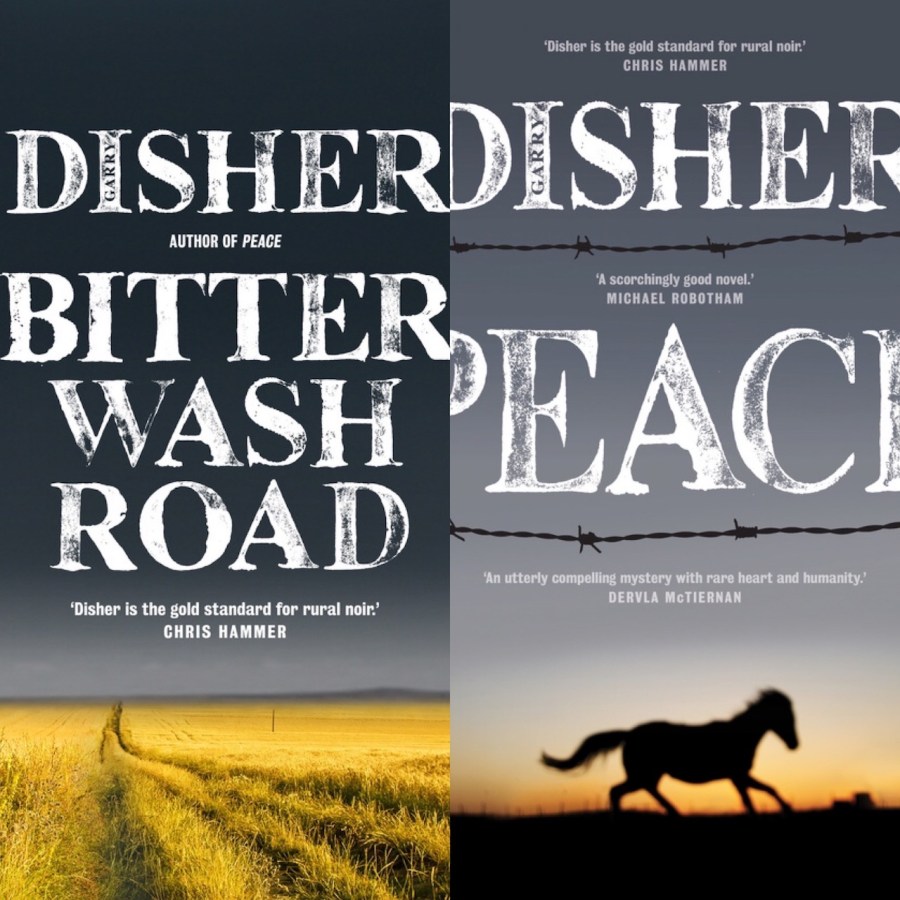
Australian veteran author Garry Disher has written over fifty books in a range of genres: crime thrillers, literary/general novels, short-story collections, YA/children’s novels, and writers’ handbooks. Disher produces about a book a year and was recognised for his extensive work when awarded the Ned Kelly Lifetime Achievement Award, 2018.
I recently read Bitter Wash Road (2013) and Peace (2019). Stand alone crime fiction novels, though they both have the same protagonist and are set in the same town. Bitter Wash Road was shortlisted for the Ned Kelly Awards, Best Crime Novel, 2014. Both novels are complex slow burners with multi layered plots that keep the reader engaged and guessing.
It was heart-stopping, seeing Wendy Street at a Hills Hoist set in the lawn, battling a great flower head of white sheets onto the line. They flung themselves about, enveloping, licking and taunting, flattening against her body and filling with air again. He watched her wreathe and dance, fighting, feeling blindly for the pegs and the line.
Bitter Wash Road
Constable Paul Hirschhausen (Hirsch), the protagonist in these two books is a whistleblower cop who was demoted and sent to remote, dusty Tiverton, three hours north of Adelaide off the highway in South Australia. Other cops don’t trust him and internal investigations keep hounding him. Hirsch spends his days trying to do the right thing and stay out of trouble trawling the country roads and building relations with the locals, doing welfare checks and resolving small grievances until more serious crimes take place and all hell breaks loose.
This close to Christmas, the mid-north sun had some heft to it, house bricks, roofing iron, asphalt and the red-dirt plains giving back all the heat of all the days.
Peace
Disher knows rural SA intimately having grown up there and invokes the isolation of a small country town and its inhabitants beautifully, using economical pared back prose to show the climate, distance, inhabitants and challenges of remote towns. Disher’s plotting is subtle and the years developing his skills shine through in these well crafted novels with complex characters.
Popular Austrian-American author Inga Karlson and her publisher were killed in a mysterious warehouse fire in New York in 1939, along with every copy of Karlson’s highly anticipated novel. The two were believed to be the only one’s who ever read the manuscript and all that remains are a few page fragments. Over the next forty years Karlson becomes a cult figure and the fragments become much studied and analysed.
And in the end, all we have are the hours and the days, the minutes and the way we bear them, the seconds spent on this earth and the number of them that truly mattered. ― Toni Jordan, The Fragments
Caddie Walker was named after a character in Karlson’s first novel and works as a bookstore assistant in Brisbane in 1986 after dropping out of university because of a failed love affair with a professor. When the Karlson fragments are bought to Australia and put on display in a Brisbane museum Caddie meets an old woman who calls herself Rachel and quotes what sounds like additional text from the book fragments that supposedly no one has read, and a mystery is born which Caddie is determined to solve.
“To spend her days reading and growing things. Could there be any better life?” ― Toni Jordan, The Fragments
The Fragments tells Karlson and Caddie’s stories across two different time periods, both of which Jordan brings brilliantly to life through her use of sights, sounds, smells and carefully selected cultural references. The character’s stories unfold at a pace into a twisty intermeshed climax. Part historical novel and part contemporary mystery the two stories are held together by the fragments and the theme of loss that runs through both characters lives. The Fragments is a page turner, and highly recommended.
“Books are time travel and space travel and mood-altering drugs. They are mind-melds and telepathy and past-life regression. How people can stand here and not sense the magic in them – it’s inconceivable to her.” ― Toni Jordan, The Fragments
The Fragments (2018) is Melbourne author, Toni Jordan’s fourth novel and the first I have read, but I’ll certainly be reading more her other work. Her debut Addition (2008) was long listed for the Miles Franklin Award, her second Fall Girl (2010) was optioned for film, Nine Days (2012) was named the Indie Book of the Year by the Australian Booksellers in 2013, and Our Tiny Useless Hearts (2016) was long listed for the International Dublin Literary Award.
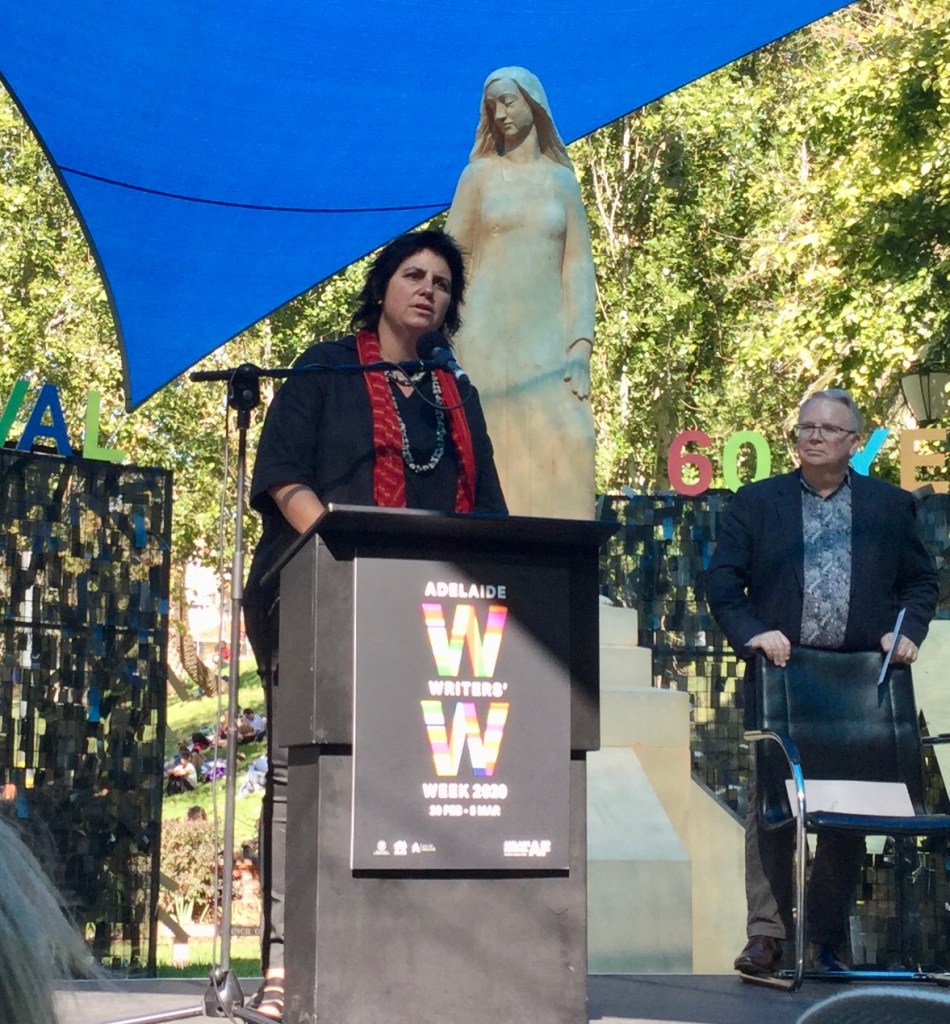
On my annual pilgrimage to Adelaide for Adelaide Festival, Adelaide Writers Week and WOMADelaide, there was so much to see I’ve milked a couple of weeks worth of blogs from it. I had only been there a little over twenty four hours and my brain had already been thoroughly exercised.
Being immersed in a diversity of creative arts of all kinds provides inspiration and motivation for writing. This blog covers the theatre I attended and WOMADelaide music festival.
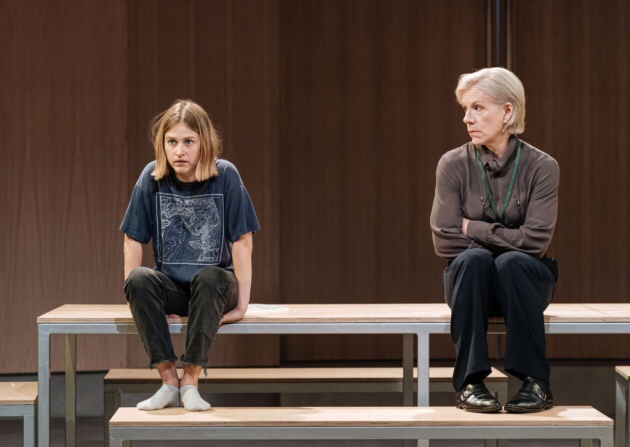
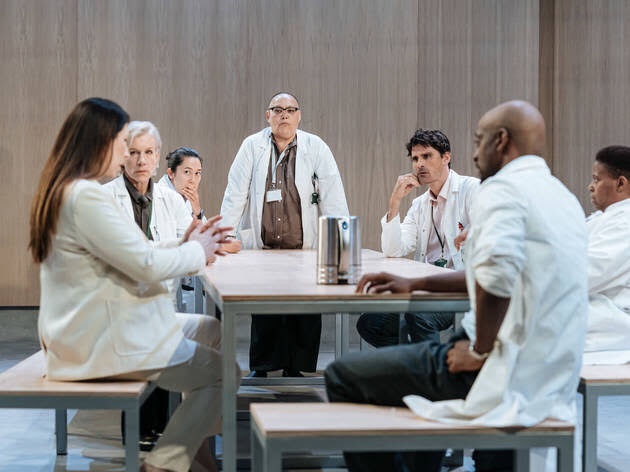
The Doctor By Robert Icke
The Doctor starring Juliet Stevenson, is an adaptation, by Robert Icke, of the play by Viennese dramatist, short story writer and novelist Arthur Schnitzler’s 1912 production Professor Bernhardi, a portrait of antisemitism.
The adaptation broadens out the focus of the play to be about identity politics (gender, sexuality, race and class), ethics (medical, religious, parental) and power dynamics. The director extended the issues and really messed with the audiences head, perceptions and biases by casting women as men, white people as black and black as white.
The protagonist Ruth Wolff is a Alzheimer’s medical practitioner and secular Jew. She prevents a priest seeing a fourteen year old girl dying of sepsis as the result of a self administered abortion. He was called by the parents but the girl is not in a state to decide for herself if she wants to see the priest. The incident goes viral and provokes a petition and TV debates, that jeopardise Ruth’s career and the medical institutes funding. ‘The incident’ itself had some of the qualities of The Slap by Christos Tsiolkas in its impact.
All the characters in the play claim righteousness in their own positions and all are shown to be potentially compromised by their own characteristics or beliefs. The playwright employs an exquisitely torturous interrogation of the use and misuse of language, and the play was an exhausting, mind bending, and brilliantly performed piece of theatre that I will be pondering for some time. If you ever get a chance, go and see it.
Dimanche by Chaliwaté and Focus
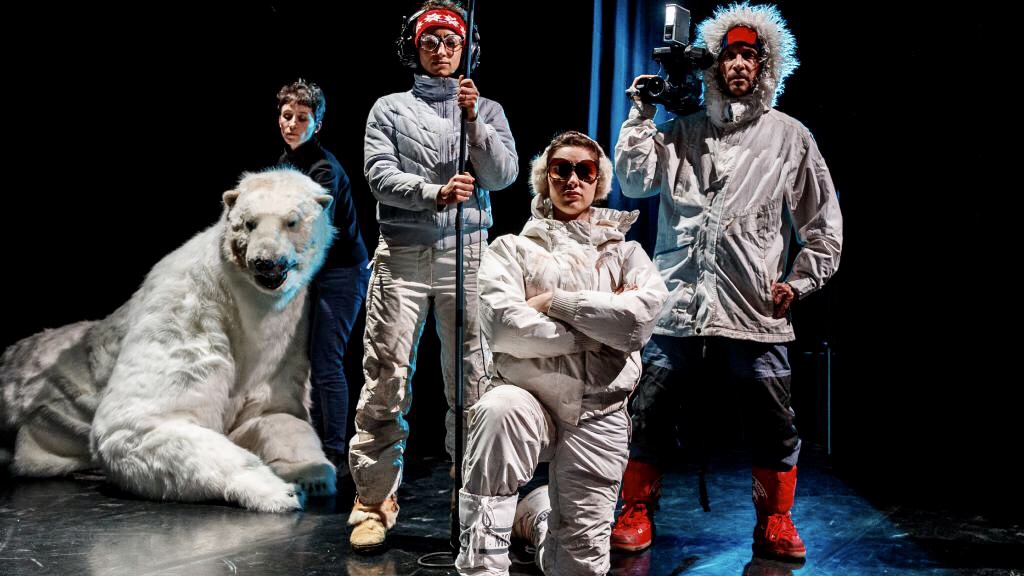
The Belgian theatre production Dimanche (meaning Sunday) was both beautiful and harrowing. The almost wordless performance was delivered through the mediums of film, acting, sound and puppetry and depicts three friends tracking and filming the cataclysmic impacts of climate change.
It begins with three filmmakers journeying in an imaginary truck to the arctic to document the breakup of ice flows. Only two survive the experience and we cut to life size polar bear puppets on a futile search for food as their habitat disintegrates. The set switches to a couple living with an elderly relative in extreme heat. As they swelter under fans, the furniture melts, and eventually the elderly woman succumbs to the elements.
With each new scene, another of the friends falls victim to the impacts of climate change until the final scene which depicts the world under water. It was a stunning piece of theatre, precisely executed. I am very glad I went to see it despite leaving feeling like a frog in a slowly boiling pot of water.
WOMADelaide
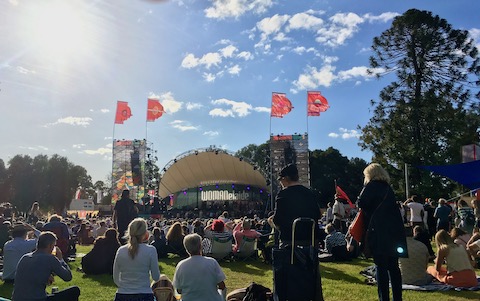
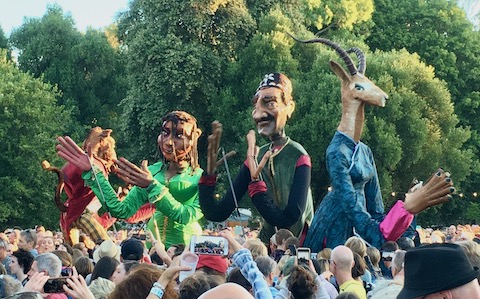
WOMAD is a four day music, arts and dance festival held in Adelaide’s shady Botanic Park and a chance to immerse oneself in what feels like a parallel universe. Around 20,000 people per day and hundreds of artist from around the world gather each day to celebrate the diversity or music and arts with performances across eight stages scattered through the park.
My favourites included music by The Blind Boys of Alabama, Tami Neilson, Mavis Staples and Spinifex Gum; acrobatic performance by Gravity and Other Myths; and climate talks by Cristiana Figures the former UN Secretary for Climate and reflections on climate optimism by film maker Damon Gameau, scientist Will Steffen, environmental lawyer Michelle Lim and Adelaide Lord Mayor Sandy Verschoor.
WOMADelaide
I departed Adelaide full of creative inspiration and having done some internal plotting and written a few scenes for my next novel, which will have an environmental theme and be set partly in Melbourne, partly in East Gippsland. Watch this space.
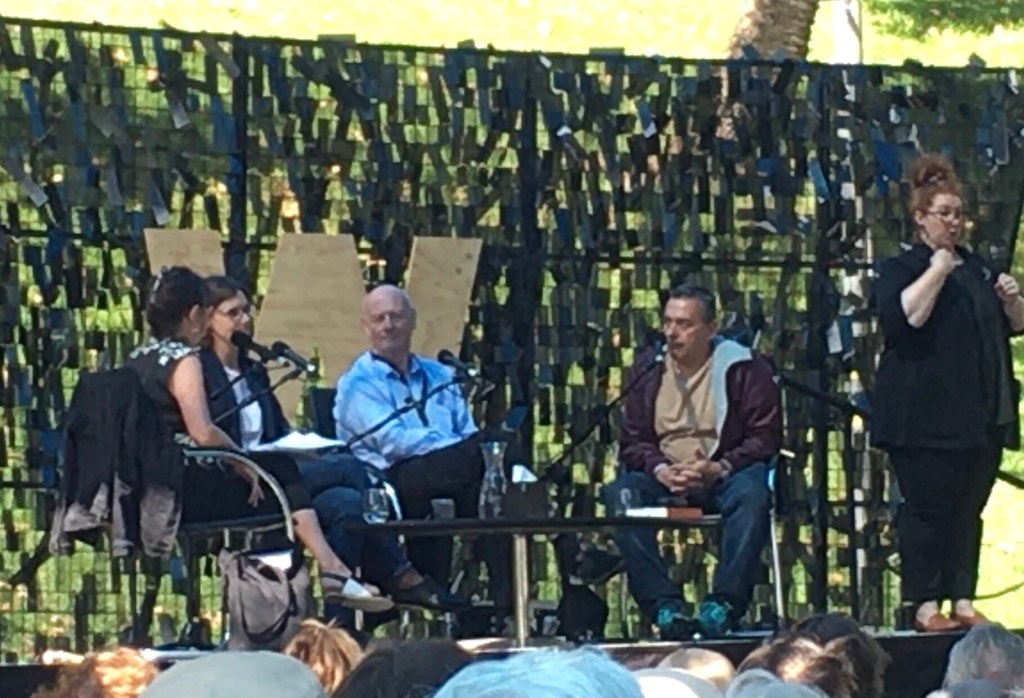
Adelaide Writers Week (#AdlWW) remains one of the best writers festivals I’ve attended. Year after year it doesn’t disappoint, and attendance is free. This year showcased a lot more non-fiction than fiction and it was an intellectual feast.
My plane landed at 3pm last Sunday and I got to #AdlWW in time for the Adelaide Festival Awards for Literature. If you want to get your reading groove on with some award winners keep an eye out for these:
Children’s Literature Award and Premiers Award – Nevermoor: The Trials of Morrigan Crow by Jessica Townsend (Hachette Australia) – An enchanting series by debut Australian author Jessica Townsend, about a cursed girl who escapes death and finds herself in a magical world, but is then tested beyond her wildest imagination.
Young Adult Fiction Award – Small Spaces by Sarah Epstein (Walker Books Australia). Tash Carmody has been traumatised since childhood when she witnessed her gruesome imaginary friend Sparrow lure young Mallory Fisher away from a carnival.
Fiction Award – The Death of Noah Glass by Gail Jones (The Text Publishing Company)The art historian Noah Glass, having just returned from a trip to Sicily, is discovered floating face down in the swimming pool at his Sydney apartment block. But a sculpture has gone missing from a museum in Palermo, and Noah is a suspect. The police are investigating.
Natalie Harkin
John Bray Poetry Award – Archival-Poetics by Natalie Harkin (Vagabond Press) – an embodied reckoning with the State’s colonial archive and those traumatic, contested and buried episodes of history that inevitably return to haunt.
Non Fiction Award – The Bible in Australia: A cultural history byMeredith Lake (NewSouth Publishing) explores how in the hands of Bible-bashers, immigrants, suffragists, evangelists, unionists, writers, artists and Indigenous Australians, the Bible has played a contested but defining role in Australia.
After four and a half days of listening to many fabulous writers, here are some snippets from the ones that most captured my attention:
Fiction
Fiction writers I really enjoyed listening to included Charlotte Wood (The Weekend); Tash Aw (We, the Survivors); Alice Robinson (The Glad Shout); Lucy Treloar (Wolfe Island); Felicity McLean (The Van Appel Girls are Gone); and Michael Robotham (Good Girl, Bad Girl).
The imagination is so private, fiction writers worry about what people think about what’s coming out of our heads… you don’t want to be Andrew Bolt but you don’t want to self sensor before you put words on the page…if you have some talent you are obliged to use it.
Charlotte Wood
Non fiction
Meredith Lake, author of The Bible in Australia had a discussion with Christos Tsiolkas, fiction author of Damascus and Tim Costello author of memoir A Lot with a Little (Christianity’s Crossroads) on ethics and the culture of Christianity at a time when faith is in decline and church institutions have been in crisis. The three interpret the words in the bible in a way that is a world away from the likes of Israel Falou and the cherry picked words that spill from the venomous mouths of the more conservative religious leaders. Their interpretations speak of tolerance and justice and equality and attempt to grapple with the contradictions of faith, including the weaponisation of the bible and the churches as custodians of as much evil as good in Australia’s history. The discussion was far reaching across subjects such as Indigenous and LGBTI rights, child sexual abuse, refugees, science and climate change and was one of the most thought provoking discussions I have heard in some time, which is saying something for a secular non-believer.
Meredith Lake, Christos Tsiolkas and Tim Costello
I want the best of faith to defeat the worst of religion
Tim Costello
Ross Garnaut author of Superpower: Australia’s Low Carbon Opportunity had a conversationwithTim Flannery author of Life Selected Writings on climate change. Garnaut pointed out there was a brief optimistic moment in 2007-08 when all Australian governments were behind a positive climate policy move. This ended when Abbott wrested power from Turnbull then got rid of the climate council and carbon pricing and set about discrediting the science.
In 2016 a cyclonic weather event had a significant impact on South Australia’s power supply after destroying some pylons that were in the main supply line. The Commonwealth Government blamed the weather event on renewable energy. In another world the reality of a cyclonic event occurring in a non cyclonic region would have been seen as an example of the problem of climate change. As the speakers noted, governments have a loud megaphone, and when they lie, they get traction. A situation we see playing out more and more with politicians peddling fake news. The risk is they open themselves up to being vulnerable themselves to being tossed out by the next, better liar.
The shining light in the climate debate is that the state parliaments are in pretty good shape and delivering positive results in the climate change space. The federal parliament is pretty weak and bleak, aside from outlier, Zali Stephen. The price of successive government failures and our failure to change policy earlier is that we now need to cut emissions by 7% per year, every year from now on. It seems there are twenty five people in the Federal parliament holding twenty five million Australians to ransom. The electorate needs to force politicians to act.
The Cut Out Girl, a biography by Bart Van Es. The story was drawn from Barts family in the Netherlands during WWII. His grandparents were one of many families who hid Jewish children from the Nazis during the war. Bart tells the story of Lien, who was hidden for some time by his grandparents.
The degree to which we dehumanise others reflects how disconnected we are from our own humanity…mainstream acts of intolerance in the middle enable extreme acts at the fringe…compassion has to be married to healthy boundaries and consequences…
Tony McAleer
Other non-fiction writers I really enjoyed listening to included Long Litt Woon (Mushrooming and Mourning); Jamie Susskind (Future politics); SophieCunningham (City of Trees); Chike Frankie Edozien (Lives of Great Men); Dennis Altman (Unrequited Love); Tony McAleer (The Cure for Hate); Yanis Varoufakis (And the Weak Suffer What They Must?); Margaret Simons (Penny Wong Biography); Angela Woolacott (Don Dunstan biography); and the delightful, thoughtful and funny Vicki Laveau-Hardie who’s debut memoir The Erratics was published when she was in her seventies and won the Stella Prize.
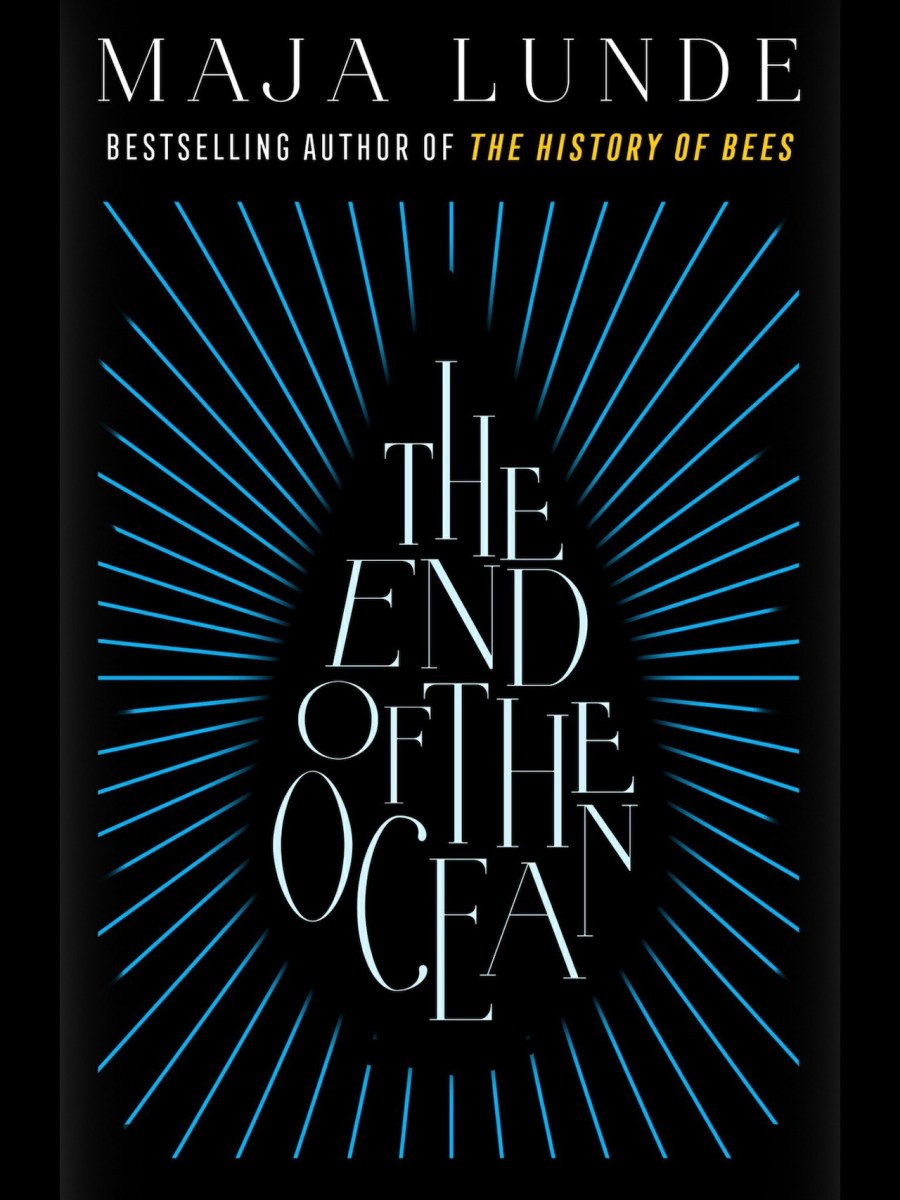
I almost drowned in the beauty and tragedy of this watery novel. The End of the Ocean is two stories that converge twenty-four years apart, either side of climate change induced environmental and societal collapse.
They talked, the two men, and the mountain ate up their words.
The End of the Ocean
In 2017, seventy year old Norwegian sailor, journalist and environmental activist Signe visits the place of her childhood. Once a place of great natural beauty, the river and waterfalls have been diverted for hydro electricity, events that destroyed the habitat of much flora and fauna, her parents marriage and her own first relationship. The glaciers are melting and she discovers her old love, whom she has never gotten over, is contributing to their destruction by selling glacial ice to the Middle East as a luxury item. She is infuriated and tips most of a load of ice into the ocean to melt and sets off in her sailing boat, Blue, with the remaining twelve non-degradable blue plastic containers in search of her old lover so she can dump them in his yard.
It is strange—no, surreal, surreal is the word—that I’m one of them, the old people, when I am still so completely myself through and through, the same person I have always been; whether I am fifteen, thirty-five or fifty, I am a constant, unchanged mass, like the person I am in a dream, like a stone, like one-thousand-year-old ice. My age is disconnected from me, only when I move does its presence become perceptible—then it makes itself known through all its pains, the aching knees, the stiff neck, the grumbling hip.
The End of the Ocean
In 2041, twenty five year old David worked at a desalination plant until the drought became so severe he had to flee with his family. He is a climate refugee in a French refugee camp trying to find his wife and infant son who he and his six year old daughter Lou became separated from when they had to abandon their home due to the drought and a massive fire. Once they have reunited they will head north to the water countries.
But the power came and went, the stores were emptied of food staples and the city became emptier, quieter. And hotter. Because the drier the earth became, the hotter the air was. Previously the sun had applied its forces to evaporation. When there was no longer any moisture on the earth, we became the sun’s target.
The End of the Ocean
Signe’s journey is fuelled by anger and despair at humanities destruction of the environment and personal sadness about her own relationships. As she encounters many perils on her sea voyage she reflects on her own life and relationships, and why she lives such an isolated existence. David’s journey is driven by desperation and the longing to be reunited with his wife and son as he tries to provide for himself and his daughter in a world where climate change and water shortages means day to day survival is tenuous. Gradually the two stories converge across time when David and Lou stumble across an old sailboat under tarps at an abandoned house far from the sea.
I have really tried, I have been fighting for my entire life, but I have been mostly alone; there are so few of us, it was futile, everything we talked about, everything we said would happen has happened, the heat has already arrived, nobody listened.
The End of the Ocean
The speculative fiction novel is a meditation on human destruction of the environment, climate change, family relationships and human resilience. The End of the Ocean, translated from the original Norwegian by Diane Oatley, is beautifully written yet a frightening rendering of what a future world might look like in the face of climate change. The ambiguous ending contributes to the haunting sadness infused throughout, a must read, but not a feel good one. Lunde, a climate change advocate, is also the author of TheHistory of Bees (2015) and Przewalskis Horse (yet to be translated), both of which I will add to my reading list.
Really the title of this blog post should be write, edit, edit, edit, edit, edit, submit. In my #AuthorsForFireys blog I mentioned that I had sent my manuscript off to an assessor. About ten days ago, editor Dan Hanks sent me his feedback and report on my manuscript. I was chuffed to read this comment in his email: The long and short of it is that this was a tremendously fun story.
Dan’s report is a considered breakdown of everything he thought worked or needed polishing. He also included a brain dump of notes scattered through the manuscript, pointing out his thoughts as he went which was really helpful. I have quoted some of his comments in this blog.
The story unfolds at pace, the structure is all present and correct, and the characters are so well written in their shades of grey that you’re never quite sure who is going to end up being good or bad or somewhere in between. Which means the tension is kept cranked up to 11 for most of the book and the reader can’t help but keep turning the page to find out how it’s all going to end. Great stuff!
manuscript assessment comment
I have heard varied opinions about the value of manuscript assessments, so I did enter into this exercise with a degree of skepticism. It was with welcome relief that found it to be very valuable. There is also the added bonus of an injection of confidence when someone you don’t know, and who’s job it is to be critical, reviews your work.
The writing style is crisp and clean and punchy, as you would hope from a book of this genre, but there is certainly scope to vary the rhythm in places and build on the beautiful flourishes of prose that crop up from time to time – which I believe will lift the book to the next level.
manuscript assessment comment
Here are the things I found most helpful from Dan’s feedback…
On story, plot and structure:
identified some gaps and areas he felt needed to be fleshed out – particularly to give context to make it work more effectively for an international market
inject a little more scene setting
identified a loose end I hadn’t accounted for that needed tying up
There is a big theme here about having the freedom to be yourself. Theme is a big way to turn a perfectly fine and well plotted story into something that the reader can’t stop thinking about after they’ve put the book down. And what you’ve done with these characters – set against a backdrop of a campaign arguing for the right to be able to be yourself – is quite special.
manuscript assessment comment
On characters:
a couple of minor characters he felt needed a bit more distinction between them
On writing style (description/dialogue):
identified a few areas to tidy up to improve clarity and flow
a couple of spots to improve logic or continuity for the reader
some advice on grouping dialogue snippets appropriately so it’s easy for the reader to understand who is saying what
The forest for the trees
Last week I worked through all Dan’s feedback and made most of the changes he suggested. The other interesting thing for me about this exercise was that between the beta readers and the manuscript assessment I set the work aside for about a month without looking at, or thinking about it at all. I had one of those ‘aha’ moments when I went back to the work, about why people say you should let your manuscript ‘breathe’. Looking at it with fresh eyes gave me a new perspective, and I made some more new changes I identified myself, because of the distance.
All in all this is a really entertaining read, with a surprising amount of heart for a thriller, and some great characters to follow as they try to solve this mystery (and hopefully more in the future??).
manuscript assessment comment
I still have some minor tidying up to do, but did send a synopsis and a sample of the work I have completed revising to query a couple of agents last week, so I feel I have now started the next part of this journey. As I enter the querying phase, I am following the approach I learnt from completing the online Pitch Your Novel course I wrote an earlier blog about and look forward to seeing how that goes, though no doubt the waiting will be a challenge!
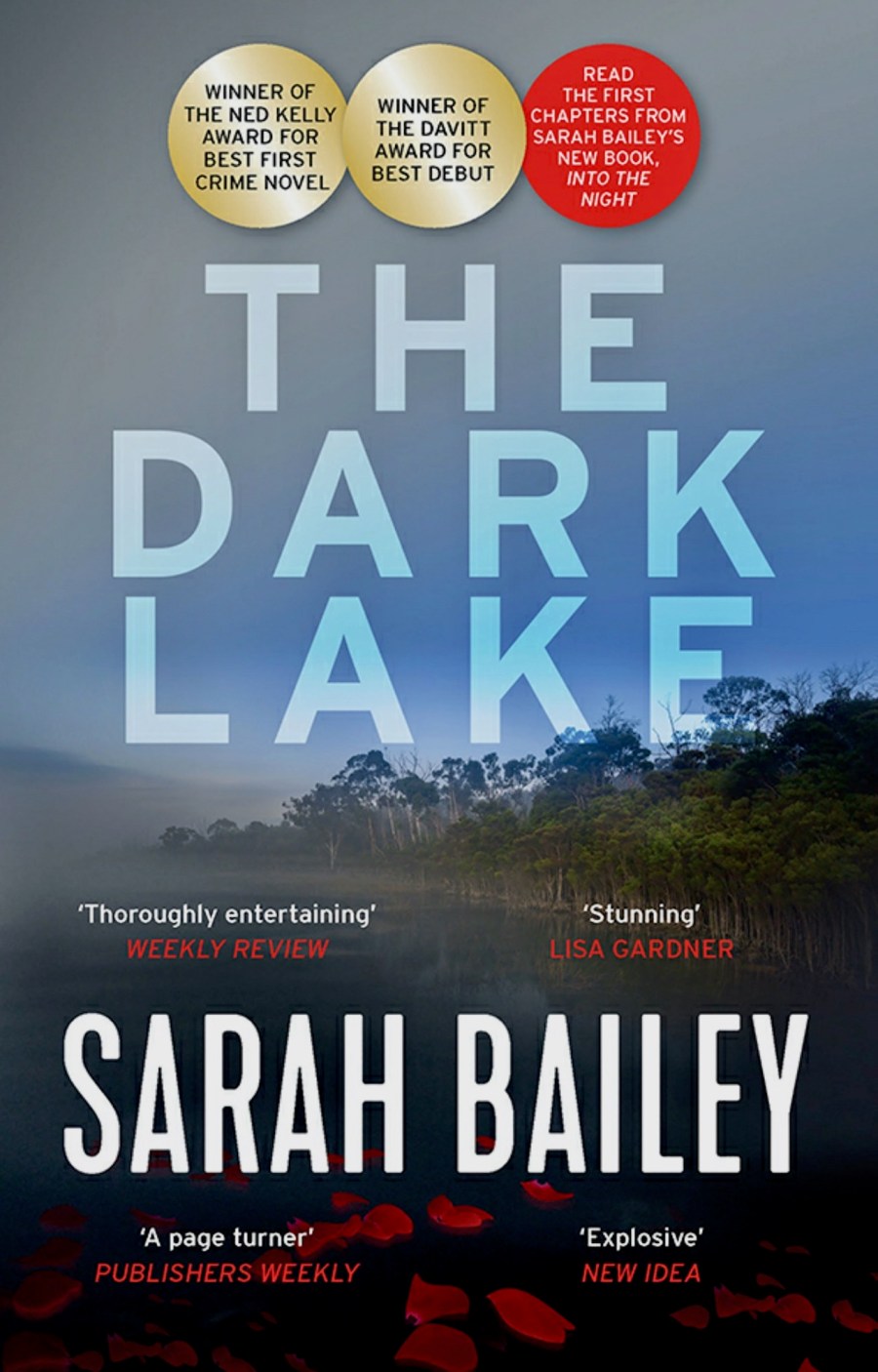
Secrets are at the heart of a good mystery and Sarah Bailey packs them into her debut psychological mystery, The Dark Lake.
The house turned out to hold more of Robbie’s secrets than I had ever expected, though I am sure there are many more that we will never know
The Dark Lake
Gemma Woodstock is a cop in Smithson, the small town in New South Wales where she grew up. She’s good at her job but a personal train wreck, which stems back to the suicide of her first boyfriend at the end of high school ten years earlier. Her relationship with her loving partner and father of her child is distant, she is sleeping with her married work partner Felix, struggles to be a good parent to the son she loves, and drowns her emotions in booze.
Probably I should move away, leave Smithson, but starting over has never been a strength of mine. I have trouble letting go.
The Dark Lake
When high school drama teacher Rosalind Ryan, who Gemma went to school with, is murdered, the small town is shocked. Gemma and Felix start to investigate the crime and the intertwined secrets of Rosalind and Gemma start to emerge. The investigation almost undoes Gemma in her effort to keep her own history and emotions separate from the case.
I allow myself to process the fact that Rosalind Ryan is dead. I suddenly feel startled to find myself a fully grown adult.
The Dark Lake
The book is a well written slow burner and hooks you in with a compelling and complex story line. It’s character driven with a well drawn cast who are easy to like and/or hate. The story shifts from the present to ten years earlier, gradually revealing the interlinking stories as the secrets are revealed.
Set in between a burst of mountain ranges, Smithson is a little oasis of greenery in the middle of endless fawn-colored acres of Aussie farmland.
The Dark Lake
I liked it enough that I will read the next in the series, Into the Night.