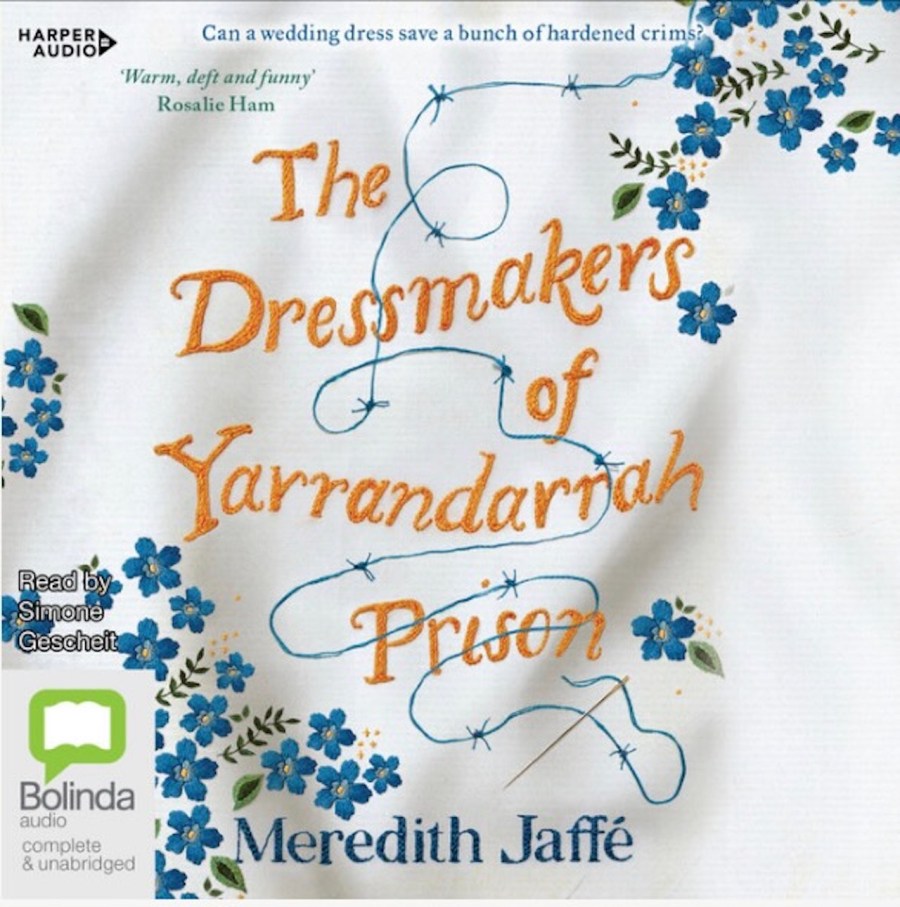
Book review: The Dressmakers of Yarrandarrah Prison by Meredith Jaffe

The Backtackers gather daily for a sewing circle with Jane who teaches them to embroider. But the Backtackers are no ordinary group, they are a motley crew of criminals at Yarrandarrah prison.

Derek, who is in for embezzlement, and estranged from his wife and daughter wants to show his daughter how much he loves her and decides he will make her wedding dress. His fellow inmates agree to help him with the job – they want to create something spectacular, but don’t always agree on what that means.

There’s a hierarchy among the long-term residents in this joint, determined by the blend of time and crime. Men like Jack and the Doc are kingpins. Even Parker earns more respect because he put a hole in another man’s chest. If the new kids knew that, they would be so quick to call him names. But Derek? Stealing money to chuck down a poker machine’s gullet isn’t a crime, it’s pathetic.

Inspired by the real story of Fine Cell Work, The Dressmakers of Yarrandarrah Prison is a funny, dark and moving story about friendship and redemption. It is both a heartbreaking and heart-warming reflection on life on the inside and the lives of the prisoners loved ones on the outside.

I found the image of big burly criminals sewing delicate items very original. It created a great juxtaposition to the outbursts of violence that erupted during the novel.

Interestingly the story is written in present tense omniscient narration, which you don’t see very often these days. It made me feel like a constant fly on the wall (or all the walls) and provided a good perspective for dramatic irony.

Book review: Room by Emma Donoghue

The thing that struck me most about Room was Emma Donoghue’s exceptional ability to maintain the voice of a five year old for an entire novel. Jack has spent his five years in the 12 foot square room he was born in. His Ma has been in the room for two years more after being abducted at nineteen. Ma has spent Jack’s life keeping him entertained and protecting him from their captor. Jack brings their tiny world to life. Each element – Rug, Spoon, Wardrobe, Bed and TV are characters. Room is real, TV world is outside – a place they cannot go. They exercise, tell stories, sing, eat and make up games and poems in the confines of Room.

Outside has everything. Whenever I think of a thing now like skis or fireworks or islands or elevators or yo-yos, I have to remember they’re real, they’re actually happening in Outside all together. It makes my head tired. And people too, firefighters teachers burglars babies saints soccer players and all sorts, they’re all really in Outside. I’m not there, though, me and Ma, we’re the only ones not there. Are we still real?

When their captor comes to Room, Jack has to go in Wardrobe as his Ma doesn’t want the man to see him. Ma has days when she does not get out of bed, it ‘gone’ with a blank stare and Jack just sits or watches TV.

Jack. He’d never give us a phone, or a window. “Ma takes my thumbs and squeezes them. “We are people in a book, and he wont let anybody else read it.

The time comes, half way through the novel, when Ma senses imminent danger and decides they need to escape. She hatches an elaborate plan to get Jack out. He succeeds. Both characters are heroic. Their captor is caught and Ma is freed. The story then moves to ‘Outside’, to explore Jacks confusion by the wider world and their adjustment to it.

Scared is what you’re feeling. Brave is what you’re doing

The point of view limited by the narrators maturity and the constraints of Room contain the story in a way that keeps the reader in a state of unease. Room is a gripping, disturbing, claustrophobic, yet hopeful read. The story a delivers an unique perspective – on love, psychology, politics, sociology, and how we life our lives.

I’ve seen the world and I’m tired now.

Book review: The Boy from the Mish by Gary Lonesborough

The Boy from the Mish is a queer First Nations bildungsroman fiction novel. This book is an important work as it represents diverse identities – both Aboriginal and queer. Young people who do not ‘fit’ the mainstream ideal need to see themselves in fiction as it helps to validate their lived experience. A lack of diverse representation not only influences how people see themselves but how they are seen (or not seen) by mainstream dominant cultures.

Go to your elders. You should ask them about your country and your totem. Because that is your identity. A blackfella with no identity is a lost blackfella. He don’t know where he belongs.

Individual and institutionalised racism, over-policing of Aboriginal youth, prejudice and lateral violence are confronted throughout this story told from the perspective of seventeen year old Aboriginal Jackson on a journey of self-discovery about who he is emotionally and sexually. On the cusp of adulthood and in his final year of high school, Jackson juggles a social life with his mates and his girlfriend with whom he has not had sex, but doing so hovers as an ever present expectation that he cannot meet.

I’m not too fucking drunk. I’m tipsy at best. And she isn’t ugly, I think she’s beautiful. Maybe my body is just broken, or maybe I’m destined to be an abstinent priest or something.

When he encounters fresh out of juvie Tomas, Jackson is unsettled by his attraction to the other young man and it triggers a change in how Jackson sees himself. The Boy from the Mish is a beautiful and heartwarming story that paints colourful insights into life in Aboriginal family homes, familial relationships and struggles, the emotionality of youth and the fears that make coming out difficult. It is also written in a way that shows white people as ‘the other’, which is refreshing.

If we don’t let ourselves be who we are, love who we are, where we come from, it’ll strangle ya until you can’t fight it no longer.

Book review: The Discomfort of Evening by Marieke Lucas Rijneveld

I listened to the audiobook of The Discomfort of Evening on my drive back to Melbourne from the Blue Mountains in NSW. The first thing that struck me was the amazing imagery Marieke Lucas Rijneveld uses in her debut novel. The second was that the word ‘discomfort’ in the title is understated. I was equally enthralled and disturbed by the novel.

It’s confusing, but grown-ups are often confusing because their heads work like a Tetris game and they have to arrange all their worries in the right place

Ten year old Jas wishes her brother Matthies would die instead of her rabbit. There are two reasons for this – she is not allowed to go ice-skating with him and thinks her dairy farming father has his eye on her pet rabbit for dinner. When her brother falls through the ice and dies, it sets up a massive internal conflict for Jas in an environment where the family is falling apart in the darkness of grief through a lens of devout faith. The unfolding drama is narrated by Jas and reported in an undramatic way, as if what is happening is ok, because she doesn’t know any better. This childlike interpretation adds to the unease for the reader/listener because it is so far from ok.

I don’t want to feel any sadness, I want action; something to pierce my days, like bursting a blister with a pin so that the pressure is eased

Each member of the remaining five in the family develop their own unique dysfunctional responses to the death of Matthies, the oldest son. Talking about his head is forbidden, having feelings is discouraged and everything is contextualised in oblique biblical interpretation.

I’m beginning to have more and more doubts about whether I find God nice enough to want to go and talk to Him. I’ve discovered that there are two ways of losing your belief: some people lose God when they find themselves; some people lose God when they lose themselves. I think I’ll belong to that second group.

The novel is told from the point of view of young Jas who is bewildered by the adult world and has developed distorted views due to the constraints of the families extreme religious beliefs. It is a book about grief, family disfunction, religion, and boundaries (or lack thereof) described in brutally vivid detail. Rijneveld’s writing is beautifully discomforting.

Book Review: The Beekeeper of Aleppo by Christy Lefteri

Aleppo in Syria is one of the oldest continuously inhabited cities in the world. It is where this story begins. Nuri is a beekeeper who lived a peaceful life in Aleppo with his artist wife Afra and their son Sami until their lives were shattered by war. Sami is killed in a bomb blast whilst playing in the garden. The same blast renders Afra blind after seeing Sami die. Afra and Nuri remain in Aleppo longer than they should, not wanting to leave the memory of their young son. Eventually they are forced to go when it becomes apparent that Nuri’s life is at risk. The Beekeeper of Aleppo is the story of their journey fleeing through Turkey and Greece as they try to reach England where Nuri’s cousin who taught him about bees lives.

But in Syria there is a saying: inside the person you know, there is a person you do not know.

Christy Lefteri, herself the daughter of refugees, wrote the novel after spending a couple of years volunteering in a refugee centre in Athens. It is a story about the refugee journey and the experiences they endure in a state of high vulnerability. It touches on the effects of severe trauma, grief, child trafficking, ethnic cleansing, flight, asylum processes, seeking a new home when your own becomes uninhabitable – it is also a love story.

I wanted to set forth the idea that among profound, unspeakable loss, humans can still find love and light—and see one another.

As Nuri and Afra escape Syria, each are haunted in different ways by what they have seen and experienced. They become known to the reader as the people they were before the troubles, as well was who they have become as a result of flight from a war torn country. We witness their struggle to stay connected with one another and their dead son whilst they navigate their way to safety.

People are not like bees. We do not work together, we have no real sense of a greater good

The Beekeeper of Aleppo is written with compassion and hope. Whilst the characters experience great brutality, the story is also beautiful and a moving plea for greater humanity in our treatment of displaced people.

Where there are bees there are flowers, and wherever there are flowers there is new life and hope

Book review: All Our Shimmering Skies by Trent Dalton

It’s 1942 and Darwin is under siege from the Japanese. The mother of twelve year old gravedigger girl Molly Hook died as a result of a curse placed on her family by Longboat Bob whose gold was stolen by her grandfather. Molly lives with her hopeless alcoholic father and abusive uncle and digs graves in Hollow Wood Cemetery, and she believes her heart is turning to stone.

In all these years, he said, he was yet to come across a single gold nugget that brought any real happiness to the person who held it. Longcoat Bob said his family had found one large nugget long ago, centuries back, that resembled a human hand. And it became so coveted by members of his family that it caused fights between brother and sister, sister and mother, father and son. During one dispute an old woman struck her nephew with the gold hand. The nephew was struck dumb and his mental capacity was like a water hole that could never be more than half full after that. And the old woman was so ashamed by her actions that she begged Longcoat Bob’s grandfather, the oldest living member of the family, to hide the gold away in a place where no one else could find it. And any other gold nuggets that were found from that moment on Longcoat Bob’s grandfather reasoned, were best hidden away with it too.

Molly is best friends with a shovel and she speaks to the sky. The sky talks back and offers gifts to help her. While Darwin is being bombed she escapes on a quest to find Longcoat Bob and ask him to lift the curse on her family. She picks up travelling companions on her way – her wicked uncles beautiful actress girlfriend Greta, fleeing his clutches, and Yukio, a Japanese fighter pilot who falls from the sky.

The travellers dodge danger and the pursuit of a greedy, angry Uncle Aubrey as they follow a poetic map etched on a gold-panning dish left to Molly by her mother. Molly believes the map will lead her to Longcoat Bob.

Molly knows the secret to a long walk. Never think about the destination. Just think about the air in your lungs, the motion of your arms and legs. There is a rhythm to it, and once you have found it that rhythm can tick-tock through time forever.

All Our Shimmering Skies is Trent Dalton’s second novel. I reviewed his first, Boy Swallows Universe, in a previous blog. The two novels have a lot of parallels – the exploration of good and evil and Dalton’s fabulous sprinkle of magical realism. The protagonists of both stories are children living in the depths of intergenerational trauma amongst abusive and complicated adults but still manage to travel through life with a sense of hope and optimism despite their difficulties. All Our Shimmering Skies is part fable, part fairytale, a hero’s journey wildly imagined in the remote top end. Dalton’s writing is sublime and lyrical, and if you give yourself over to it, he will take you on a heartfelt magical journey.

Book review: Girl, Woman, Other by Bernardine Evaristo

Joint winner (alongside Margaret Atwood for The Testaments) of the 2019 Booker Prize, this densely populated novel tells the story of twelve characters across twelve chapters and different decades. The characters are black British woman of varying ages, sexualities, ethnic origins, faiths, classes and experiences, and choices whose lives overlap.

We should celebrate that many more women are reconfiguring feminism and that grassroots activism is spreading like wildfire and millions of women are waking up to the possibility of taking ownership of our world as fully-entitled human beings.

The collage of stories include theatre director Amma, her daughter Yazz and former partner Dominique. Mathematical whizz, Carole who’s intellect drew her from her poor upbringing to a lucrative banking job, Bummi her mother and La Tisha an old school friend and single parent of three who works in a supermarket. Shirley, veteran school teacher, her mother Winsome retired to Barbados, and Penelope a retired colleague of Shirley’s. Non-binary Megan/Morgan a social media influencer, Hattie their great grandmother, an elderly Northumberland farmer, and Grace, Hattie’s mother. The characters are complex and flawed.

why should he carry the burden of representation when it will only hold him back?
white people are only required to represent themselves, not an entire race

Girl, Woman, Other is a novel about the lived experience of black women, identity, friendship, feminism, struggle, longing, love, loss, joy, hope, bitterness and imagination. Evaristo’s prose-poetry writing style carries the reader with a delightful rhythm through the polyphonic choir of woman characters and delivers an emotionally engaging read.

we don’t exist in a vacuum… we are all part of a continuum, repeat after me, the future is in the past and the past is in the present

Book review: My Brilliant Friend by Elena Ferrante

I read an article about books on female friendship written by Italian novelist Elena Ferante (a pseudonym) whose true identity remains a mystery and was intrigued, so I picked up one of her novels.

They were more severely infected than the men, because while men were always getting furious, they calmed down in the end; women, who appeared to be silent, acquiescent, when they were angry flew into a rage that had no end.

Studious and plain Elena who narrates the story, is in awe of the charismatic Lila, always feeling second best despite her own achievements. As children Elena is the teachers pet and fiery Lila relates to her as competitor and a role model. In adolescence Elena continues to study seeing it as a way to escape her circumstances whilst Lila drops out and pursues marriage as a means to escape her situation.

I feel no nostalgia for our childhood: it was full of violence.  Every sort of thing happened, at home and outside, every day, but I don’t recall having ever thought that the life we had there was particularly bad.  Life was like that, that’s all, we grew up with the duty to make it difficult for others before they made it difficult for us

My Brilliant Friend traces the girls relationship and ambitions of rising above their circumstances from childhood through adolescence. It is a story about power and gender relations, the effect of patriarchy and violence, class, and left wing politics and how they influence smart young women trying to make their way in the world.

There was something unbearable in the things, in the people, in the buildings, in the streets that, only if you reinvented it all, as in a game, became acceptable. The essential, however, was to know how to play, and she and I, only she and I, knew how to do it.

Set on the outskirts of Naples in the 1950s, Ferante’s writing is vivid, authentic and epic. My Brilliant Friend is an uncensored study of female friendship, the first in a series of three novels about the two highly intelligent working class girls with an intense, enmeshed intimate friendship.

Book review: Who is Vera Kelly? by Rosalie Knecht

Who is Vera Kelly? set across dual timelines (1957 and 1966) and two countries (Maryland, USA and Buenos Aires, Argentina) is coming of age meets coming out meets espionage with a side of literary historical fiction.

Vera Kelly is a troubled teenager coming to terms with her sexuality. Her mother lands her in a juvenile detention centre after she steals a car. When released she moves to Greenwich Village in New York City and works night shift at a radio station and tentatively explore the queer scene.

On a Tuesday I came home from school to an empty house, watched the evening news, and then took Equanil caplets lifted from my mother. Nothing happened, so after an hour I took three more, and then maybe after that, I can’t remember.

Vera Kelly is a young CIA agent with a flair for electronics on her first big mission to Buenos Aries during the Cold War in the lead up to a coup. Revolución Argentina would establish Juan Carlos Ongania as defacto president. Vera rents an apartment and pretends to be a Canadian student befriending a group of local students suspected of being KGB agents.

I had found the apartment in San Telmo with the help of a motherly rental agent in a pink suit who had tried to cheat me on her percentage not once but twice, and reacted with a broad and charming laugh both times I pointed it out, as if we were flirting on a date and I was removing her hand from my thigh.

Vera bugs the students bicycles and with the help of a local contact, the Argentina Vice President’s office, tracking the students movements during the day and transcribing conversations from the officials office at night. When the coup seems imminent Vera decides to action her escape plan but the borders are closed faster than she can escape. Upon returning to her apartment she finds she’s been betrayed by her local contact and has to go into hiding until she can find another way out.

Oh my God, you should have seen us in ’55, ’56, ’62,’ he said, sighing. ‘Every year, another old man shouting from a grandstand with all his medals on. “I’ve come to replace your previous old man.” Some people would go to jail, everyone else would get used to it, and then it would start all over

There’s a long set up in this novel, but the character of Vera carries it off with her whip smart intellect, dry humour and keen observations of the times. I really enjoyed the insights into the New York queer scene in the early 60’s when being queer was illegal, and the history of Argentina. There is a correlation between being gay when it’s illegal and a spy running through the novel – the coded language and pretending to be someone you are not.

Vera is a relatable character and if you like women driven, realistic spy stories with a strong plot – this book could be for you. Even better, there are two more Vera Kelly novels to devour – Vera Kelly is not a Mystery (2020) and Vera Kelly Lost and Found (2022)

I woke with an ache in my chest and heard the subsiding whistle of a teakettle in the kitchen. I read the spines of the paperbacks on the night table: Graham Greene, Patricia Highsmith. Novels about liars. I needed to call Gerry.

Book review: 7 1/2 by Christos Tsiolkas

7 1/2 is a book about an author (Christos) who has fled the city to an isolated small town on the East Coast of Australia to write a story that has been lingering in his mind for years. Chistos wants the book to be about beauty – an antidote to a world that has been brimming over with crisis. And there is much beauty in it – landscapes and the weather and animals that pass across them, human connections and bodies are described lavishly. He also reflects on his pleasure in his writing process, and with affection on his childhood and the people who made him the man he has become.

I listened to the audiobook (twice) narrated by Lex Marinos and the words spilled over me like honey as I toiled in my Autumn garden and cooked and preserved the excess produce in my kitchen. Whilst listening to Christos’s writing about the things he loved, I was doing things that I love. Turning the soil, making pickled zucchini, poached quinces, pumpkin gnocchi and soup from the abundance of Autumn produce for my freezer whilst glancing out at the grapevine turning fire red through my kitchen window.

But I no longer trust the judgements of my age. The critic now assesses the writer’s life as much as her work. The judges award prizes according to a checklist of criteria created by corporations and bureaucrats. And we writers and artists acquiesce, fearful of a word that might be misconstrued or an image that might cause offence. I read many of the books nominated for the globalised book prizes; so many of them priggish and scolding, or contrite and chastened. I feel the same way about those films feted at global festivals and award ceremonies. It’s not even that it is dead art: it’s worse, it’s safe art. Most of them don’t even have the dignity of real decay and desiccation: like the puritan elect, they want to take their piety into the next world. Their books and their films don’t even have the power to raise a good stench. The safe is always antiseptic.

A man in middle age reflects on what he loves about being in the world. The book is auto fiction – part deeply personal and part fiction. The novel the protagonist is writing is called ‘Sweet Thing’ and is about an ageing ex-porn star and drug addict who leaves his wife and child temporarily to take a trip from Australia home to the USA where his is confronted by his past.

At the start of the novel Christos declares that he is tired of writing about issues – politics, sexuality, race, history, gender and morality – they bore him. Yet there are echoes of these topics throughout the novel – because they are part of life and it is difficult to separate ourselves from them completely. Ugliness and beauty coexist. We never really know what a thing is unless we can give an adequate account of its antithesis – a concepts Christos acknowledges at one point in 7 1/2.

There were moments in this book that were so personal, poetic and exquisite, they bought tears to my eyes. I will no doubt read it again just to inspire my own writing.