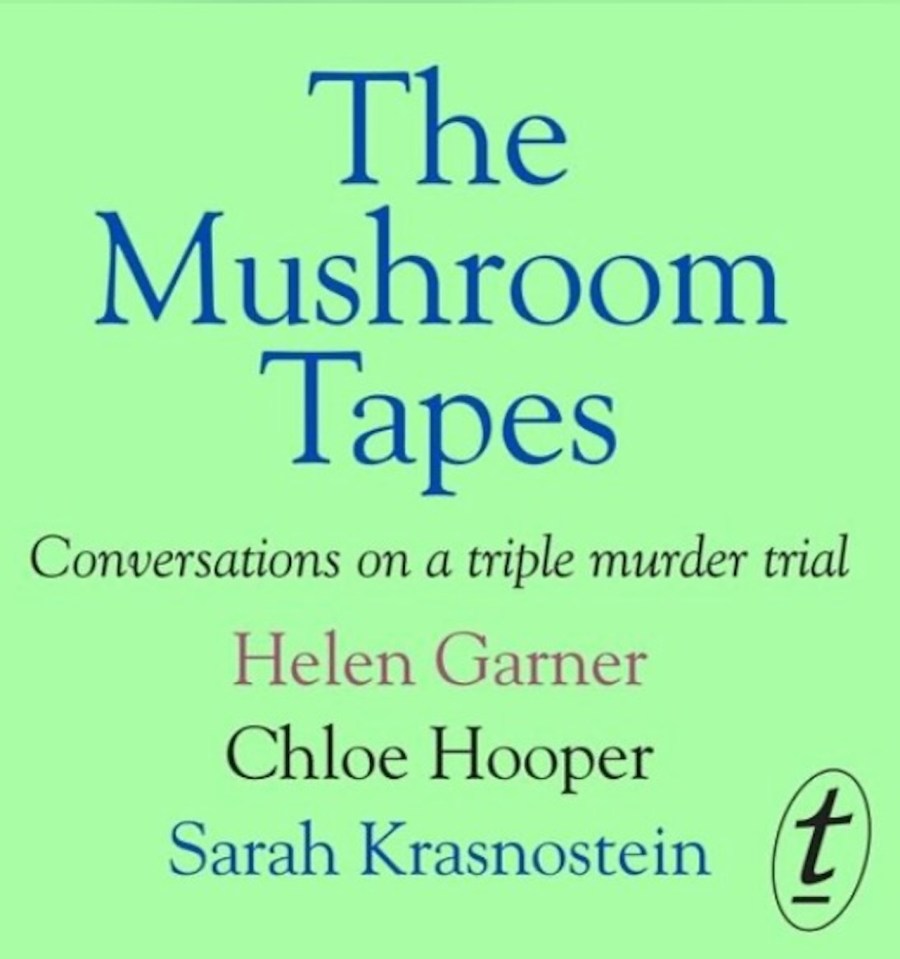
Book review: The Mushroom Tapes by Helen Garner, Chloe Hooper and Sarah Krasnostein

I read The Mushroom Tapes by Helen Garner, Chloe Hooper and Sarah Krasnostein due to the stellar lineup of authors, and I was not disappointed. I don’t read a lot of true crime and didn’t closely follow the case of Erin Patterson at the time it took place, so only had a peripheral knowledge of it. Patterson was facing three murder charges – the deaths of three family members by poisoned mushrooms in beef wellington. It was a case of life being stranger than fiction. The trial ran for eleven weeks. 

Basically what we’re doing is bearing witness… We’re bearing witness to a rent in the social fabric and how the law is going to deal with it.

The Mushroom Tapes is primarily a series of transcripts from conversations between the three authors driving to and from the courthouse, in coffee shops, or at their hotel. Each writer reflects on the trial, the people involved in, and spectators of the proceedings. They also contemplate what motivates a woman to kill, whether Patterson did it, and question their own motivations for being there as they grapple with the ethics of it.

I’m thinking about the room we’re about to walk into. The sorrow it contains. Medea is an interesting comparison because, like this, it’s a horror story.

The book provides a different perspective to that shown through a media lens. It is their presence in the courtroom as ordinary observers of all those around them, and their observations of the mood up close. For me it was also an interesting insight into the minds of the three women writers and their relationships to one another.  

Sometimes, as a writer, there’s a detail that you don’t know how to deal with … But if you can look at it the right way, it’s a portal into something deeper and bigger.

The Mushroom Tapes is a dialogue driven collaborative work of non-fiction for lovers of true crime and fans of the authors who penned the book (I am writing this while eating mushroom filo…eek!).
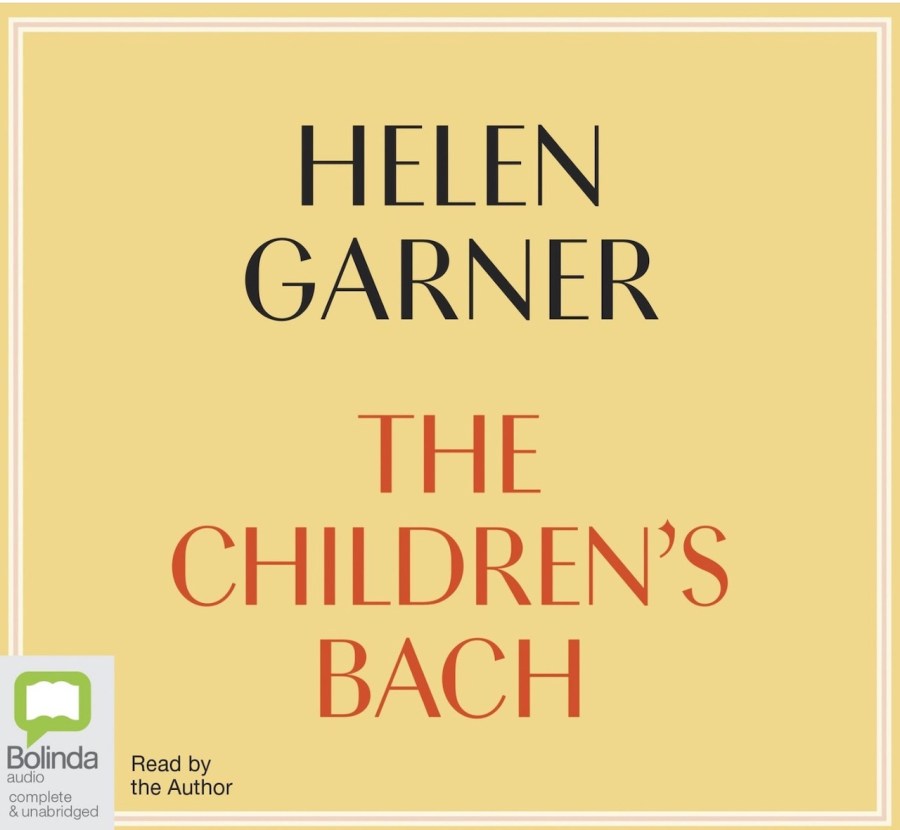
Book review: The Children’s Bach by Helen Garner

When I mentioned to a friend I had just read a great Helen Garner novella, they said they were conflicted because they love her writing, but couldn’t stand the person. Tongue in cheek, I said I didn’t know her personally so couldn’t comment on her character but thought her writing was beautiful. It was an interaction that sums Garner up quite well…both the woman and her work seem to attract controversy and elicit strong feelings.

‘Course I care. I always care. But there’s no point in making a song and dance about it, like that night he stayed here. Know something? There’s only one thing that’ll bring ’em back, and that’s indifference. The one thing you can’t fake.’
‘But you are faking it.’
‘At the moment I might be. But as soon as it stops being faked and starts being real, he’ll turn up. Rule number one of modern life.’

Beyond the personal satisfaction gained through the creative process of writing, we write with the hope that we will entertain, inspire, broaden horizons, challenge, or provoke, all outcomes which require the elicitation of emotions. It lends me to wonder then, whether Garner is not the personification of success if both the woman and her work can excite such polarised views.

The Children’s Bach (1984), Garners third published work, invites us into the 1980’s Melbourne suburban household of loving middle aged couple Athena and Dexter Fox who are united by their children, Billy who has autism and their a bright articulate son called Arthur. At its heart it is the story of a stable and caring couple’s life being interrupted by a the introduction of a disruptive influence. For Anthea (who is a bit suffocated by her own domesticity) and Dexter, it is the introduction into their orbit of Dexter’s old friend Elizabeth, her bohemian lover Philip and sister Vicki that fuel unrest.

‘She’s a frump,’ thought Elizabeth with relief; but Athena stepped forward and held out her hand, and Elizabeth saw the cleverly mended sleeve of her jumper and was suddenly not so sure.

Among the turmoil of relations between the adult characters, it is Billy who represents the manifestation of the parts of ourselves that are inaccessibility to others.

‘I used to be romantic about him,’ said Athena. ‘I used to think there was some kind of wild, good little creature trapped inside him, and I tried to communicate with that. But now I know there’s . . .’ (she knocked her forehead with her knuckles) ‘ . . .nobody home.’

Family, morals, ideals, and naivety are pitted against hedonism, freedom and independence. The Children’s Bach has been mooted as one of the best novels of the twentieth century and Garner is certainly a master of domestic drama, of female desire and the complexity of love and relationships. The point of view moves rapidly between the characters, and music, in which each of the actors finds a kind of solace, echoes through the book and lends a rhythm to Garners exquisite, precise, efficiently crafted, intimate and lyrical prose.

The novella was turned into an opera by Andrew Schultz as part of the Canberra International Music Festival in 2008. If we still have an arts sector post COVID-19 and the show is ever re-staged, I’ll definitely go and see it.