Book review: The Truth According to Us by Annie Barrows

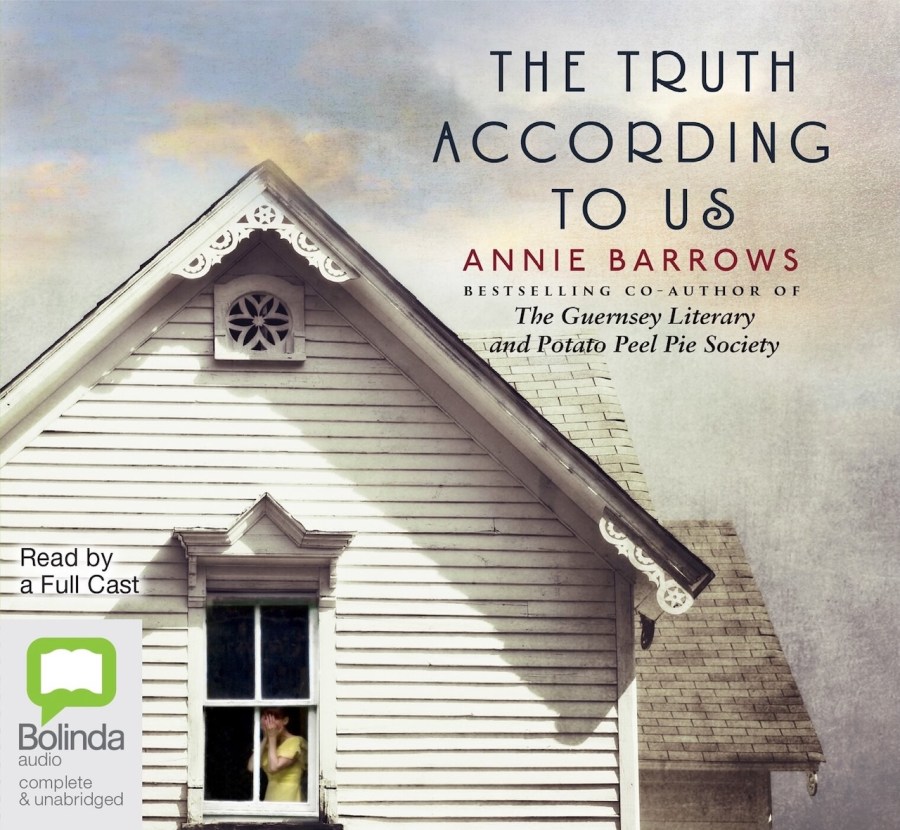
The Truth According to Us by Annie Burrows (co-author of The Guernsey Literary and Potato Peel Pie Society) is about what happens to independent women in 1938 when they refuse to marry a suitor their father thinks they should say yes to.

It’s very demoralizing to be regarded as a problem rather than an individual.

When Layla Beck refuses to marry, her father cuts off her allowance and tells her to get a job. He thinks she’s spoilt. Her uncle helps her out, commissioning her to write the town history of Macedonia, West Virginia, as part of the federal writers project. The version of history she is to write is one sided, dictated by the towns families of influence. No one, including Leyla expects her endeavour to be a success.

I’ve learned that history is the autobiography of the historian, that ignoring the past is the act of a fool, and that loyalty does not mean falling into line, but stepping out of it for the people you love.

She is to board with Romeyns, a local family. The Romeyns household is comprised of twelve year old Willa and her younger sister, Bird, their father Felix and his sisters Jottie, Mae and Minerva. They are the unconventional remnants of a once respected family whose late father ran the local mill.

Whatever gave you the idea we were like everybody else?

Leyla soon begins to thrive, and decides to tell the real history of the town in all its technicolors. Her endeavours takes place against the backdrop of factory strikes and family secrets. What unfolds is the Romeyn family saga (the family become Leyla’s chosen family), and the local towns story, told from the perspectives of Willa, Jottie and Layla.

Ladies don’t smoke in public, Jottie said. In public included a lot of places, even our front room because of all the windows, so Jottie smoked like a stack in the kitchen.

I really enjoyed the unfolding of this tale, and the character building, as hidden truths were unearthed, both by Leyla for her project, and Willa determined to understand the adults in her life and unearth their secrets.

If you’re going to unearth hidden truths, keen observing is your shovel

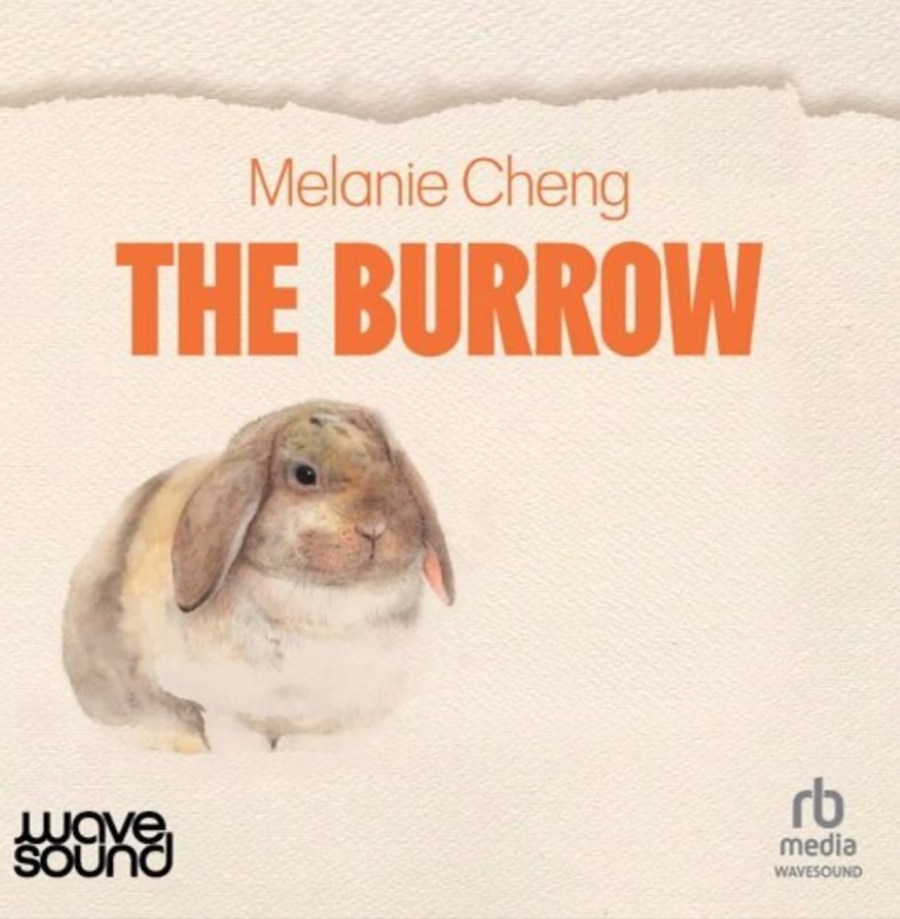
Book review: The Burrow by Melanie Cheng

The Burrow by Melanie Cheng is a novella about loss and grief in a family after the unspeakable happens. How does a family go on when a very young child dies in an accident whilst in the care of another family member?

There were clues: things she said in passing, a grisly observation about how a particular animal could die, or the prospect of a missing schoolgirl she’d heard about in the news being found alive (which was apparently close to zero). Comments so ghoulish they seemed out of place on the lips of a ten-year-old child

Six years ago, six month old Ruby drowned while being bathed by her grandmother, Pauline, who suffered a stroke.  Set in Melbourne at the tail end of the pandemic, the family, comprise on Jin, Amy and their ten year old daughter Lucie, are stuck in their grief. Their pet rabbit Fiver, was bought during a lock-down and becomes the focus of family members trying to avoid focussing on their own trauma and loss.

Perhaps this was the purpose of pets after all, she thought, to provide a buffer between humans who had forgotten how to talk to one another.

After Pauline has a fall, she is moved in with the family and joins in the focussed care of Fiver. In the novel Fiver reflects back fragility and the pandemic setting amplifies the families isolation and disconnection from one another and themselves. The Burrow is a quiet and sparsely written exploration of intergenerational grief.

Book review: Orbital by Samantha Harvey

You know that sense of amazement when you gaze out an airplane window to the earth, or lie on the grass on a clear dark night and wonder at galaxies of stars? Orbital by Samantha Harvey is this sense taken to the extreme. It is a beautifully written meditation on the everyday and magnificence of life from the perspective of an astronaut. 

Our lives here are inexpressibly trivial and momentous at once, it seems he’s about to wake up and say. Both repetitive and unprecedented. We matter greatly and not at all. To reach some pinnacle of human achievement only to discover that your achievements are next to nothing and that to understand this is the greatest achievement of any life, which itself is nothing, and also much more than everything. Some metal separates us from the void; death is so close. Life is everywhere, everywhere.

The story revolves around six astronauts as they circle the planet sixteen times in a cramped spacecraft. Each of the astronauts, from a variety of countries, are loosely drawn so we do not get to know them in a deep way. But we do learn about the minute of their roles on the ship, the effect of weightlessness on their bodies and what they must do to counteract it, and how it feels to live like this. We see and understand their birdseye view as they witness from space what is happening on earth  in some detail, from their spectacular but strange vantage point where time is bent and distorted.

The earth is the answer to every question. The earth is the face of an exulted lover; they watch it sleep and wake and become lost in its habits. The earth is a mother waiting for her children to return, full of stories and rapture and longing. Their bones a little less dense, their limbs a little thinner. Eyes filled with sights that are difficult to tell.

A slim volume, Orbital is a poetic, immersive reading experience for which Harvey won the Booker Prize in 2024. The story left me with a sense of awe.

How are we writing the future of humanity? We’re not writing anything, it’s writing us. We’re windblown leaves. We think we’re the wind, but we’re just the leaf.

Book review: Salt and Skin by Eliza Henry-Jones

Salt and Skin by Eliza Henry-Jones is a beautiful lyrical story with evocative descriptions of place that make the location a main character. 

Luda and her two children, Darcy and Min move to Seannay from Australia soon after Luda’s husband dies in a car accident. Seannay is a remote Scottish island and a place still steeped in the folklore of the witches who were found guilty of the crime of calling whales. The family are given accommodation in the ‘ghost house’ that has witch marks carved in the walls.

The ghost house is the only habitable place on Seannay, which is hitched to Big Island via a causeway. Seannay has no trees, just the house and turf and gorse and piles of stone and slate where other houses and byres had once stood. The ghost house is tiny and smells of damp sand and chalk. 

Luda is a photo journalist tasked with documenting how climate change is affecting the islands. On her first day she is photographing the cliffs when they collapse taking a small girl with them. Luda captures the moment on film just before the girl dies and the release of the images puts her offside with the locals.

Luda snaps a few frames. She inspects them and is impressed by the mood of the midwinter light, which she had expected to be flaring or dull. She lifts the camera back to her eye, trains it back on the cliffs. And then the world collapses.

Over time the family develop relationships with the locals including Theo, a foundling who washed up on the island years before and has webbed finger. The islanders think he is a selkie. Darcy falls in love with him.

This is what she knows: being haunted is not static. It is a fluid thing, a constellation of changing colours. Some days, she sense him everywhere. Other days, she barely thinks of him. On those days she will recognise his absence – her own self-absorbed carelessness – and it will be like a physical blow. She will stagger.

Salt and Skin is a family drama with the feel of a gothic novel. The story is infused with grief, loss, fury and tenderness, and explores a range of themes including myth, folklore and magic.

Book Review: The Hitwoman’s Guide To Reducing Household Debt by Mark Mupotsa-Russell

The Hitwoman’s Guide To Reducing Household Debt by Mark Mupotsa-Russell is a dark, funny, violent and original suspense thriller. 

After leaving the defence forces, Olivia Hodges became a hit woman for hire in Spain, working for a ruthless syndicate. She fled that life to save her own and returned to Australia where she took up an ordinary suburban existence with a husband and two daughters in the leafy eastern suburbs of Melbourne.

I think I’m missing a piece inside. Something crucially human. I’m not sure when I lost it – Spain probably – but I can feel the hole it left behind, like a pulled tooth.

When a group of young men turned bank robbers accidentally kill one of her children while fleeing the scene of a crime, Olivia wants revenge. Her challenge is that she thinks the incident is karmic revenge for her own past crimes. She needs to get payback without accruing any further karmic debt that could put her remaining family members at risk.

I was never the movie ideal of a hitwoman. My kills were uncinematic. No poisoned darts at the opera, single-handedly defeating the Yakuza or honey-potting the Russian ambassador. I speak one and a half languages, at best, and the highest political contract I ever got was president of the local bocce club.

Olivia goes to great lengths to set up situations where the men she is after get themselves killed. At the same time she is trying to mislead the police to give herself time to wreak revenge before they solve the crime of her daughters death.

In my experience every cult starts with Let’s build utopia! And Speak directly to God! But pretty soon it’s Did we mention enlightenment can only be inhaled from the Supreme Leader’s penis?

The Hitwoman’s Guide To Reducing Household Debt is a wild ride of action interspersed with suburban tragedy and plenty of tension. It’s also about personal morality, families and grief.

Book review: Days at the Morisaki Bookshop by Satoshi Yagisawa

I’m a sucker for a novel about books. I’ve also become drawn to Japanese fiction. It has a distinct style that often explores emotional landscapes and can be beautifully subtle and introspective.

It’s important to stand still sometimes. Think of it as a little rest in the long journey of your life. This is your harbor. And your boat is just dropping anchor here for a little while. And after you’re well rested, you can set sail again.

Days at the Morisaki Bookshop by Satoshi Yagisawa (translated by Eric Ozawa) is about a young woman called Takako. Takako resigns from her job after a man from her work who she’s been dating, breaks up with her to marry someone else. Depressed and unemployed, she moves into a room in the bookshop owned by her uncle in the Jimbocho district to hide in her misery. Takako is not a reader.

I don’t think it really matters whether you know a lot about books or not. That said, I don’t know that much myself. But I think what matters far more with a book is how it affects you.

Takako’s uncle asks her to mind the shop for a period each day and over time Takako learns to love reading and begins to make friends in the community. She also develops a deep bond with her uncle and the experience heals her.

It was as if, without realizing it, I had opened a door I had never known existed. That’s exactly what it felt like. From that moment on, I read relentlessly, one book after another. It was as if a love of reading had been sleeping somewhere deep inside me all this time, and then it suddenly sprang to life.

The second half of the book revolves around Takako’s uncle Satoru’s heartache.  His wife who mysteriously left him five years earlier returns unexpectedly. Satoru asks his niece to find out why his wife Momoko has returned. Takako and Momoko go on a road trip to the mountains and their relationship develops.

Don’t be afraid to love someone. When you fall in love, I want you to fall in love all the way. Even if it ends in heartache, please don’t live a lonely life without love.

Days at the Morisaki Bookshop is a short comforting novella. Elegant in its simplicity, it’s about loss, family, friendship, hope, new beginnings and how reading can facilitate change and open doors to help us understand our feelings. The book also has a great cover.

Book review: Woo Woo by Ella Baxter

Anyone who is passionate and sincere about creating art would be familiar with the self-doubt, imposter syndrome, and rage that can creep up without warning, all consuming and tumultuous as it is channelled into creativity. Woo Woo by Ella Baxter is about a feminist performance artist questioning herself in the lead up to her latest exhibition.

I am impregnating every image with my unruly, creative juju. Are you getting my full body in? … The shoes?

It is a week before conceptual artist Sabine’s solo art exhibition, titled Fuck you, Help Me, in a Melbourne gallery. The show is comprised of fifteen photographs of the artist in costume taken outside at night. She is wearing the mask of a female archetype and a translucent body sheath. 

It’s about pretending to be something you already are.

Despite being an established artist, Sabine is having a crisis of confidence. She is dealing with a real life stalker who loiters in her garden and sends her caustic letters that unsettle her.  She is also being visited in her house by the ghost of 20th century feminist performance artist, Carolee Schneemann. The stalker, who Sabine calls ‘Rembrant Man’ feeds her sense of anxiety and doom, while Carolee becomes an ally and mentor. 

What a thought-provoking piece Sabine provided for us this evening. Brings to mind such questions as what fear is, why we run, who the man represents, what is considered safe—an so many more! Great work tonight, Sabine! We were all right there with you! Brava! (Dare we say, encore?)

Sabine is married to an adoring husband, Constantine, who is a chef and her primary emotional support. He grounds her and placates her anxieties. He is not sure how to deal with the stalker, or even whether he believes the stalker exists. He thinks Sabine is just worked up about the exhibition, as usual. She is after all easily spooked – by the tenuousness of her place in the art world, by the number of fans that follow and join her livestreams. Her anxiety about validation leaves her vulnerable.

It was necessary for him to provide some Yang to her constant, thrumming Yin.

Suspend belief and be prepared to indulge in some visceral feral mayhem. I suspect it is one of those novels you will either love or hate, depending on your relationship to the world of art and artists.

Book review: Stoneyard Devotional by Charlotte Wood

Who hasn’t fantasised about abandoning their life responsibilities and running away to a different life?

After so many years of living in cities, the endlessness of the night sky here pours a wild, brilliant vertigo into me.

In Charlotte Wood’s Stone Yard Devotional, that is what her protagonist does. She leaves her marriage and her job and runs to Monaro in New South Wales to live amongst nuns in a reclusive religious compound, despite being sceptical about religion.  

In her remaining life there was only room for the truth, and sometimes that would be brutal. It was sad, but it was too late; she had to prepare herself for what was to come. Only what was essential could be allowed to reach her now.

Our unnamed narrator applies herself to her daily tasks like scrubbing the floor with vigour and we become privy to her memories and flashbacks that indicate some kind of existential crisis. In the outside world covid and bushfires rage, while in the convent the focus is on a mouse plague, and the skeletal remains of a dead nun returned to her proper resting place

There may be a word in another language for what brought me to this place; to describe my particular kind of despair at that time. But I’ve never heard a word to express what I felt and what my body knew, which was that I had a need, an animal need, to find a place I had never been but which was still, in some undeniable way, my home.

Stone Yard Devotional is a meditation on escape, letting go, living with life’s choices, the nature of women’s friendships, belonging, devotion and sacrifice.

The beauty of being here is largely the silence, after all. Not having to explain, or endlessly converse.

Book review: Conversations with Friends by Sally Rooney

Set in Dublin during financial crisis in 2008, Conversations with Friends is written by Irish author Sally Rooney, who also wrote Normal People.

Everyone’s always going through something, aren’t they?

Conversations with Friends is a meandering story focussed largely around Francis and her relationships with the people around her. Francis is a mass of contradictions. Intelligent, ironic, fragile, nervous and terrified of showing her vulnerability to others.

I realised my life would be full of mundane physical suffering, and that there was nothing special about it. Suffering wouldn’t make me special, and pretending not to suffer wouldn’t make me special. Talking about it, or even writing about it, would not transform the suffering into something useful.

Bobbi is a pragmatic lesbian who goes to university with Francis. She and Francis were lovers for two years and remain friends, performing spoken work poetry together. 

The acclaim also felt like part of the performance itself, the best part, and the most pure expression of what I was trying to do, which was to make myself into this kind of person: someone worthy of praise, worthy of love.

After one performance Francis and Bobbi meet Melissa, a photographer and essayist a decade older. She wants to profile them for a magazine and they go to her house where they meet her husband, Nick an actor. Francis begins an elicit and toxic affair with Nick in which their need to feel wanted by each other seems to become necessary in order to feel anything about themselves. 

I was like an empty cup, which Nick has emptied out, and now I had to look at what has spilled out of me: all my delusional beliefs about my own value and pretensions to being a kind of person I wasn’t. When I was full of these things I couldn’t see them. Now that I was nothing, only an empty glass, I could see everything about myself.

The novel tracks the next seven months and the relationships between these four individuals, though largely it is Francis’s relationships with Bobbi and Nick that take centre stage. 

He was the first person I had met since Bobbi who made me enjoy conversation, in the same irrational and sensuous way I enjoyed coffee or loud music.’

Conversations with Friends is a very human book about poor choices, identity formation, sexuality, desire, and power dynamics.

Book review: Appreciation by Liam Pieper

Appreciation is a novel by Liam Pieper that has (apparently) many parallels to his own life as a ghost writer for celebrities. I don’t know which celebrities, because no one outside the publishing business seems to know which books he wrote, and he would be bound by some kind of confidentiality agreement. I can understand why he is a sought after ghost writer – because he writes very well.

The night of his cancellation, Oli does not sleep. He is unable to stop reading the posts calling for him to be stripped of prizes, fellowships, his honorary doctorate.

Australian queer painter, Oliver Darling (Oli) is the toast of the town until he causes himself to be cancelled after a drug fuelled rant on live television. The incident causes the value of his work to tank, infuriating investors and mobilising a mob of unsavoury debt collectors.

Oli circumnavigated the party once, twice, and settled finally into conversation with the person he found the most interesting, because she was the richest.

Appreciation is the story about how Oli got to where he is, his floundering attempts to redeem himself, salvage his career, and save his own life and that of his agent by writing a memoir with a ghost writer.

How to explain the appeal of Old? He is wonderfully charming when he needs to be. He has a way of shuffling into the room like a very old dog, turning his attention to you, and in doing so lighting up your day.

Appreciation is a satirical novel about the art world, the struggle to make money from art, celebrity, authenticity, the precarious nature of fame, toxic masculinity, personal myth and vanity, and the world of drugs and criminals. The book has received mixed reviews, but I enjoyed the journey and Pieper’s excellent writing skills.