I’m not sure what the equivalent term is for a page turner when it’s a podcast. Ear grabber, binge listen or hearing hair-raiser perhaps. The latest offering from Unravel is called Snowball and it’s one of the best and most bizarre true crime offerings I’ve ever listened to…and nobody died for it.
Naive New Zealand man Greg Wards fell in love and married charismatic American con artist, Lezlie Manukian from California after meeting her on a backpacking trip to the UK. Lezlie moved to New Zealand with him and ripped off his whole family. Right before Lezlie got on a plane to go back to the US to visit her family she had a parting message for Greg.
“The snowball is about to hit you.”
Soon after his family discover that Lezlie had defrauded over a million dollars from them. Greg’s brother Ollie Wards, a journalist, decided to investigate Lezlie in an attempt to understand what happened and help his family put the experience behind them. Ollie’s podcast paints a picture of a genuine, warm, compassionate and close knit kiwi family and the trail of destruction left across the globe by Lezlie.
It was a fascinating study into the art of the con artist, one of the worlds oldest professions. Grifters, scammers, hustlers, swindlers, fleecers. They make a living out of violating trust. It’s all about brains, not brawn. They play to emotions and hone in on vulnerability.
Greg was a perfect target. A naive New Zealander on a big exciting adventure. A Yankophile in the United Kingdom who heard the confident American at a crowded party and was immediately enchanted. She would have charmed him, a master actor and a good listener who excelled at fabricating common ground to break down her targets defences. She didn’t grow a pinocchio nose when she lied, and what man would expect a beautiful charismatic woman fascinated by their greatest desires to rip the rug right out from under them? As one of her victims said, he’d come home to a beer and a blow job…emotion trumps reason.
I felt a great deal of warmth toward the Wards and was gobsmacked by what happened to them. I was also flabbergasted by the chutzpah of Manukian. You have to wonder why people like her don’t just go into acting – I’d have thought it would be much more rewarding in the long run. An extraordinary tale that had me gasping ‘no way’ at every turn.
I picked up Kristoff’s epic fantasy novel after hearing him interviewed on The Garrett podcast. I don’t read a lot of fantasy, but he seemed like an interesting guy. Godsgrave is the second in a chronicle and it’s fare to say after reading it I wish I’d started with book one.
Our scars are just gifts from our enemies…reminding us they weren’t good enough to kill us.
Mia Corvere wants revenge for the murder of her familia, and she’s ruthless. She orchestrates herself to be sold off as a slave to a gladiatorial collegium. But it’s a tough and bloody road to revenge in Nevernight. Mia encounters allies, rivals and lovers all the way egged on by her mysterious magical shadows. Kristoff puts Mia under more and more pressure as the story unfolds and forces her to choose between pursuing revenge or friendships.
The old man hooked his thumbs into his waistcoat. ‘Problem with being a librarian is there’s some lessons you just can’t learn from books. And the problem with being an assassin is there’s some mysteries you just can’t solve by stabbing the fuck out of them.
The book is a long, dark, blood soaked, sexy, action packed page turner with plenty of twists to keep you on your toes. The world building is grand, the action spectacular, the narrator playful and amusing (if you read the footnotes), and the writing style poetically gruesome. And it ends on a cliffhanger.
Because the voices in your head that say otherwise are just fear talking. Never listen to fear.
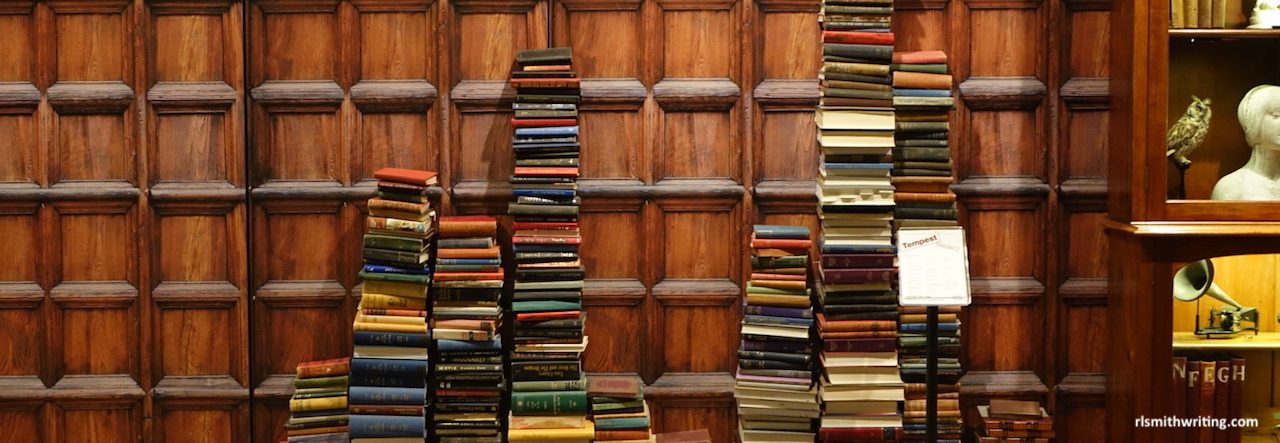
What happened when you saw the main image on this post? Did you automatically think palm trees and cows?
Humans love to organise, categorise and classify. Slapping a label on things helps us make sense of the world, and prevents us from becoming overwhelmed by it. The publishing industry is no different. There is a preference to categorise authors – mystery, romance, literary, science fiction, speculative fiction. Apparently they like authors to ‘stick to their genre.’ Failing to do so might confuse readers, not to mention the marketing team.
I can’t blame you for trying to categorize me. It’s a human instinct. It’s why scientists are, to this day, completely flabbergasted by the duck-billed platypus: it’s furry like a mammal, but lays eggs like a bird. It defies conventional classification.
Jeff Garvin, Symptoms of Being Human
Categories can be hot air, Instrument Museum, Prague
It’s an interesting perspective given one of the other key pieces of advice for writers is to read widely across genres. Reading improves vocabulary, teaches us how to build narrative structure and tension, create interesting characters, and construct dialogue. Reading broadly also provides inspiration. If our creativity is enhanced from reading across genres, the result presumably includes some leakage from what we absorb to what we produce. Novel ideas emerge and the genre lines start to blur.
I just finished reading Kate Atkinson’s A God in Ruins. It’s an absorbing read as well as a great title. A saga about postwar Britain told from the perspective of a single family over four generations. I was captivated by Atkinson’s use of language. Her writing is elegant, poetic and humorous. The story is an expertly plotted, time skipping narrative with rich three dimensional characters. It is rare that a novel will bring me to tears, but some of main character Teddy Todd’s reflections on life did just that.
A God in Ruins is a historical fiction novel written by an author previously best know known by her mystery writing about protagonist detective Jackson Brodie, and her earliest works were family sagas. Atkinson has definitely not stuck to her knitting. She is an author who is unbound by genre conventions, rules and categories. She even makes reference to the genre box in A God in Ruins when Viola, Teddy’s writer daughter is on her way to a literary festival in Singapore.
…she was also down for a couple of panel events as well. The role of the writer in the contemporary world, popular versus literary, a false divide. Something like that.
Kate Atkinson, A God in Ruins
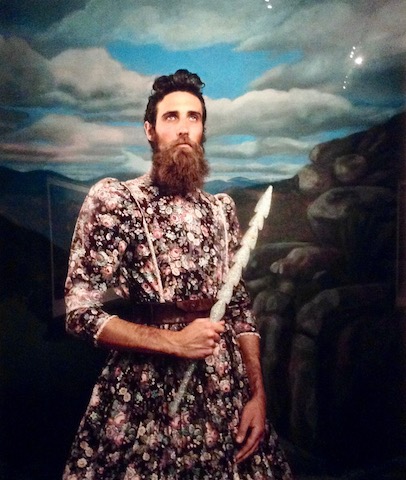
Image: Jacqui Stockdale, Mann of Quinn from the series The Boho – 2015, Adelaide Biennial of Art, 2016. Art Gallery of South Australia.
Atkinson is not alone in the endeavour of writing in different genres. She keeps the company of well known names such as Stephen King (science fiction, fantasy, mystery, and suspense); Margaret Atwood (children’s books, literary novels, speculative and historical fiction); and JK Rowling (children’s and adult mystery)
I love that Atkinson has written what takes her creative interest, rather than what might be expected, regardless of genre, and she done it always using her own name.
Would you be brave enough to defy a genre category?
I recently completed, the Australian Writers Centre’s online course Inside Publishing – What You Need to Know to Get Published, which delivers a comprehensive overview of the global publishing landscape. This is a must do course for anyone thinking about publishing a book and not already familiar with how the publishing industry works. The course is self paced and contains five modules, each consisting of videos, handouts and links to relevant resources, all of which you can download for future reference. AWC does a great job of breaking down complex legal and technical concepts and explaining them in accessible language. It offers a terrific overview of how the publishing world its together, as well as providing handy tips for writers about to launch themselves into it.
The first module is about copyright – boring right? Surprisingly I found it fascinating. It explains in plain language how copyright works and the curious way it is carved up across geography, languages, film, television and books. It delves into what you own, what is yours to sell and the role of agents in getting you the best deal. Learn about the structure of the global publishing industry, the professional roles of various people who work in publishing houses, and how they make decisions. There are also tips on what to look for and what to avoid in the industry.
Module two focusses on the broad array of book formats – hardcopy sizes, audio, ebooks, why different book formats are produced and what it means for the author. This module then goes onto to explain how different formats relate to book marketing, buying, distribution, audiences, how sales are measured and how this guides publishing decisions about printing, as well as what happens to books that aren’t sold. The module also touches on the differences between the traditional publishing route and indie publishing and things to think about when considering which way to go.
The third module goes in deep on author editor relationships from the time they pitch to the final proofread. It explains all the different types of edits, the difference between editing and proofreading and the value of a good edit. Of course first you have to submit a manuscript and this module covers the pros and cons of submitting to agents versus direct to publishers and what you need to think about with both of these approaches. The resources include sample pitches and submissions, dealing with rejection, how to use rejections to improve your work and what happens after your receive an offer from a publisher.
Module four gets down to the nitty gritty of offers and what you need to think about, including how advances work, marketing, royalties, public lending rights (libraries), and educational lending rights, and an introduction to some of the things to look for in contracts.
Contracts is the focus of module five, which sensibly comes with a disclaimer that it’s not a substitute for legal advice. Make sure you’ve had your morning coffee as this is the serious end of the business and requires some concentration. This lesson talks about negotiating contract terms and goes into quite a bit of detail about the various clauses in standard publishing contracts. It ends with a little reminder that publishing is a business, so you have to approach your author journey professionally and do your best to educate yourself about how the industry and the publishing process work.
I got a lot out of this course and one of the best things about it is that when you enrol, you get access to the online materials for twelve months. I’m confident I’ll go through it a couple more times before that time is up and will learn a bit more with each viewing.
I don’t read a lot of true crime but just finished Helen Garner’s work, This House of Grief. I know some people find the genre too hard because of the voyeuristic nature of it, or because they cannot bear to hear about the terrible things people are capable of doing to one another. The genre is often criticised for being disrespectful to victims and their families, an argument that primarily revolves around issues of consent, appropriation, representation and concerns when stories are embellished for the purposes of drama.
Those who do like true crime reference its value in providing insight into, and an understanding of, the inner workings of the legal system and human behaviour. There have been instances of true crime pieces shining a light on forgotten cases and having an extraordinary impact, such as facilitating the resolution of unsolved crimes or the reopening of cold case investigations. Rachael Brown’s, Trace, a true crime podcast series about the cold case of the murder of single mother Maria James at the back of her bookshop in 1980 resulted in a new coronial investigation. Katherine Kovacic’s historical fiction novel, The Portrait of Molly Dean, based on a 1930 unsolved murder delivers a sensitive remembrance for a largely unknown young woman who’s life might otherwise have been forgotten.
This House of Grief by Helen Garner is a non fiction true crime story about the murder trial of Robert Farquharson. Farquharson was charged after the car he was driving left the road and crashed into a dam outside of Winchelsea, Victoria and resulted in the death of his three children on Father’s Day. Farquharson was convicted to three terms of life imprisonment without parole in 2007. The original conviction was overturned in 2009 but a retrial again found him guilty of murder and he was sentenced to life imprisonment with a 33 year minimum.
Garner never interviewed Farquharson but did attend both trials as part of her process of writing the book. The trial and re-trial form the narrative spine of the novel in which Garner herself is both a witness to events, and a character within the text. The story blends Garner’s personal experience of the harrowing trial with the procedural formality of the legal system. Her her own emotional responses to the unfolding evidence, and the mundanities of her everyday life run along side the factual reporting of the trials. It is written with the calm eloquent voice of an observer equipped with the exceptional skills of a fiction author and a fearless honesty. Garner strives for an empathic understanding of the terrible event as the rational, ordered legal system tries to make sense of it and find the truth at the centre of all the swirling grief. She lays her own and others emotions, prejudices, and preconceived notions of human behaviour bare, challenging their intractable nature and unreliability on the page.
As Garner records and critiques the courtroom drama and her own conflicting responses to it, she describes in expressive detail impressions of the people she encounters in appearance, language and tone, the mood of the room, the surreptitious glances and subtle shifts in body language. When the evidence leans toward a guilty verdict Garner clings to the possibility of reasonable doubt because she doesn’t want to believe a father could be capable of intentionally killing his three children. When rebuked by a barrister friend, she reflects on the question of why lawyers always make her feel stupid. It seems to be a comment on gendered views where the legal system is masculine and certain, but she is feminine and tentative.
Garner has received both praised and criticism for this work and other true crime books she has written (Joe Cinque’s Consolation; The First Stone). I found This House of Grief a fascinated and compellingly intimate insight into Garners inner world. In striving to be objective she had to wade through confusion, doubt and sudden flights of compassion or repulsion she felt for the subjects of her study, and her own responses to those feeling.
Ultimately This House of Grief raised more questions for me than it answered – about the fallibility of the legal system and the ambiguity in taking a highly technical procedural process and asking ordinary emotion laden laypeople to make a judgement of certainty about what they hear; about our societies insistence on imposing gender stereotypes that sometimes turn out men so incapable of managing their own emotional turmoil they carry out terrible acts in some misconceived belief it will soothe their own pain; about women unable to reconcile the possibility that love and vengeance can coexist in a way that can make the ones they love capable of both great heroism and of terrible violence; about how our own social conditioning, past experiences and emotional worlds shape how we perceive and interpret what goes on around us; and how our individual prejudices and beliefs shape what we can and cannot bear to hear and believe about the world.
Peter stifled his ambitions to become a writer and studied nursing in order to meet his parents expectations. Penelope Whitman was a famous author, but now she’s a crabby old woman nearing the end of her life in the nursing home where Peter works. Her eyes are fading and her arthritic hands can’t hold a pen, so she passes the time absorbed in her imagination. There’s one problem, a story in her head that persists in wanting to be told to the world. When Peter discovers who Penelope is, he sets out to befriend her and eventually becomes her protege when she asks him to transcribe her story.
As the telling and transcribing progress it becomes apparent there are other forces lurking. Em Jewel for one. Em is a creative, temperamental and supernatural force with the capacity to both inspire and destroy.
Part way through the telling of Penelope’s story, tragedy strikes and Peter has to find a way to finish the tale without her. What unfolds is a bit Agatha Christie for psychics – part supernatural mystery, part love story, part adventure and part historical intrigue spanning several generations. It’s a story within a story within a story.
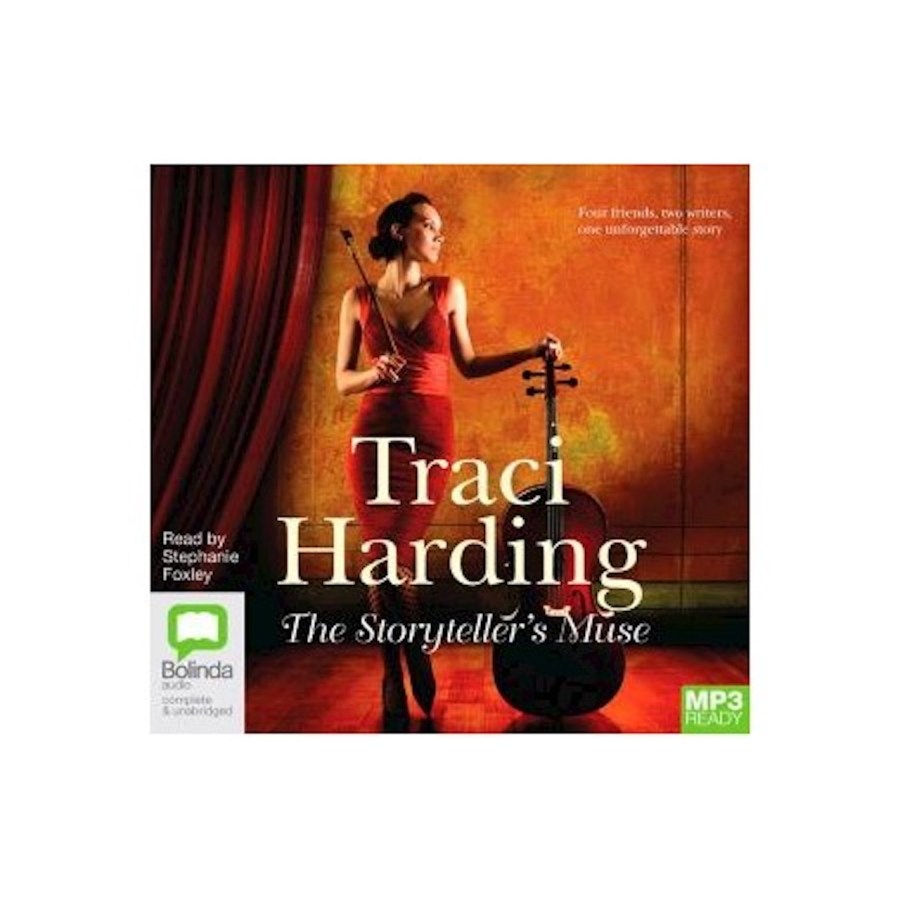
The Story Tellers Muse is the first Traci Harding book I’ve read. Most of the works of this Australian author are science/fantasy series. I picked it up because it was in the mystery genre but might dip into some of her other work now I’ve had a taste of her writing. As an artist developing her craft, I particularly enjoyed the theme in the book that explored the relationship between creative artists and their muses. The Story Tellers Muse was also a fun and easy read that had me turning the pages – or rather pressing the play key as I ‘read’ the audio book, rather than the paper version.
Each winter Melbourne hosts Rare Book Week which delivers a program of free talks and events across the city to celebrate the importance of books, literacy and literature. Twice this week I fought my way through the dark, windy and desolate streets of Docklands to Library at the Dock, which is a fabulous library and community hub if you are ever in the area.
The events I attended were The Knife is Feminine about Australian mystery writer Charlotte Jay, and Portraits of Molly Dean in conversation with author Katherine Kovacic on her true crime book about the murder of Molly Dean in St Kilda in 1930. This blog is about those two events.
The Knife is Feminine
A dagger…it had a curious hilt shaped like a woman’s torso, with wings, only she had no face, just a visor like a knight.
The knife is feminine, Charlotte Jay
I’d never heard of Charlotte Jay, but as it turns out she was one of Australia’s best crime and thriller writers and I will certainly seek out some of her work to read now. Panel members for this event were Carmel Shute (one of the founders and national convener of Sisters in Crime), author Katherine Kovacic (The Portrait of Molly Dean and Painting in the Shadows), Abbe Holmes (actor) and Chris Browne (convener of Rare Book week, former academic and a book collector with 12,000 books and counting).
Charlotte was born Geraldine Mary Jay in Adelaide in December 1919, she chose the author name Charlotte because she thought it sounded literary. She married Albert Halls, an Oriental specialist who worked for UNESCO, and she spent much of her adult life traveling the world with him. Initially she worked as a stenographer for twelve “terrible years,” according to an interview Carmel Shute did with her in 1992. When she realised she had a talent for frightening people and telling a good story so became an author. Carmel observed that in life Jay had a liking for gin and tonic and a habit of snorting when she found others ideas ludicrous.
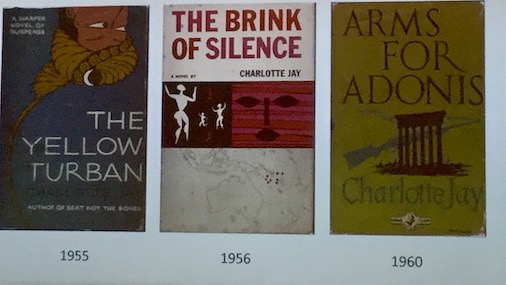
The author wrote seven crime novels as Charlotte Jay between 1951 and 1964, one as Geraldine Mary Jay in 1956, and seven as Geraldine Halls between 1967 and 1995. The stories in her novels included exotic settings like Papua New Guinea, Pakistan, Japan, Thailand, England, Lebanon, India, the Trobriand Islands, as well as Australia.
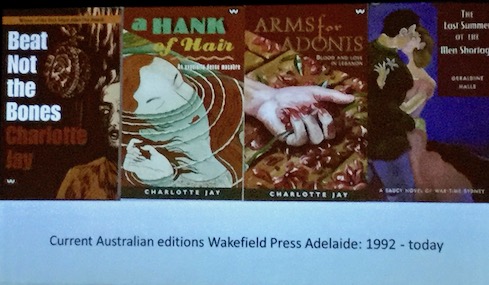
One of her books, A Hank of Hair was so risqué that Harper Collins refused to publisher it. The book was later picked up by Pan Publishing and released in 1964. Another novel, The Fugitive Eye written in 1953 was filmed for television and stared Charlton Heston. Her first novel, The Knife Is Feminine is out of print and there are only a handful of copies still in existence worldwide. We were lucky enough to get a couple of readings from one of those copies.
She wrote in the Gothic tradition and hearing her work, Charlotte Jay had a talent for the weird . She used slow, creepy build ups and detailed observations to tell cracker stories. She was the first winner of the Edgar Allan Poe Mystery Writers of America Award for Beat Not the Bones set in Papua New Guinea, which has some fascinating commentary on racism and colonial power in the 1950s. The following year Raymond Chandler won the award with The Last Goodbye.
The writer eventually returned to Adelaide and her last book was published in 1995, she died in October 1996. I for one shall look forward to reading some of her works, which are listed below.
Charlotte Jay novels
• The Knife Is Feminine (1951)
• Beat Not the Bones (1952)
• The Fugitive Eye (1953)
• The Yellow Turban (1955)
• The Man Who Walked Away (US Title: The Stepfather) (1958)
• Arms for Adonis (1960)
• A Hank of Hair (1964)
Geraldine Mary Jay novels
• The Feast of the Dead (US Title: The Brink of Silence) (1956)
Geraldine Halls novels
• The Cats of Benares (1967)
• Cobra Kite (1971)
• The Voice of the Crab (1974)
• The Last Summer of the Men Shortage (1977)
• The Felling of Thawle : a novel (1979)
• Talking to strangers : a novel (1982)
• This is My Friend’s Chair (1995)
Portraits of Molly Dean
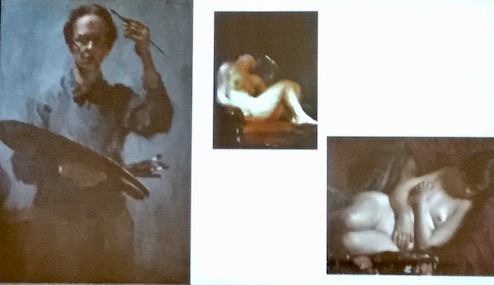
Mary (Molly) Winifred Dean (1905–1930) was brutally murdered in Elwood on 21 November 1930 near her home after walking home late one night. Author of The Portrait of Molly Dean, Katherine Kovacic first came across Molly when studying the art of painter and sculptor Colin Colahan and became fascinated by her life which seemed to have been reduced to a single sentence in a Colahan’s biography. Molly had been Colahan’s lover and one of his models.
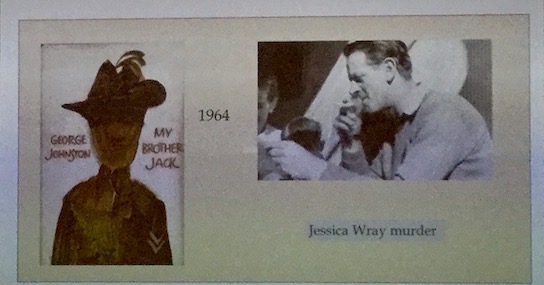
The historical mystery fiction, The Portrait of Molly Dean, was written to shine a light on Molly’s life, which along with her death feature in a number of other works. She was the subject of non-fiction A Scandal in Bohemia: The Life and Death of Mollie Dean by Gideon Haigh, and appeared in fiction works My brother Jack by George Johnston, and The Eye of the Beholder by Betty Roland, as well as the play Solitude in Blue, written and directed by Melita Rowston.
Molly Dean trained as a primary teacher and showed great promise for the profession but aspired for journalism and writing. She had had one long blank-verse poem titled Merlin published in a Melbourne publication called Verse.
Young Molly had a strained relationship with her widowed mother, Ethel Dean, who didn’t approve of Molly’s involvement with the Bohemians – the Meldrumites (followers of painter Max Meldrum) who Molly met when she became intimately involved with Colin Colahan, a well-known sculptor and painter of nudes.
On 20 November 1930 Molly went to the theatre to see Pygmalion with friends. She arrived at StKilda station on the way home, but missed the last tram, apparently due to stopping to make two phone calls to Colin from a phone box, so walked the two kilometers to Elwood along the tram route to the corner of Mitford and Dickens Streets. There were a number of sightings of her as she walked, but no witnesses to her attack. She was discovered early on Friday 21 November severely injured in a laneway less than two hundred meters from her home. She was rushed to hospital but she died of her injuries.
The police believed that due to the nature of the crime, Molly probably knew her attacker and the motive was most likely jealousy. An intense and exhaustive police investigation followed her death. A family friend, who was suspected of having an affair with Ethel Dean was investigated then dismissed. A man called Arnold Karl Sodeman, who confessed to four other killings, was also considered. His involvement was dismissed primarily due to his other attacks having very different profiles, and that he swore he wasn’t Molly’s killer. Sodeman was executed in Pentridge Prison in 1936 for the crimes he admitted.
The Crown Prosecutor did not proceed with the case and conspiracy theories abounded about Molly’s unsolved murder over the years. One theory suggested it wasn’t solved because she’d crossed paths with very powerful people in Melbourne, and they had shut down the investigation.
Artist Colin Colahan
Katherine Kovacic’s fictionalised account of Molly’s story is a fascinating tale of art, intrigue and murder, and Melbourne’s history. Her melding of fact and fiction patches together a coherent and sensitive narrative to re-tell a victim’s story and shine a light on her young life. It’s told from the perspective of a fictional art dealer called Alex who buys a painting in 1999 believed to be the last portrait of Molly Dean. Kovacic has released a second book Painting in the Shadows that also revolves around Alex, and a third is due out next year.
For the section of this blog on Molly Dean I have drawn on Kovacic’s talk at Rare Books Week and a piece published on the Public Records Office website by Dr Eric J Frazer about her murder.
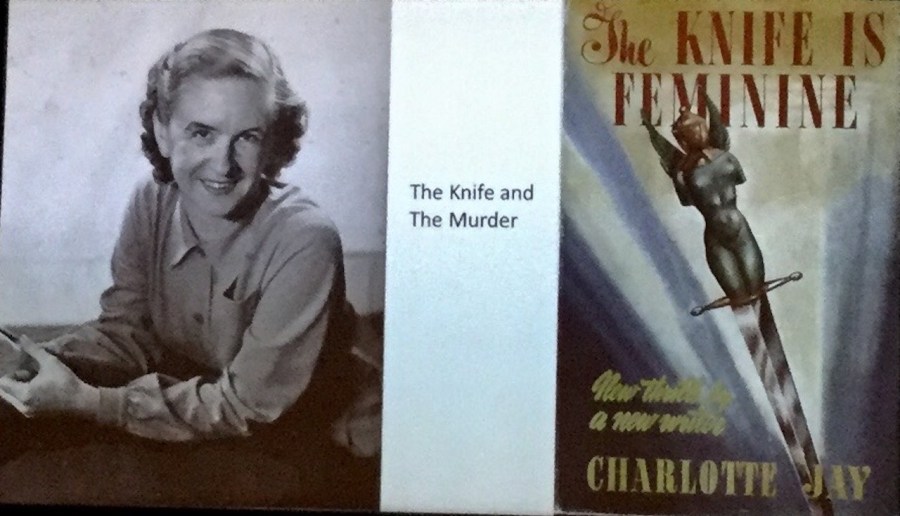
Main image: Charlotte Jay and The Knife is Feminine
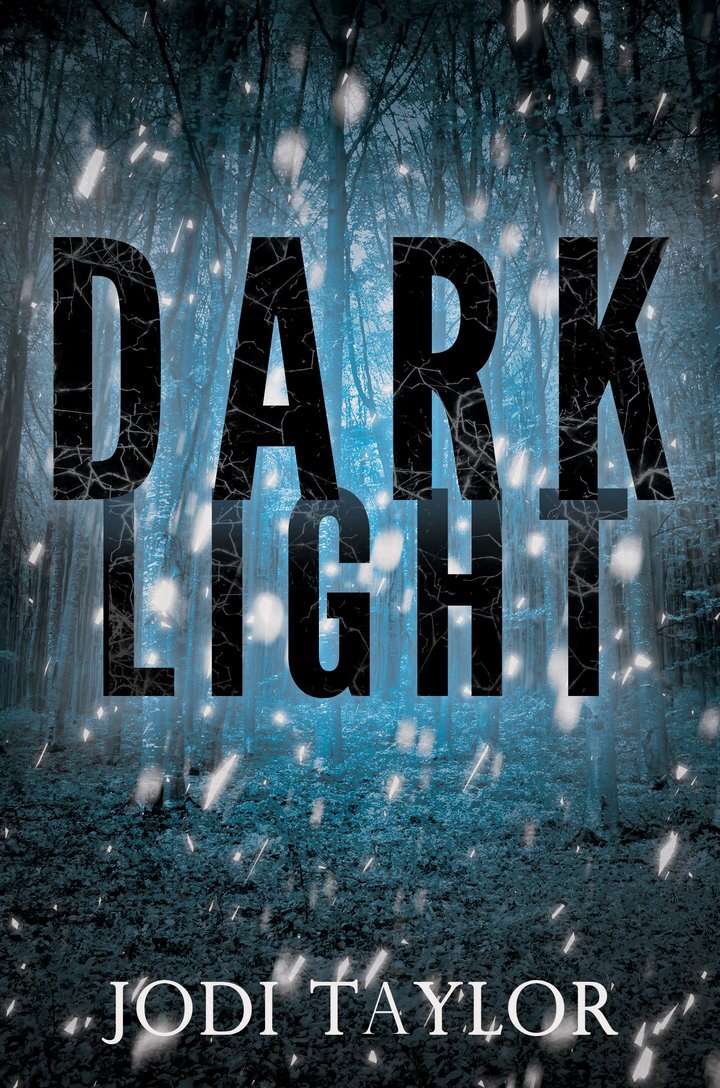
This is one weird book – I mean that in a good way. Elizabeth Cage is a mostly ordinary widowed housewife who likes a quiet life. Her primary problem is that she can see colours, which means she can read others emotions by the colour aura that swirls around them. We discover through her backstory that her special power is of interest to a man who had her locked up in an asylum so he could study and exploit her, until another inmate helped her escape.
Dark Light opens with Elizabeth running away and trying to cover her tracks by jumping random buses, then disembarking only to do it again on another bus until she decides to stop in the town of Greyston out of pure exhaustion from being on the move all the time. That’s when things really start to get wacky. Greyston is a small English village of women with a medieval tradition that involves kidnapping a man to be king for a year, getting him to impregnate the towns women then sacrificing him to the stone gods on New Year’s Eve. Elizabeth is recused from almost becoming one of the towns women by the man she was running away from.
It soon becomes evident Elizabeth has other special powers as she slips between the cracks of this world and other bizarre, chaotic, parallel universes inhabited by creatures from your childhood nightmares. In these other spheres bad things happen, dramatic rescues take place and Elizabeth is subjected to all kinds of quirky twists and turns, all the while wishing she could just sit quietly at home in a warm bath with a cup of tea.
All the way through this supernatural thriller, I was surprised at how it drew me in. When I had to put it down to go and attend to my ordinary life, I couldn’t wait to get back between it’s strangely engrossing pages. I have never read any of Jodi Taylor’s writing before and it wasn’t until I finished Dark Light that I realised it was the second book in a series – luckily it turned out that didn’t matter particularly, other than being disappointed I hadn’t started at the beginning with White Silence. I am certain I will be reading more of Taylor for another dose of peculiar, spooky fun in the future.
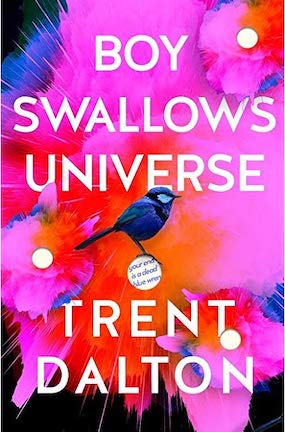
Trent Dalton’s novel Boy Swallows Universe is part crime novel, part coming of age story and part memoir. Eli Bell is a boy growing up in commission housing on the outskirts of Brisbane in the 1980’s with his brother August who doesn’t speak. It follows Eli from age twelve through nineteen when he realises his boyhood dream and becomes a journalist. As a child he gets life advice from his babysitter and mentor Slim who is a convicted murderer, and he lives with his heroin addicted mother and violent, drug dealing step father – until his stepfather disappears when his criminal past overtakes him, his mother goes to jail and Eli loses his lucky charm.
Eli and August then go to live with their father, an anxious, alcoholic man who is a prolific reader of fiction and buys Eli writing paper to ‘burn the house down or set the world on fire.’ And Dalton certainly set the world on fire with this novel.
The book has won more awards than you can poke a stick at including four ABIAs: Book of the Year, Literary Book of the Year, the Matt Richell Award for New Writer of the Year and Audio Book of the Year (Wavesound, narrated by Stig Wemyss); the UTS Glenda Adams Award for New Writing and Peoples Choice Award at the NSW Premier’s Literary Awards; the Indie Book Awards Book of the Year; and the MUD Literary Prize. Oh, and it’s going to be adapted for screen.
It’s a long work at 480 pages, but every one is packed full of humour, tragedy, hope, love and a splash of magical realism, all written in Dalton’s unique lyrical prose. It gets the one of my favourite ever books award because it’s a rollicking good read and I loved his writing style. I expect I will read it more than once.
“Watch my language? Watch my language? This is what really shits me, when the clandestine heroin operation truth meets the Von Trapp family values mirage we’ve built for ourselves.”
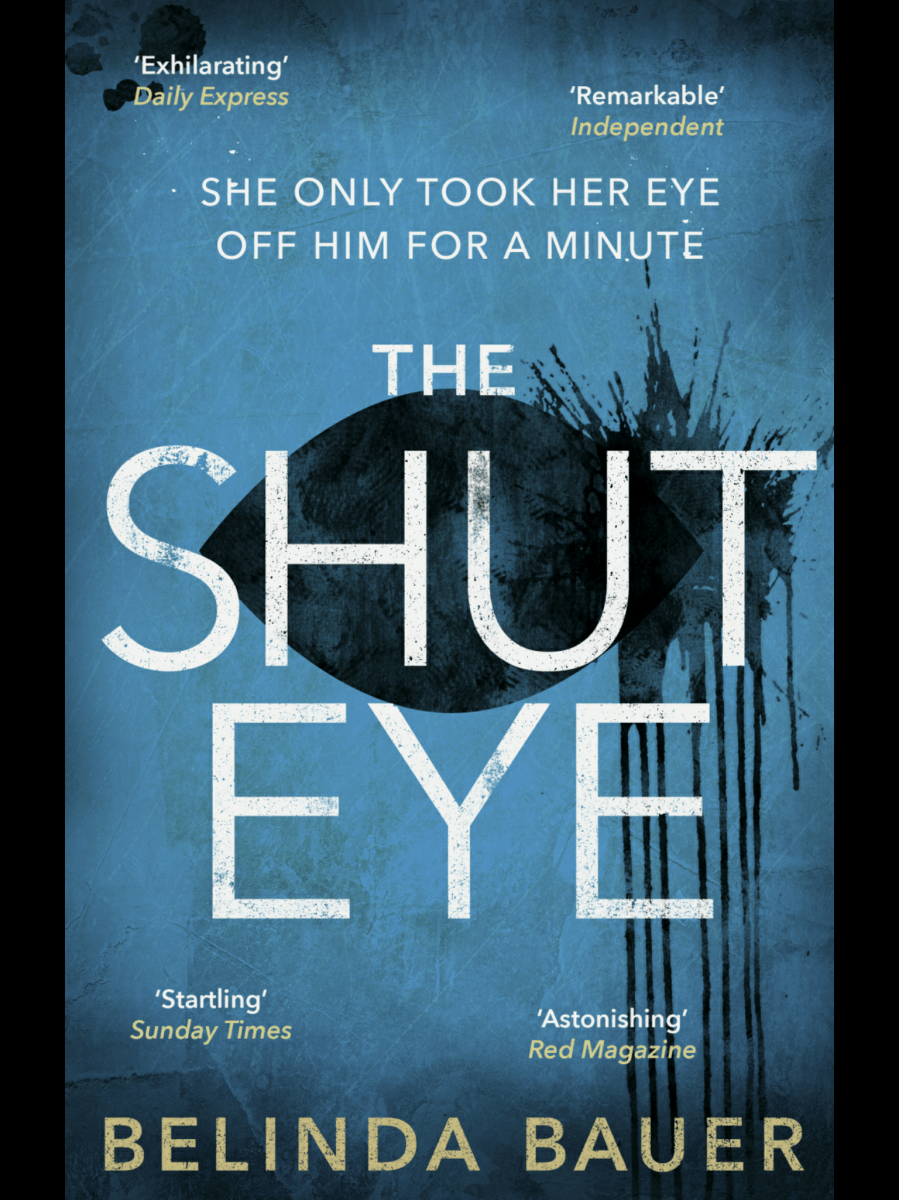
Anna can’t bring herself to end it. Instead she spirals toward insanity while she sits on the pavement outside her house and polishes five tiny footprints embedded in the cement, protecting them from passers-by. Her son Daniel disappeared and the footprints are all she has left.
DCI Marvel is a curmudgeonly detective who hates most people but has a uncharacteristic empathy for the missing and murdered. His mood takes a turn for the worse when he’s assigned to look for his bosses wife’s lost dog.
Anna and Marvel meet when Anna is trying to throw herself off a bridge. When Anna goes to a psychic for help to find Daniel, she meets the owner of the missing dog and decides to help the cynical Marvel find it. Then things take a strange turn.
English crime writer Belinda Bauer brings her characters to life by exposing quirky details about the absurdities of life and then weaving them with human tragedy. She has a knack of making the almost unbelievable plausible and times you’re not sure whether to laugh or cry. Her prose flows in a way that is easy to digest and draws the reader into the characters.
The first Bauer novel I read was Snap, short listed for the Man Booker Prize in 2018. Snap was a page turner that surprised and delighted with its offbeat, idiosyncratic characters and made me an immediate fan. I must admit I wondered if I would enjoy her earlier novels as much given I seemed to have started with the best. I’m pleased to say The Shut Eye did not disappoint and I’ll be delving into more of her work in the future.