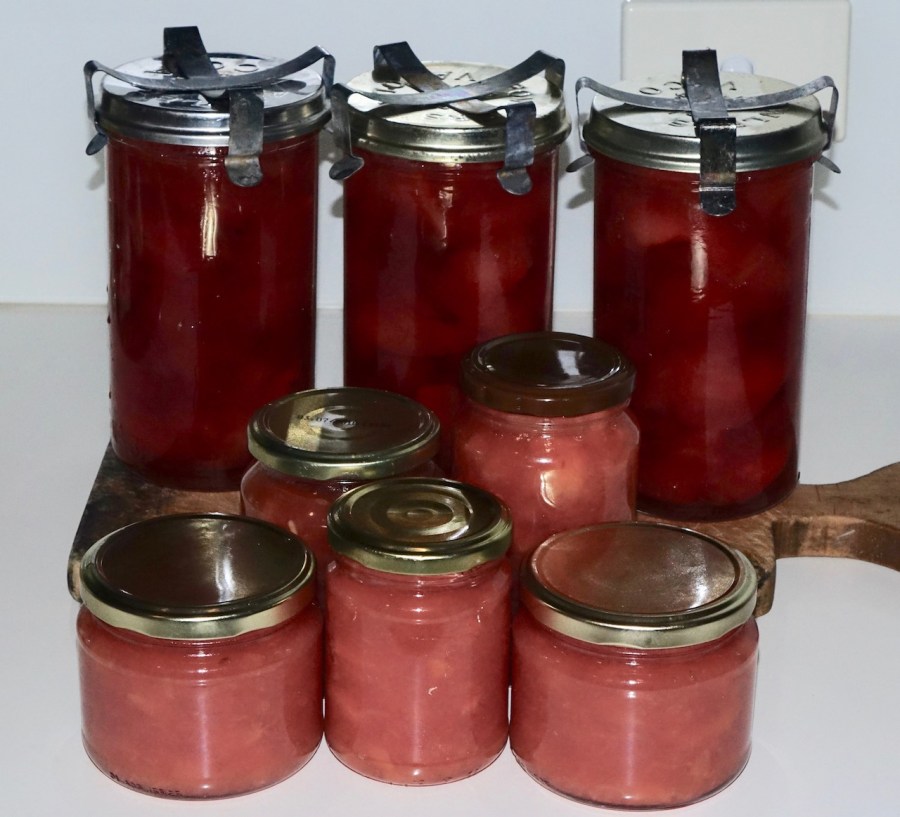
Three large jars of preserved quinces and five small jars of quince jam. Home made

Preserving my sanity

It’s blowing a gale this morning. I live atop a north facing hill surrounded by bush land. I listened to the sound of the wind screaming through the treetops and rattling everything not tied down in the night until I could take it no more and closed the windows against the noise. It’s unseasonal for autumn in Melbourne which is usually characterized by morning fog clearing to fine, sunny days. A good day to stay indoors and deal with that pile of quinces in the fruit bowl.

I provided a commentary on poaching quinces in my Easter post. This time I’m going to move onto preserving. I currently have 22 fruit and nut trees in the garden as well as a sizeable vegetable patch. My mother in-law dusted off and donated her Vacola kit to me when it became evident that my frenetic gardening was going to produce more produce than we could possibly eat.

The Fowler’s Vacola system uses glass jars, rubber sealing rings and metal lids secured by tension clips to vacuum seal the contents. The Australian system was developed in 1915 – and looks like it. Whenever I get it out I feel like I should be wearing a hobble skirt or harem pants a’la Paul Poiret (who made a great contribution to freeing women from corsets). The fashion of the time was heavily influenced by World War I and the women’s suffrage movement and was a pivotal moment in the emergence of modern fashion.

George Fowler was a soldier who served in the British Royal Army Medical Corp as well as the Regular Army.  George clearly didn’t think much of the battle field quzine offerings and invented field cooking stoves and registered new patents for a food bottling and preserving system. His nephew Joseph Fowler came to Australia in 1912 to set up his own bottling business that grew to become the iconic Fowler’s Vacola Pty Ltd.  Fowlers  advertised ‘bring progress to your home by installing a Vacola bottling outfit‘. I can attest that despite feeling like I’ve gone back in time when I wheel out my Vacola, it has actually driven progress. I can now have home grown fruit and vegetables all year round and have almost no waste.

While the wind was blowing I preserved quinces. I used Fowlers preserving jars for this, but you don’t need to have a Vacola itself, just the jars.

Ingredients:

  • 3 large quinces (multiply the recipe if you have more)
  • 300 ml white sugar
  • 300m warm water to dissolve the sugar

Method:

  • Place the whole quinces in an oven dish and bake at 160 C for 2.5-3 hours until the skins blister. Remove from the oven to cool.
  • Wash and sterilize preserving jars and lids
    To make the syrup dissolve the sugar in the water in a large saucepan and boil it until it thickens
  • Cut open the quinces and discard the peel, core and seeds and cut into large slices
  • Add the quince slices to the syrup and simmer for 10-20 minutes
  • Fill the warm sterilized jars with fruit and syrup, seal and keep somewhere cool for a delicious winter dish with porridge or yogurt.

Image: Preserved quinces and quince jam

Sign for second hand store "objects of desire" Istanbul

The writing odyssey begins

Odyssey: a long and eventful or adventurous journey or experience
– Oxford Dictionary

And so it begins. The ancient Greeks spoke of a time when heroes walked the earth performing superhuman endeavors, fighting monsters and consorting with the gods. They made up stories of men and women – neither gods nor humans – who became the heroes of Greek mythology.

Odysseus, the hero of Homer’s epic poem Odyssey, tricked the Trojans into bringing a giant wooden horse inside the walls of Troy. His army defeated the enemy and ended the Trojan War. In the epic Greek poem Odysseus spent many years traveling home from the Trojan war encountering monsters, cannibals, drugs, alluring women and he even visited the afterlife.

I have twelve months off work and I have noticed among friends and colleagues a hint of  expectation that like Odysseus I will set out an an epic adventure. Each year my annual leave has taken me on some new adventure around the world so surely a long break is the perfect opportunity for an extended trip. When I told people about my leave the immediate response has most commonly been where are you going? When I announced I was mainly staying home their faces often folded into confusion and disappointment. Who takes all that time off work to stay home right?

Yesterday was my last day of work for the year. I have decided to spend my time at home to focus on writing (try to finish that crime fiction novel I started two years ago) and my garden (finish all those half completed landscaping projects) – two of my passions. Other than a few short breaks this time will be an internal journey to learn new skills, flex and build my writing muscle and discover where my imagination can take me. That decision feels just right at this point in time. Building and launching this website and writing a weekly blog is also part of the plan. Follow me if you dare…

Image: Istanbul, Turkey

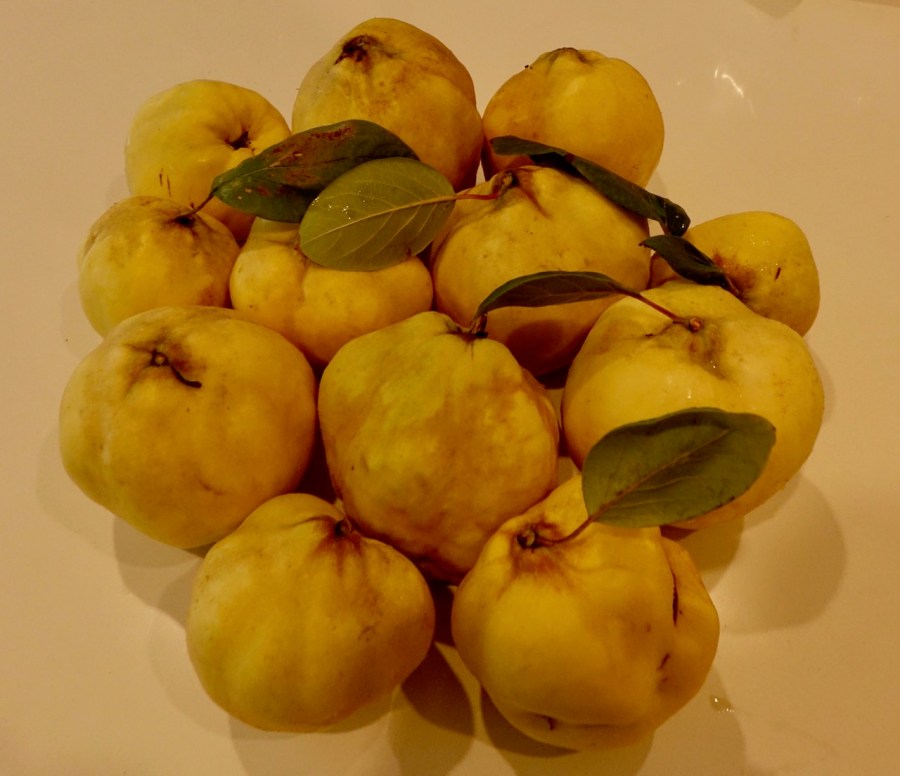
12 fresh picked quinces arranged in a circle

Old food

Never one to shirk a challenge, I took up surfing aged forty-nine. It all started on a romantic week away to Byron Bay for my partners birthday. We tried hang-gliding but found it a bit boring as we could only be passive passengers.  Then we went for a surf lesson and were hooked. We stumbled across this guy called Rusty Miller who taught surfing at The Pass. Rusty is in his seventies and originally from California. He was a world champion surfer and is a great teacher as well as a politically astute and fascinating man. He runs a surf school with his daughter Taylor who is also a great surf teacher. That trip was the start of an annual winter pilgrimage to the iconic Byron Bay to learn to surf on the long, slow, reliable warm water waves.

Easter weekend is exactly three years since those first surf lessons with Rusty and we took our boards and headed down to Anglesea on the Great Ocean Road in Victoria with some surfing buddies. Easter brings with it a big moon and king tides which drive large rolling waves. My Liquid Shredder surfboard, fondly referred to by a friends husband as the ‘floating footpath’, is an advanced technology soft hybrid long-board made in Peru. It’s easy to ride and can handle any surf that I can. On those big waves rolling in, I hang on for dear life as the board is caught and rushes forward with the wave, then I get to my feet as it gathers momentum. It’s such a thrill and a great way to play. Who says you can’t teach old dogs new tricks I say.

Speaking of old, the quince tree in my garden was full of ripe fruit at Easter. Quinces were highly prized by ancient civilizations though I only discovered them fairly recently after I planted a tree in my garden. The tree itself grows like a image in a Dr Seuss book. It produces the most beautiful delicate white-pink flowers in spring followed by giant yellow woolly fruits that have a surface as irregular as a boxers nose. I always preserve some of them, but we were having friends from Torquay over for brunch over Easter so I took a bag of quinces with me. There is nothing quite like the aroma that slow poached quinces infuse throughout the house. They develop a great pink-red color as they cook and are delicious served with Greek yogurt for breakfast.

Ingredients:

  • Six large quinces
  • 1 cup rice malt syrup and six cups of water or equivalent volume of sugar syrup (two parts water to one part sugar)
  • 3 tbsp lemon juice
  • 3 cinnamon sticks
  • 1-2 vanilla beans, split and seeds scraped
  • 12 cardamom pods, bruised
  • 24 black peppercorns

Recipe:

Place all the ingredients except the quinces in a heavy baking dish. Bring slowly to the boil over a medium-low heat, stirring to dissolve the syrup. Peel the quinces (keep the peel) and cut each into 6-8 wedges, leaving the core intact. Add the quince to the syrup in the pan. Tie the peel in a piece of muslin and add to the pan, pop the lot in the over on 150 C for three hours until the quinces are soft and a rich red color. Serve the quinces with Greek yogurt and a drizzle of the poaching syrup. Sprinkle with pistachios and cardamon.

What’s your favorite quince recipe?

Image: Quinces from my garden

Microphone, Art Gallery of South Australia

Listening for inspiration

Discovering podcasts and audio-books was a revelation to me. Suddenly I could listen to a book or a favorite program out walking, gardening, driving the car and commuting to work. I could catch up on my favorite shows that I had missed and when my eyes were too tired from looking at a screen I could lie on the couch and someones silky voice would read to me. It reminds me of my parents reading to me at night as a child when I went to bed.

I wrote about writer skill building in my post on writing resilience. Podcasts can be a great (free) way to learn about writing and hear from more experienced writers how they go about their craft and what motivates and inspires them. You can also keep up with the latest books published.

My favorite podcast at the moment is So You Want to be a Writer. I discovered it when it was already in its third year, so have been binge listening on my way to and from work. Valerie Khoo and Allison Tait have a great formula with their show. These two writers make an entertaining and informative hosting duo. Their show delivers news, advice and tips on writing, writing tools, publishing and blogging. They interview a writer for each episode and their approach is both inspiring and motivating. Each show includes show notes and references published on the website.

For crime fans Valerie also hosts a pop-up podcast called Murder and Mayhem that explores the authors who bring us, well murder and mayhem. The authors they interview provide tips to improve crime and thriller writing. You can also get a free companion ebook linked to the series from the Australian Writers Centre website.

Other podcasts I enjoy include:

  • The Garret – cross genre program exploring how successful writers start, draft, complete and market their writing. Show notes and transcripts are published for each episode on website.
  • The True Crime Sisters Podcast – sisters Harry and Bill explore the touchy and tricky subject of true crime using cases from Australia and New Zealand. The series is supported by a blog.
  • Unladylike – Adele Walsh and Kelly Gardiner talk with women and non-binary people about writing and reading. The podcast focuses on women and non-binary people in all aspects of writing and publishing and the processes they use for thinking, planning, plotting, research, drafting and editing their writing.
  • Partners in Crime – English podcast for crime fiction fans
  • Writer Types – an American crime and mystery podcast series that interviews authors, industry professionals and provides book reviews
  • Writing Excuses – short (15-25 minutes) fast paced educational podcasts for writers by writers.
  • Grammar Girl – quick and dirty tips on grammar – can always improve on grammar
    The Bookshelf – ABC Radio National – to keep up with the latest fiction

All the podcasts listed can be downloaded via the podcast app or check out the links above to the websites linked to the podcasts.  I’ll also add to the list on my links page as new podcasts grab my attention.

Image: Art Gallery of South Australia

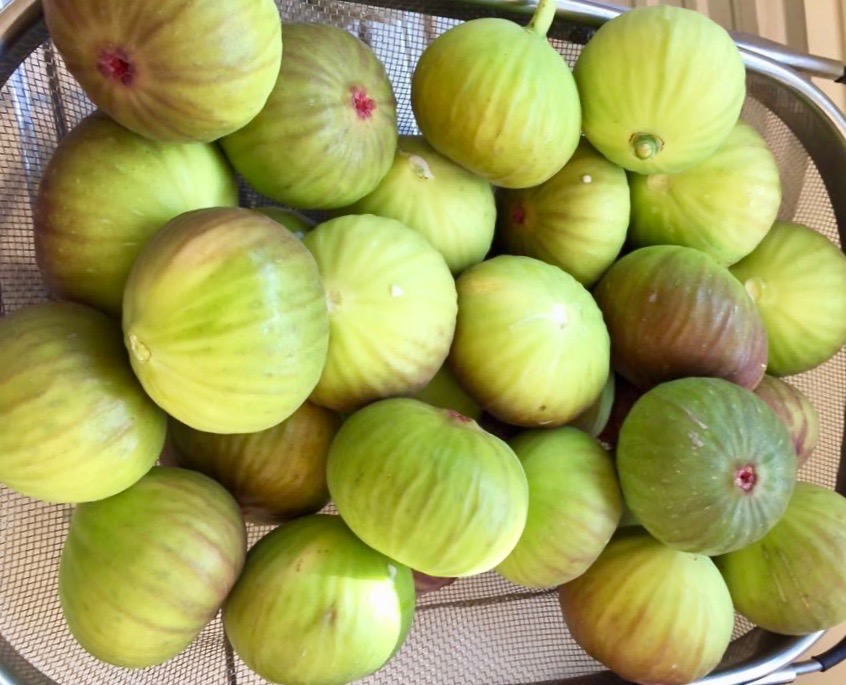
Collander filled with lots of fresh figs

Fig that

In his poem Figs D H Lawrence wrote

“The proper way to eat a fig, in society,

Is to split it in four, holding it by the stump,

And open it, so that it is a glittering, rosy, moist, honied, heavy-petalled four-petalled flower.”

The fig tree in my garden is laden and it delivers over ten kilograms of fruit. More than I could ever consume by Lawrence’s method.  I’ve been on the hunt for 101 ways to eat and preserve figs as one does when there is an abundance of produce. This has included fig, tomato and prosciutto tart; fig and walnut bread; fig compote; burnt fig jam as well as dried figs and fig leather in the drier. For leather cut up the figs and turn to mush in the blender. Spread on kitchen paper on the drying trays and leave on over night. Great for a sweet snack – just don’t eat too much at once.

When I go travelling I love to learn as much as possible about the local food culture and cuisines. A great way to do this is to eat your way around town on a walking food tour which many places have or to attend a cooking class. When I visited Turkey a few years ago we did three of the walks hosted by Culinary Backstreets to get immersed in the local food scene. We also went on a kebab crawl to try and find the best kebap seller.

Turkey is the biggest producer of figs in the world and at the right time of year their distinct perfume wafts through the streets of Istanbul. A days cooking class in Istanbul taught me how to make some mouth watering Turkish dishes including fig and walnut desert.  This is the recipe.

Incir Tathsi (Walnut stuffed figs in syrup) – serves 6

Ingredients:

  • 12-18 dried figs (kuru incir)
  • 100g Walnuts (ceviz)
  • 1/2 lt/1 cup water (su)
  • 250g lemon (limon)
  • 12-18 cloves (karanfil)


Preparation:

Prepare a syrup by bringing the water, sugar, cloves and lemon (squeeze the juice and throw in the peel as well) to the boil.

Meanwhile, stick a little knife into the side of a fig and cut through to a little beyond the centre, then turn the knife in a way that a little less than half of the fig gets opened on its side (big enough to stuff a walnut half inside). Stuff the opened fig with half a walnut, the bulbous side of the walnut under the stem of the fig. Close back up, making the sides stick back to each other. Repeat procedure for all the figs.

Add the figs with their stem up to the boiling syrup (just covering). Simmer for about 30 minutes. Turn them mid-way through the cooking process and then turn again 5 minutes before the end to give them some colour on each side. Take off the heat and let hem cool in the syrup. Transfer the figs to plates plate, leaving behind the syrup. Decorate with ground pistachios and/or grated coconut. Serve at room temperature with kayak (heavy Turkish cream) on the side.

Variation: add Turkish tea and bay leaves to the syrup.

What to do with the leftover syrup:

  • Figatini: Cool and shake over ice with vodka (half/half) – tone down with soda water if too sweet. Serve in a shot glass next to the figs.
  • Boil down into a sweet thick sauce and drizzle over things that are not too sweet such as yoghurt, porridge, a fresh white cheese, pancakes, fruit tart, etc

What do you do with your figs?

Image: Figs from my garden

hair art at WOMAD 2015

Music to my ears

In March each year I make the pilgrimage to Adelaide to the alternative universe that is WOMADelaide (World Music, Arts and Dance Adelaide). It’s a four day global music festival in Adelaide’s Botanic Park. I usually don’t know most of the bands and there are always several new discoveries for me that get added to my play list. Without WOMAD I would not have found the desert sounds of Aziza Brahim whose roots are in the Sahrawi refugee camp in Algeria, the indie pop of Lake Street Dive and the uplifting South African a cappella group, The Soil. All of whom have enriched my music collection.

When the Adelaide thermometer is turned up high, WOMAD can be tough and dusty. There are times when you need to find a shaded spot away from the crowds and stimulation to chill out. The park provides plenty of beautiful big old trees under which you can park yourself and do some writing.

I generally prefer silence when I write, but have spent most of the last two years writing on the bus on the way to work and have learnt to detach myself from background noise. A creative space, like a music festival, can be quite stimulating for the imagination also. One day I will set a story at a festival I expect.

Many writers have found inspiration away from the desk. Gertrude Stein often wrote from the drivers seat of her Model T Ford, Agatha Christie liked to plot in her Victorian bath eating apples and my personal favourite Sir Walter Scott penned his epic poem Marmion whilst riding his horse through the Scottish hillside.

Some writers require a very specific environment in which to work, some must have silence, some noise. The writers idiosyncrasies about the place where they write is curious given that when fully absorbed and writing well the place disappears into oblivion altogether. One wonders if it is the place that creates the ambiance for writing or the writers superstition that they can only find their creative muse in a particular environment that drives attachment to a setting.

Perhaps it is the simple act of creating a routine and habit that is the key to a writers creative and productive endeavors and the place and physical trappings are simply props. As EB White, the author of Charlotte’s Web famously said, “The writer who waits for ideal conditions under which to work will die without putting a word on paper.”

Where do you like to write? What are your rituals and habits? How and why do they help your writing?

Image: WOMAD 2015

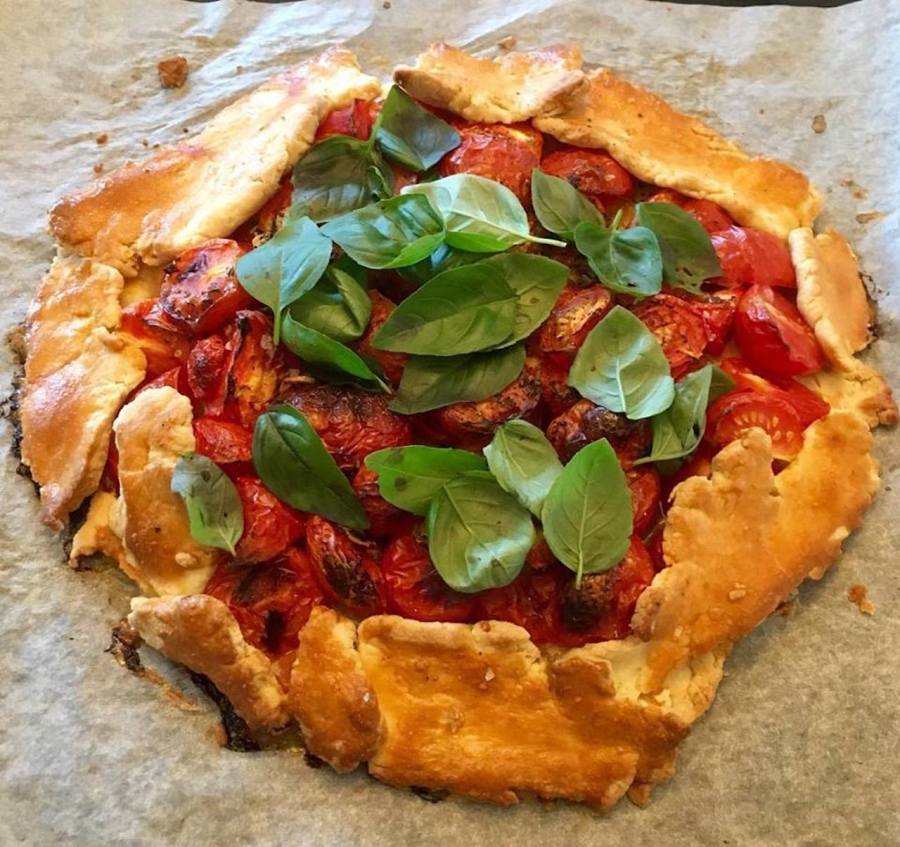
Homemade rustic tomatoe pie with fresh basil

What’s the difference between knowledge and wisdom?

Knowledge is knowing a tomato is a fruit. Wisdom is not putting it in a fruit salad. An oldie, but a goodie. Essentially if it has seeds, its a fruit (tomatoes, olives, cucumbers, legumes as well as apples and pears). Vegetables are the non-flowering bits like leaves (spinach and kale), roots (carrots and turnips) and tubers (potatoes). We tend to talk about fruit and vegetables more from their culinary use – vegetables are savory, fruits are sweet, but botanically speaking this distinction is not correct. Confusing, I know.

Speaking of old, I discovered the pure joy of growing bucket loads of tomatoes when I discovered heirlooms. There are so many varieties, from bite size cherries to big whoppers for hamburgers. A personal favorite, at least aesthetically, is the black and red (pictured in an earlier post). I can’t go past a yellow tomato to add an extra sweet taste and color to a salad, and as a crime fiction lover my personal name favorite is the Tomato Ananas Noir, because who doesn’t love a noir right? The Noir is huge and delicious, just like a good book, and gets darker as it ripens. The tomato even wrote its own thriller back in the middle ages. Wealthy people often ate from pewter plates, but items with high acid content like tomatoes made lead to leach into the food, causing lead poisoning and death. Tomatoes were considered toxic for about 400 years after that.

Of course growing bucket loads of tomatoes, one needs to find creative ways to serve and preserve them. There’s nothing quite like eating paddock to plate, but it does require research to fossick out new recipes so you don’t feel like you are eating the same meal three times a day, day in, day out. My most recent new find was the shortcrust tomato pie. Easy to make with a nice rustic finish (pictured).

Shortcrust tomato pie

Oven temperature: 220/220 Celsius fan-forced

Pastry:
• 2 cups plain flour
• 150g butter
• 1 egg yolk
• 2 tblsp chilled water

Mix flour and butter in  a food processor till it resembles breadcrumbs.  Add egg yolk and chilled water.  Process until the mixture almost comes together.  Add a little extra water if needed.  Place dough on a lightly floured surface and knead until smooth. Roll out the dough between two sheets of baking paper to about 30cm and refrigerate for 30 minutes on a backing tray.

Pie:
• 1 tblsp olive oil
• 1 clove garlic
• 1/2 tsp mixed dried herbs
• 1/3 cup grated parmesan cheese
• 450g small tomatoes (I use cherry or other small varieties and cut in half)
• 1 lightly beaten egg
• basil leaves

Combine the olive oil, garlic and herbs in a small bowl.  Sprinkle the parmesan over the pastry, leaving a 3cm border. Arrange the tomatoes over the parmesan.  Spoon the oil mixture over the tomatoes and fold the pastry edges in over the filling.  Brush the pastry edge with egg and season the pie with salt and pepper.  Bake in the oven for about 30-35 minutes until the pastry is crisp and golden and the tomatoes are tender. Sprinkle with basil leaves and serve.

What’s your favorite tomato dish?

Image: Shortcrust tomato pie

Pile of books on the floor at the Tasmanian Museum and Art Gallery, Hobart

Jane Harper: a resilient writer

I can report that I have successfully returned to bike riding without further incident. Sylvie (the new bike) is a great ride, and faster than my old one. Though I am being more cautious around that fateful corner the thrill of the ride has been restored.

Speaking of thrillers I have just finished binge reading The Dry and Force of Nature by Jane Harper. Both were definitely page turners for me. The Dry was dark and frightening, though not overly graphic. That part is left to the imagination. Jane wrote believable three dimensional characters that really gave the stories depth and presented an authentic rendition of the Australian bush and country towns. I love rural Australia with its great sense of community and harshness. I spent years living in the Victorian country side and I was convinced by her portrayal of it.

I was surprised by Force of Nature. Even though I disliked nearly all the characters, except the protagonist Falk, I still couldn’t put the book down. To keep people reading characters they don’t like is quite an achievement. I work in an office environment these days and no one likes a team building event. Force of Nature takes team building and turns it into your worst nightmare, being lost in the wilderness with a bunch of people you can’t stand. Its entire story is injected with creepiness by the insertion of the threat of a Milat style serial killer. The story keeps you guessing right to the end.

Admittedly Jane Harper has had what at least on the surface seems like a dream run, but in listening to interviews with her she clearly took a pragmatic and strategic approach to learning her craft and getting the work done. Dare I use that word resilience again?

Despite being an experienced journalist, when she decided to write a novel, Jane signed up for a 12 week online writing course in part to keep herself motivated and create some deadlines. No doubt the course also taught her much about the craft and skill involved in writing a novel as opposed to straight journalistic writing. A writing course can also create an instant writing community from which discussion can promote further learning and inspiration. Jane comes across as being extremely organized and disciplined, great attributes for a writer to ensure they sit down day after day to get the work done. She was still working as a journalist by day so had to snatch time in the evenings and weekends to work on her novel.

Jane has also noted in interview that she set out to write the kind of book she likes to read – great advice for a beginner author. She entered the unpublished manuscript in the 2015 Victorian Premiers Literary Awards as another learning experience for herself, and won.  She does not describe herself as a naturally gifted writer but clearly has the ability to apply herself to a task with pragmatic vigor. She is conscientious, hardworking and seeks to learn the fundamentals. In other words she is what I would call a great model of a resilient writer.  What writers do you admire for their approach to writing?  What is it about them you admire?

Image: Tasmanian Museum and Art Gallery, Hobart

ripe grapefruit on espaliered tree

Grapefruit

Chinese New Year and the Spring Festival officially begin today.  The zodiac system has existed in Chinese culture since the Qin dynasty, more than 2,000 years ago and 2018 is year of the Earth Dog. The Dog occupies the eleventh position in the Chinese zodiac, after the Rooster, and before the Pig.

Zodiac signs play an integral part in Chinese culture, and can be used to determine your fortune for the year. The Spring Festival was originally a ceremony to pray to gods for a good planting and harvest season. Like any good festival, food plays a central role. The exotic giant citrus, the pomelo, an ancient ancestor of the grapefruit holds a place of honor on the New Year table. The pomelo symbolizes prosperity and hope and is presented with leaves and stems in tact to ensure wholeness and balance.

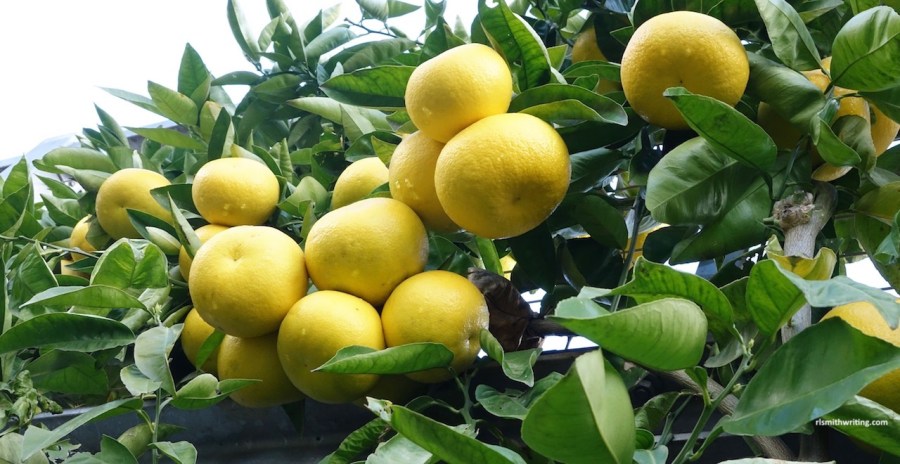
I bought what I originally believed to be a grapefruit some years ago, but am suspicious its actually a pomelo due to the massive size of the fruit with thick pitted skin.  Though the fruit does grow in clusters like a grapefruit. The answer is possibly academic due to the close relationship between the two species. The pomelo looks like a grapefruit on steroids and is a non-hybrid citrus native to South-East Asia. The grapefruit is an accidental hybrid between the orange and pomelo originating in Barbados. China is one of the top producers of both.

I planted my grapefruit/pomelo facing north and espaliered it into a green wall that reaches some 4-5 metres from the ground to a deck which I can step onto and pick the high fruit.  I can also enjoy the beauty of the giant yellow orbs from the lounge-room. The tree is prolific, though only fruits every second year, probably due to the exhaustion of its alternate production. The fruit cling to the tree like great yellow balls for months. I only picked the last one in early April. I like to leave them on the tree as long as possible as they become sweeter with extended ripening and make a great breakfast juice. On hot days one must be wary walking past the tree in case it casts one of its fruits off onto your head. Death by grapefruit would be a bitter way to go!

I have not ventured past juicing or eating the fruit whole, but believe they are a great with salads (avocado, red onion and spinach) or segments added to fish before its baked. What are your great fruit (grapefruit) ideas?

Image: espaliered grapefruit/pomelo


pencil sketch of bike rider being attacked by Australian wildlife

Writing resilience

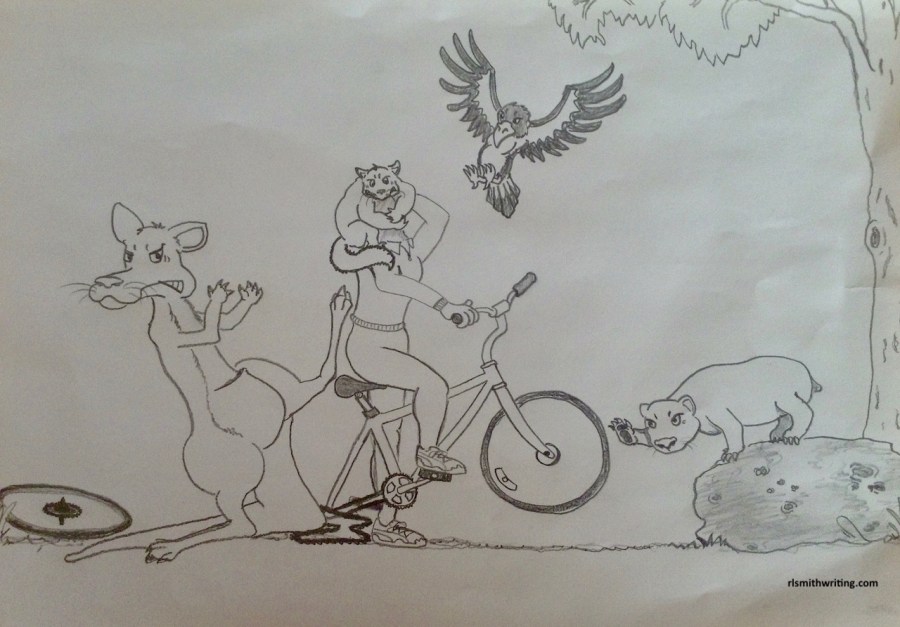
I fell of my bike three weeks ago. Well actually I was going too fast around a gravelly corner, lost the back wheel and skidded along the ground like a car on black ice. Except it wasn’t ice, it was gravel and my bare skin. That particular corner had claimed me before, but this time it was different. I sat on the ground until the initial shock passed and then got on and rode the rest of the way to work. I arrived covered in blood and people looked at me, cringed then turned away. The first aid officer at work patched me up and advised medical care, so I went to my doctor. The damage included opening up my knee and elbow and gravel rash down one side of my belly. The knee was stitched, but the elbow was too messy for stitches. The doctor scrubbed out the gravel under local anaesthetic and I had to go back every few days for three weeks to have it cleaned and the bandages changed. It also turned out I cracked the forks on my bike.

I cycle to or from work most days – about 30km. The first part of my route winds along the Yarra river through bushland inhabited by kangaroos and wombats that open up to fields with grazing cows and horses. There is a bridge I cross where I often see a platypus in the Yarra River. I move through the morning bird choral and hear frogs croaking as I cycle past billabongs.

For the second half of the ride I zip past people sitting in traffic in their cars and ride down Brunswick street where people hang out drinking coffee at Marios. I pedal past the housing commission flats and the people congregating outside St Mary’s House of Welcome waiting for breakfast, then past St Paul’s Cathedral and into the city proper. I pass the court precinct where nervous young men, uncomfortable in suits, smoke cigarettes and wait for their hearings, and through the red light district which is always quiet in the morning. I turn the last corner and get the blast of wind coming from the docks that sweeps away any lingering inertia.

I have had about one accident a year, none of which have involved cars. They have either been due to my own carelessness (recklessness?), or run ins with wildlife. I have been knocked off by a wombat on one occasion and a kangaroo on another.

Tomorrow I go to pick up my new bike. A silver lining after the last few weeks of discomfort, which brings me to what I wanted to write this blog about. Resilience. It was resilience that enabled me to get up and ride to work after the crash and it is resilience that will enable me to mount my new bike, battle scars healed and start riding to work again next week focussed on what I love about it, though perhaps with a little more caution around that tricky corner.

Writing is a practice that requires resilient thinking, particularly if we decide to take up writing novels. Writing is a long haul process and practicing resilience means we need to be in it for the journey, not just the destination. We need to be prepared to challenge and to tame our monkey mind in order to stay the course. Monkey mind is what the Zen Buddhists call the constant internal chatter that creates catastrophic ‘what-if’ scenarios, magnifies our fears and hurts, messes with our concentration and causes us to behave in ways that are less than our ‘best selves’.

Self Doubt is where the monkey mind really comes into play and you need resilience to manage it because it can be extremely persistent and unpredictable. Like when that magical writing fairy becomes elusive. It can be easy to catastrophize that your imagination has dried up never to return. You might as well give up. Self doubt leaves us sitting in front of a blank page or not even sitting down at the page at all. It takes resilience to keep going, even when what you write is crap. But if you push through just on the the other side of the crap is where the good stuff is.

Self doubt is good friends with procrastination. Your writing is not good enough yet – to go onto the next section or to let anyone else read it. Procrastination leaves us stuck in a perpetual loop of starting and never finishing like ground hog day. At some point you have to call it complete. Try entering some short story competitions with deadlines, its a great way to learn to finish. Welcome constructive criticism without being defensive or taking it personally. You will learn the craft of writing faster if you are open to feedback, particularly from those more experienced than you. If you take it personally or get defensive that monkey mind takes over very quickly and will fill you with self doubt. Make failure your friend. Think of it as a learning experience rather than an excuse to collapse into yourself. Remember that he who never made a mistake, never made a discovery.

You need perseverance to keep turning up at the desk and writing. To make writing a habit and sit down (or stand) every day, sometimes for many years, including when you don’t feel like it, to pump out those words. Because doing it day in, day out is the only way to get it done. Even if it’s only fifteen minutes at a time.

Bet you thought you could already write when you came up with your story idea right? Trouble is an idea isn’t a tightly woven plot, well developed characters with layered backstories, realistic dialogue, tension and conflict, and the right balance of description and action. Those are skills that you learn. An idea is a seed that needs to be planted just right, watered, fed, pruned and nurtured. Or it won’t bear good fruit. And you need to know exactly the right time to harvest it. That takes skill. Don’t be afraid of being a novice. Be open to learning and seek out guidance to learn what works and what doesn’t.

It takes perseverance to keep going when you get to the end of the first draft, only to realise that it is just the beginning. If you want to get published, a first draft won’t cut it. Your work has to be the best it can be and that means revising and redrafting over and over. Did I mention ground hog day already?

To try again, and again, and again in the face of rejection requires resilience. We invest so much of ourselves in our stories that rejection can feel like a personal blow. It isn’t. It could be a range of things. Your story isn’t the cup of tea of the reader, they are having a bad day, there were thousands of submissions and some of them were just more suited to the publication than yours, or maybe you still have some learning and polishing of your craft to do. And that is OK. I turned it into a game. I keep a spreadsheet of all my submission (yea, I’m a bit of a geek) and I collect the rejections as well as the acceptances. This is what it tells me. In four years I have made 64 submissions of poetry and short stories (wow that’s 16 per year – more than one a month on average) and I’ve had seven acceptances (that’s just under an 11% success rate). I’m pretty happy with that. It tells me I’ve worked hard and had some recognition for it – and this practice has helped me grow a thicker skin.

Writing is a lonely sport and it’s good to have someone in your corner cheering you on. Connect with other writers. Go to festivals, join a writing group in your town, listen to podcasts or engage with other writers on social media. These interactions, no matter how fleeting, can be motivating, inspiring and contribute to building our skills and our resilience. And you might make some great new friends.

Wow, this post is already much longer than I intended. What tips do you have for being a resilient writer? I’m off to get back on my bike.

Image: sketch by Peter Rode of me being attacked by wildlife