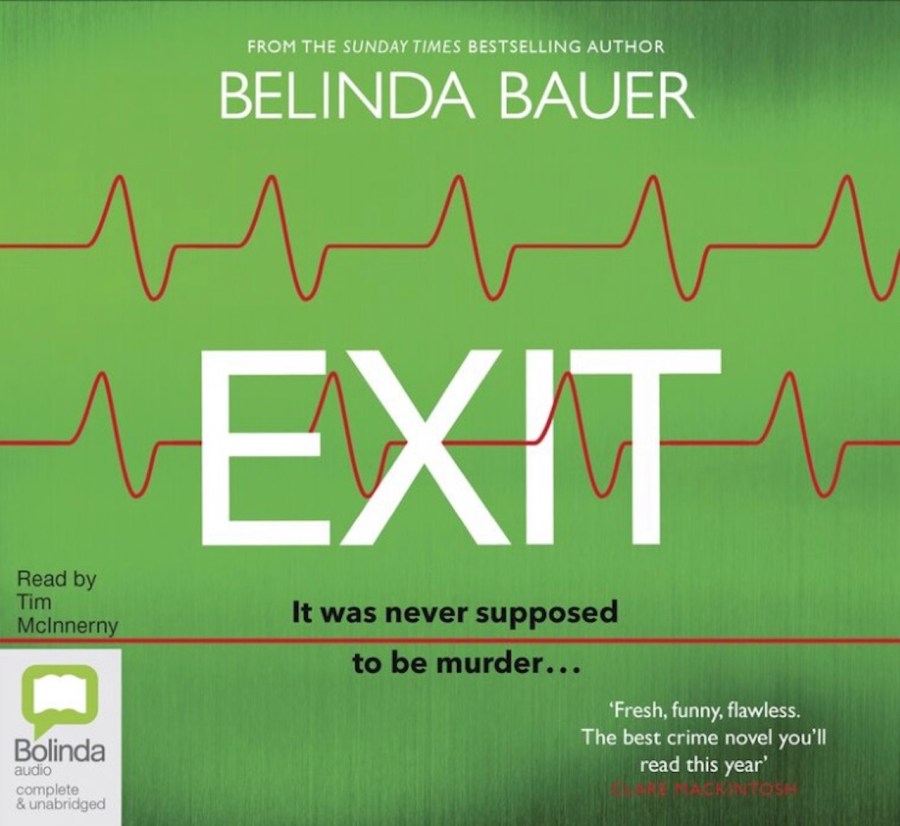
Candice Fox, The Chase cover image

Book review: The Chase by Candice Fox

Candice Fox, all-around good guy, champion of emerging writers, writer of creepy thrillers. I’ve been a fan of Candice Fox since reading her first novel, Hades. Her crime novels are fast-paced and brimming with big bold characters doing outrageous things. She takes us to the limits of believability and holds us there, peering over the cliff face.

The Chase is set in the USA and I suspect Americans are the primary audience for the novel, though perhaps American culture simply allows Candice to take things a step further.

Every year Proghorn Correctional Facility had a Christmas softball game between the wardens and the inmates.

The warden’s families come on a bus through the Nevada desert to make a day of it. This year they are held hostage under the gaze of a sniper in order to free the entire prison population, some of the most dangerous in the country. The incident prompts the biggest manhunt in history. The novel takes the reader on a journey with some of them.

Celine Osbourne is in charge of the death row prisoners. She takes her job, and the break out very seriously. She’s also obsessed with one prisoner in particular and makes it her mission to track down and capture John Kradle.

She pinched the tobacco between her thumb and forefinger, flicked out the rolling paper with a touch more flair than she probably needed to, and laid the little caterpillar of brown fibres down in its thin, dry bed. Three boys, all cousins of hers, crowded in to watch her lick and roll the cigarette. Celine put the smoke to her lips and lit up. Their eyes were big and wild with excitement. It was a thrilling display on many levels. They were all farm kids, and lighting a match for any reason in a barn full of hay was like flipping the bird to Jesus Christ.

John Kradle had been on death row for five years after being found guilty of murdering his family.

He didn’t believe in all the ghost stuff. But he showed up anyway. He figured that was what you did when you loved someone. You nodded and laughed and chipped in with a ‘She’s right, you know. I’ve seen it!’ occasionally.

The breakout is Kradle’s one chance to set the record straight, prove his innocence. Trouble is, a serial killer and Celine are on his tail.

Kradle put his hands on the table, stared at them, and felt a wave of relief roll over him. A part of him had known, in all the years that Christine had been missing, that she had left simply because she was broken. That even if an explanation ever came, it wouldn’t be rational or healing to him.

I could feel the heat of the desert, the desperation, rage and grief of the characters as the complexity of their inner worlds drove their choices – good and bad. The Chase kept me turning the pages and sneaking moments in my day to keep reading. And how lovely to get to the end of find that Candice has dedicated the book to those of us unpublished writers who keep plugging away, hoping that our work will one day find a home.

I have dedicated this book to all aspiring authors. It’s not an easy road. Waiting. Trying. Daydreaming. Being rejected. Having your hopes destroyed and trying to rebuild them. It’s lonely, frustrating, and tedious. But whatever you do, my advice is never to let it become hopeless. Only you have control over that.

Book review: Murder in Mt Martha by Janice Simpson

I’m a sucker for a story set in my home town and this one provides some interesting insights into 1950’s Melbourne.

Janice Simpson was inspired to write her debut novel, Murder in Mt Martha, by the 1953 unsolved murder on the Mornington Peninsula of Shirley May Collins. First published in 2016, this fictional story proposes a potential solution to the open ended real life mystery.

It is sixty years after 14 year old Beverly Middleton was murdered. Nick Szabo is working on a thesis about Hungarian defectors from the polo team that come to Melbourne for the 1956 Olympics. Whilst interviewing an old Hungarian man, Arthur Boyle, Nick stumbles across Arthurs connection to the unsolved murder.

The narrative shifts between 2013 and 1953 and the events leading up to and following the murder.

The story sets a good pace, with well drawn characters, and the complex interwoven story lines hold the readers interest.

Online course reviews

Writing courses can be a great way to learn new techniques, think more deeply about your writing, and motivate you to keep putting ink on the page. Here I review a couple I have completed recently.

Kill Your Darlings: Mastering Emotional Honesty with Lee Kofman

One of the main pieces of feedback I’ve had from editors has been ‘put more emotions and/or drama into your work’. I took this online course to focus a bit of energy on that feedback.

Dr Lee Kofman, who delivers the online course, is a Russian-born Israeli-Australian author of five books and editor of two anthologies. Kofman unpacks the complex and hard task of writing with emotional honesty and helps you discover the rewards of making your writing more prolific and productive.

In the introduction to this course, Kofman suggests a writer should be ‘like a firefighter whose job it is, while everyone else is fleeing the flames, to run straight into them.’ Intellectually safe writing is easier to do, but does not engage readers as effectively – if you want to touch their hearts you have to take risks.

The exercises in this course challenge you to tap into personally emotive events to develop and challenge your writing. It covers concepts such as moral outrage, internal contradictions, sentimentality, nostalgia, emotional complexity and creating emotionally rich complex characters.

Example texts identified in the course include fiction works like Gustave Flaubert’s Madame Bovary; Hanif Kureishi’s Something to Tell You; and memoir including Ann Patchett’s Truth and Beauty and Alice Pung’s Her Father’s Daughter.

KYD courses are good value, well structured short courses with a mix of audio/audiovisual, text, and exercises. Once you purchase a course it is available to you in perpetuity. The learning platform is easy to navigate, so if you are a bit of a luddite you shouldn’t have any trouble.

Australian Writers Centre: Anatomy of a Crime: How to Write About Murder with Candice Fox

I’m a big Candice Fox fan and she’s written about fourteen crime fiction novels so she knows a bit about the genre. I love her bold characters and unpredictable, and sometimes outrageous, but still believable plots.

There is a lot of content in this course. The course has eight modules estimated to take eight hours of study time. However, if you go through all the available resources provided you can go a lot deeper and further than the estimated time to complete.

Candice’s great character writing comes to the fore in the course as she explores the psychology of crime, what makes people kill and what happens after they do. Topics covered include premeditation; types of murder crimes; writing crime scenes; looking for suspects and the killer; making the arrest; trials and prison life.

AWC produces quality content using a mix of audio, audio-visual, and practical exercises. Each course is accessible for 12 months from the date of purchase and AWC has regular specials that make them more affordable.

For other online course reviews see here and here and here.


Ode to a red headed man

I was twenty-four when I first met Mo. He was a gawky red head with a kind eye and a spunky attitude. Despite the fact that he threw me to the ground during our first meeting, I fell for him immediately. He was to be a part of my life for the next 30 years.

Of course Mo was a horse, not a man – in case you were wondering. This post is a tribute to that horse who passed away last week at the grand old age of thirty-two, and who I knew for longer than many of by closest human friends.

Mo was short for Mauclair, named after Camille Mauclair, the French poet, novelist, biographer, travel writer, and art critic. I purchased him a while after returning to Australia from Portugal where I had been a working student for a couple of years under the tutelage of Maestro Nuno Oliveira. Oliveira, one of the last great masters of classical dressage, was taught the art by Joaquim Goncalves de Miranda who trained horses for the last king of Portugal.

We had our challenges, the greatest being that at the tender age of two Mo was a failed racehorse. This meant he had been poorly broken in, trained only to go very fast in one direction, and was whip shy. He bore a scar on one flank that I suspect was the result of being beaten in an effort to make him run faster than he was capable of. I purchased him to teach him classical dressage, the polar opposite of what he knew. To begin with he was like riding a broomstick – rigid and inflexible. I worked very hard to help him unlearn his difficult first years, and we achieved a lot, but his early trauma always remained a shadow beneath the surface.

Over a number of years of doing gymnastic exercises Mo transformed from a weedy upside down nag into a muscular athlete capable of all the basic classical exercises as well as flying changes, piaffer and a little passage. There is a sense of both great lightness and great power when riding a classically trained horse in harmony. That you can direct the movement of a half tonne of beast with the slight shifting of weight, the brush of a heel, or the turn of a head and shoulder, feels like magic because the animal is willing and confident in responding to your requests.

When Mo was twelve, there was a fracture in our relationship. I was riding him on top of a hill in a large paddock when he took fright at something. The incident took me completely by surprise so when he suddenly spun to the left and launched himself toward a tree, I lost my balance and landed heavily on my side on ground baked hard by a hot summer. The excruciating pain that seared through my body made it clear something was wrong. I was about a kilometre away from help.

Whilst I lay gulping air, Mo regained his composure and returned to stand by me, dipping his head as if to ask if I was ok, or enquire as to why I was on the ground rather than on his back.

I gingerly got to my knees and then my feet, using his body to steady myself. Holding onto the horse to keep upright and mustering all my resolve I hobbled delicately to the nearby house, Mo treading slowly beside me supporting my weight. Luckily the homeowner was there and helped me into the house where I lay on the floor just inside the front door feeling like I was going to pass out. I stayed there gasping for air until an ambulance arrived. The morphine the ambos administered was a godsend. After a night in emergency I spent six weeks flat on my back whilst my fractured spine healed.

Eventually I was well enough to ride again. I only got one or two in before Mo injured himself terribly in the paddock, tearing his knee open. I spent many weeks dressing the wound, cutting away the proud flesh and changing bandages. The injury healed, but despite my best efforts the scarring interfered with his joints and he could no longer be ridden.

I took him down to a friends farm near Warnambool where he was well cared for in his very long retirement and became a familiar fixture – known for cantering everywhere he went, his affection towards visitors and sticking his nose in to see what was going on. He was active right up until his last day.

His passing marks the end of a significant chapter in my life. I shall go and visit his grave soon and plant a tree in his honour.

Seeing the Light

One of the things I most missed during lockdown was immersion in the arts. Like reading – galleries, sculpture parks, theatre and music all provide fertile ground for inspiration. Art helps us to see the world through different lenses, challenge our perspective on the world and transports us to different places. I have been to four exhibitions in recent weeks and feel creatively refreshed by the experiences.

Looking Glass at Tarrawarra Museum of Modern Art bought together two contemporary Australian Aboriginal artists – Waanyi artist, Judy Watson and Kokatha and Nukunu artist, Yvonne Scarce. The exhibition was a tribute to, and a lament for country. It reflected Aboriginal history from colonial massacres to Stolen Gernations, climate change and the impact of the Maralinga bomb tests.

Flesh after Fifty explored stereotypes of ageing and celebrated the older female form through photos, painting and sculpture. We are so accustomed to the memorialisation of youth and cajoled into drinking from its fountain at any cost through the media. Older women often talk about being ‘invisible’ and ‘overlooked’, and they do, with a few exceptions, for all intents and purposes ‘disappear’ from public view once their bodies start to wrinkle and sag.

To me, in many ways older people have always been beautiful. I see the lines etched on their faces and bodies as stories. Their creases and scars mark the life that has been lived – a rich source of story and inspiration if you take the time to explore them. It was a refreshing balm to go to a show that celebrated the diversity of the older woman’s form, challenging negative stereotypes of ageing.

One day I got lost in the National Gallery of Victoria Triennial exhibition. A celebration of the porosity and cross disciplinary influences of the creative arts. It was an awe inspiring, challenging visual feast, and at times a little nerve wracking when I found myself caught in the buildings maze unable to find my way out without help from the concierge.

My final drink from the creative fountain was Lisa Sewards Short Stories, an exhibition of printmaking and painting inspired from contemporary Australian short stories Lisa read during lockdown. The exhibition was held at Fortyfive Downstairs, a great art space off Flinders Lane, Melbourne.

I climbed down the steep wooden staircase into the bowls of the building to the gallery and found myself alone. Having time to peruse the stunning etchings and paintings brimming with emotion somehow made the experience much more intense.

The stories that inspired the works included A Constant Hum by Alice Bishop; The Flight of Birds: A Novel in Twelve Short Stories by Joshua Lobb; Nova (a raw manuscript) by Laurie Steed. My personal favourite, because it drew so strongly on emotion (and includes a dog), was The Edge of Tears inspired by Bec Yule’s unpublished Dog walking in the time of Corona, with apologies to Gabriell Garcia Marquez.

It was such a privilege to be able to go back out into the world and fill my creative cup from the inspiration of others. I encourage you to get out and support the artistic community who were hit so hard by lockdown and yet kept on creating. We need artists and their works to help us think critically, connect with the world around us in new ways, and nourish our cultural lives.

Main image: Melbourne Laneway

Book review: The Bird of Night by Susan Hill

The great poet Francis Croft was mad. He drifted between exquisite poetic vision and being overtaken by internal daemons that at times drove him to being either homicidal or suicidal. Harvey Lawson, an Egyptologist, met Francis a few years after World War I at a house party. At a subsequent meeting Francis was in a psychotic state, crying and clawing at his face which he claimed was not his own. The two men developed an intense friendship dominated by Francis’s mental illness, and Harvey became Francis’s protector and carer.

And if he is mad, it is because one man’s brain cannot contain all the emotions and ideas and visions that are filling his without sometimes weakening and breaking down. But he will be perfectly well again, his generally well. When his is not he is in despair and when his is fit he dreads the return of his illness. What can that be like to live with?

The Bird of Night is about love and madness. It is a bleak and tender story narrated in the first person in a journal style by Harvey, now an octogenarian, reminiscing about his relationship with Francis to whom he gave himself over. We know from the beginning how the story ends and there is a deep sadness in his narration that explores the space between genius and madness and the minutiae of how it impacted their relationship.

But understanding was not control. If Francis knew what he was, he could not alter it, he had no power at all over the vagaries and eruptions of his own mind. He was helpless in the face of an attack of insanity, no matter which way it went with him, whether he was depressed or violent, whether he was hysterical, agitated or deluded by visions and voices.

Hill’s book is a beautifully written portrayal of the effects of mental illness and the experience and anguish felt by those who care about a person who suffers. She draws a detailed and exquisite portrait of loyalty, tenderness and the intense disquiet of living with mental illness. The novels sense of place is evocative and the descriptions of the countryside and wildlife provide intermittent relief from the poignancy of the story.

But the cycle of Francis’s madness was never a regular or predictable one. I had prepared myself for days, perhaps weeks, spent closeted in that dismal flat by candlelight, having to comfort and support him through his deepest apathy and depression. Certainly, for the next two days he stayed in bed or sat slouched in a chair looking as though he were half drugged, his eyes blank and all his attention turned inward upon himself. He hardly spoke to me and when he did answer a persistent question, it was with a monosyllable. He would not shave or eat or read, but only sat up once in a while and muttered to his own hands. “It’s all wrong, I tell you, it’s all wrong.” Once I caught him staring at himself in a mirror, his face very close to the glass. He looked puzzled. “I’m afraid we have not been introduced,” he said to his reflection. “I do not know your face. Should I know your face? Is this a good party?

The Bird of Night won the Whitbread Award in 1972 and was shortlisted for the Booker Prize the same year. It is the first time I have read a novel by Susan Hill, but I will definitely read more of her work.

Book Review: Transcription by Kate Atkinson

Choice, it seemed, was one of the first casualties of war.

Schoolgirl, Juliet Armstrong is orphaned just before the outbreak of the second world war. She applies to join the Women’s Armed Forces, but is summoned to a job in the secretarial pool of M.I.5 from where she gets selected to work on a special surveillance operation.

The blame generally has to fall somewhere, Miss Armstrong. Women and the Jews tend to be first in line, unfortunately.

Transcription is about the lies and inventions that can shape people’s lives and the consequences of those choices catching up with us. Nothing is exactly as it seems in this slightly camp spy story that moves between 1961, 1950 and 1940, a device that contributes to the sense of obfuscation, along with the invisible ink and hidden cameras and microphones.

People always said they wanted the truth, but really they were perfectly content with a facsimile.

Transcription is a gripping spy story with a skillfully constructed narrative with emotional complexity book-ended by humour. I loved how Atkinson used Juliet’s inner commentary and it’s contrast to what she reveals outwardly to create tension and comedy.

She didn’t feel she had the fortitude for all those Tudors, they were so relentlessly busy – all that bedding and beheading.

The novel is also a bit of a girls own adventure. And who doesn’t love one of those complete with a good strangling with a Hermès scarf and a dog character?

Stuck in the middle

I’m up to the middle

It takes a long time to write a novel. There’s the heady wild rush at the start when the excitement and intrigue of a new idea compels us along. There’s the relief and satisfaction when the end is in sight and we are tying things up with neat bows. Then there’s the middle…

Middle’s are hard. In the middle our protagonist is in the thick of things. It’s their darkest hour. They are not sure whether they will prevail, or if all will be lost.

It is the point where we need to keep the reader reading. We don’t want them flicking through the pages to see how many are left, or worse, dozing off. We’ve all experienced that moment in the middle of a book – the yawn. When we may make a choice between reading on, or putting a story down and starting something new. So how do we avoid ‘the saggy middle’?

In the hero’s journey the protagonist is dogged by emotional despair and psychological darkness as they face apparent defeat at the midpoint. They feel all is lost and must let go of their old self in the face of failure.

Saggy middle

Then they have a revelation and take a leap of faith.

During the midpoint the protagonist makes a decisive choice to sacrifice themselves for the greater good, to do what is right or what is necessary regardless of the consequences in order to attain their goal. The midpoint needs to raise the stakes and force our hero toward making a moral choice. They represent the Warrior archetype taking a stand for what they believe in. They may have a revelation or an epiphany that makes them decide to fight to attain their goal.

The midpoint is where your story reveals itself – everything builds up to it and then unravels from it. At the midpoint in the movie Casablanca, Rick is so harsh to Ilsa that she runs off. He is left alone in the bar, head in hands, pondering what a terrible man he has become. It is his dark night of the soul. He makes a choice and is then propelled into redeeming himself in the second half of the movie.

Can’t wait to find out!

The midpoint shakes up the plot and often reveals new information about the hero. The protagonists inner journey takes place before the final showdown when they pass the point of no return and come out all guns blazing. The midpoint needs to accelerate the plot for the reader, not put them to sleep.

You know that feeling when you stay up too late reading because you can’t put a book down because you must find out what happens next? That’s what we’re looking for. Now I must get back to my own…

Main picture: Sketch by Peter Rode

The trials and tribulations of an adventurous hound

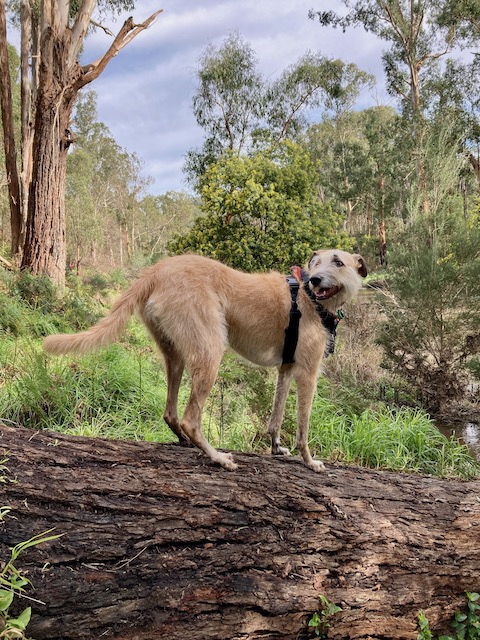
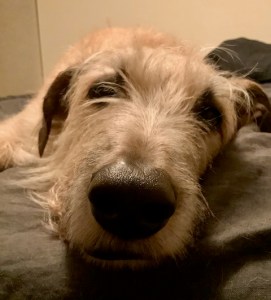
We were finally released from our collective misery last week, and I’m not talking about lockdown. The hound and I have experienced another kind of restriction as a result of an injury I wrote about back in January, after what should have been a two week resolution turned into six.

After a couple of weeks of rigorous supervision and battles with the cone of shame, which I can attest made both the hound and myself miserable, we returned to the vet to have the sutures removed. I was relieved the saga was over and had the best nights sleep since Harper’s surgery. So imagine my horror to wake up in the morning and notice a small hole had opened up where the stitches had been. By the time we got to the vet it had turned back into a gaping wound.

The vet took one look and said, ‘We’ll have to staple her up.’

He disappeared into the surgery and reappeared with some goo on his finger — a local anesthetic which he wiped around the hole. Next, he produced a staple gun and whilst the vet nurse and I placated the 46kg beast he proceeded to staple her together. The anesthetic didn’t worked on one spot and Harper screamed blue murder. My heart leapt into my throat at her distress but fortunately she is such a gentle beast that she tolerated the procedure despite the discomfort.

The next three weeks were a slog of close supervision and anxiety about whether the wound would heal. After one week the vet indicated if it wasn’t significantly improved by week two they might have to do surgery again, which would have meant a return to ground zero.

The wound was located on the most bendy part of the dog, making it slow to knit. It was clearly itchy so I couldn’t leave Harper out of my sight without the cone of shame on, and could not leave the cone on for anything other than short periods due to the stinking hot weather because the device prevented her from drinking water.

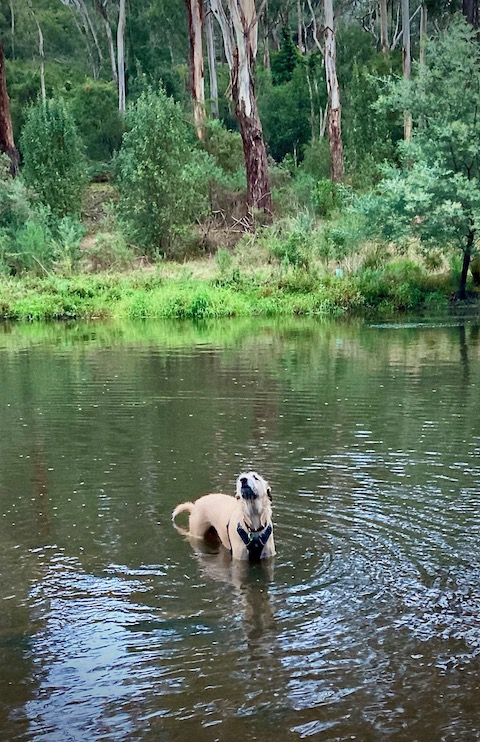
It’s hard work trying to contain a 46kg playful young dog, even if she is a lazy sod 90% of the time. As the days dragged by, she became more and more frustrated with the restrictions I had to impose. All she wanted was to play zoomies with her friends and I could not let her.

Six weeks later, after being substantially locked in the same room together, save for one day that Harper spent on a kind friend’s sofa, the staples were removed. I held my breathe willing everything to stay together. After a few days without any sign of complications, Harper had her first off lead play and I got a chance to go out without her for a meal with a friend. Tails are wagging all-round.

Locked in

Melbourne’s been back in lockdown, so a post on locked-room mysteries seems appropriate.

Locked-room mysteries are a sub-genera of crime fiction in which a seemingly ‘impossible crime’ is committed. The circumstances surrounding the crime make it implausible that the perpetrator committed the offence at all, or if they did, it seems unlikely they could evade detection. The crime scene is sealed from the inside with no way out (unless they were Houdini).

These stories usually involve a closed circle of people with a limited number of suspects and a whimsical detective to keep us guessing as they investigate. The solution is always right there, if only we could lay our eyes on the sleight of hand that plays on our curiosity. They are great mysteries for lovers of puzzles and a world away from gritty police procedurals or thrillers about psychopaths and the more brutal side of humanity. They are more cosy-supernatural-gothic.

Think a group of acquaintances getting locked up together on a remote property. They are caught out when the weather turns bad, making leaving impossible and bringing communications down. Keith, who had been driving everyone mad, is found dead in the garden shed. The garden shed has no windows and is locked securely from the inside. When the group break the door down they find Kieth lying on the floor with a bullet wound to his head. Strangely there’s no gun in the shed…Lucky one of the group is also a brilliant detective.

Locked-room mysteries were hot in the Golden Age of detective fiction between the two world wars. Agatha Christie perfected the genera, but Edgar Allan Poe is credited with invention of its long form in 1841 with The Murders in the Rue Morgue, although some say John Dickson Carr pre-dated him with The Hollow Man in 1935.

Casting even further back, the style was evident in short stories. In Dashiell Hammett’s Continental Op story Mike or Alec or Rufus that appeared in the January 1925 issue of Black Mask, the action takes place in an apartment building and the private investigator tries to solve the crime through interviewing suspects; Wilkie Collons’ The Moonstone (1854) is also credited as contributing to development of the sub-genre. Elements can even be found in the Old Testament story of Bel and the Dragon in which an idol who eats food offerings from a sealed room is worshiped. The stories hero Daniel, exposes the secret entrance used by the priests who are taking the food for themselves.

In a Guardian article from 2014, Adrian McKinty nominated his top ten impossible murder novels, ranging from The Moonstone by Wilkie Collins (1868) to La Septième Hypothèse by Paul Halter (1991). Interestingly there are a lot of locked room mysteries with a French origin.

Contemporary novels in this sub-genre are dominated by women writers and include Ruth Ware’s In a Dark, Dark Wood (2016), The Hunting Party by Lucy Foley, They All Fall Down by Rachel Howzell Hall, The Last by Hanna Jameson, Nine Perfect Strangers by Laine Moriarty, The Last Resort by Susi Holliday, and One by One by Ruth Ware who must like four walls, a ceiling and a floor.

Locked room mysteries are concerned with psychology and relationships between people in high pressure environments. They study what can happen when we are forced to spend more time with other’s than we would choose to. When we see one another more clearly that we ever have before and it becomes claustrophobic and uncomfortable because we are cut off from the outside world. Under these conditions our masks and defenses fall away and our true selves are revealed, warts and all. The evaporation of the veneer of civility creates a perfect environment for a mysterious crime. And of course there must be a brilliant detective to keep everyone contained until they solve the case.

I hope your lockdown was less dramatic, but if you can’t get your fill of a locked-rooms in lockdown try one of these:

  • The Black Lizard Big Book of Locked-room Mysteries by Otto Penzier – collection of 68 of the all time best
  • Miraculous Mysteries, edited by Martin Edwards – anthology
  • Locked Room Murders by Robert Adey – a bibliography of the problem and solution to 1,280 locked room crime novels and short stories