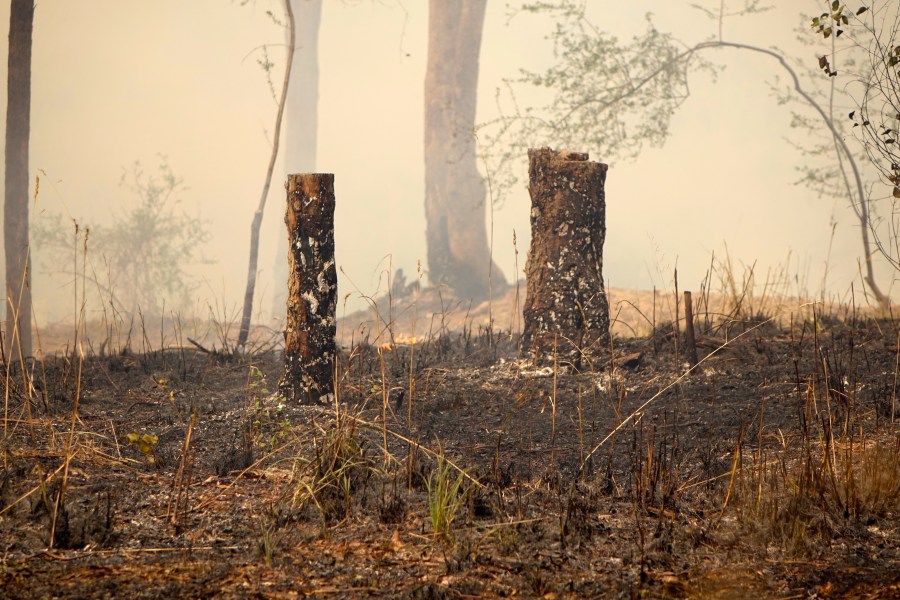
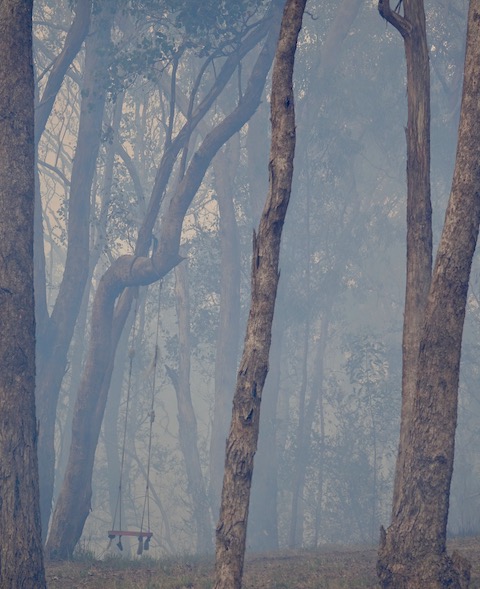
Burnt stumps and smoke after control burn, Warrandyte

God, fire and politics

I was going to do a bookish Christmas post, but have concluded that Christmas is a bit overrated. Besides, a few things have got my goat this week, so a pre-Christmas rant is in order.
On a day of 44 degrees in Melbourne, when half the coastline of the country is ablaze, and NSW is in a state of emergency, my dystopian fantasy of our future world is right on my doorstep and plastered all over the media. Meanwhile, our political leaders continue to bury their heads in the sand about climate change and the environment. I use the term leader loosely as it’s an attribute I feel is sorely lacking among our current political class. The best Scott Morrison seems prepared to offer is thoughts and prayers in its place.

You may be wondering why a fiction writer is having a rant about politics on a blog about writing? As it happens the crime fiction manuscript that I will start querying in the new year has political hypocrisy as one of its central themes, and it is something I am both fascinated and repelled by in the real world as well.

Morrison has gone to some lengths to avoid engaging in discussion about climate change and has pushed his perverse nothing to see here stance while communities are raised, flora and fauna are decimated, and city populations choke on the smoke. Earlier this month the man determined holding a press conference about his controversial Religious Freedoms Bills was more important than showing leadership about the bushfires. The first version of the bills had been heavily criticised by faith and secular groups alike, and I can tell you the second version is no better.
While Sydneysiders were gasping on smoke, Morrison was touting a package of legislation with potential to significantly change Australia. It may prevent many individuals accessing services such as medical, education, employment, aged care, and some commercial services on the basis of their otherness. Not to mention the Isreal Falau clause about how we can interact on social media. It is the most hateful piece of legislation to be tabled in some time.

I find it curious that institutions that were called out on poor governance, lack of transparency, and accountability in the Royal Commission into Institutional Responses to Child Sexual Abuse should now be deemed in need of the types of protections that will enable them to be even more closed and secretive by excluding anyone they view as other from their ranks. It strikes me as a recipe for more festering problems and institutional failure.

The religious freedoms debate started as a knee-jerk reaction to a small group of ultra conservatives railing against a secular state and afraid that allowing gays to marry would cause the sky to fall. After years of preventing progress in this area these conservatives were over ruled by the Australian public who voted in favour of same sex marriage. The religious right were offered a review to assess the state of religious liberty in Australia by the government as a consolation prize for the postal vote on same sex marriage to keep them sweet. Phillip Ruddock was tasked with overseeing the review. The first airing of the reviews outcomes was in the form of leaks of key findings around the time of Malcolm Turnbull’s demise. The leaks exposed the fact existing law already exempted religious groups from discrimination laws and enabled them to discriminate against teachers and students. They could sack teachers and expel students of diverse sexualities already if they chose to – it caused a moment of outrage, that many may have forgotten.
Subsequently Attorney-General Christian Porter was tasked with turning Ruddock’s review into legislation. It took an extraordinarily long time because ultra conservatives did not just want anti-discrimination laws for religious groups, they wanted a positive right to discriminate. Any reasonable person would agree that an individual should not be discriminated against on the basis of their faith, but what the religious right wanted was a weapon to strike out at people they deemed unworthy, like the LGBTI community, not just a shield to protect their faith. The laws are not about freedom to speak ones religion, but freedom for institutions to hire, fire, deny service, insult and humiliate based on an individuals personal characteristics. The cynic in me can’t help thinking Morrison may have chosen that moment on 10th December to announce the bills, with Australia burning in the background, to invoke some kind of symbolic fire and brimstone moment. But in reality who knows what Morrison really thinks about anything (he abstained from voting on same sex marriage)? He appears to be a man who will go wherever the favourable winds of power blow.

On the same day as focussing on a bill few deemed necessary, Morrison insulted volunteer firefighters by downplaying their work. Two CFA volunteers died fighting fires yesterday, and three more were injured. I wonder if Scott still thinks they really want to be doing this job?

…they’re tired, but they also want to be out there defending their communities…

Scott Morrison

All the volunteers were, foregoing income and time with their families to risk their lives fighting fires with often substandard equipment, yet Morrison was more interested in announcing legislation that has never been needed, and has the potential to create great divisions in society.

The wife of a firefighter wrote a heartfelt response to Morrison’s insensitive comments about our volunteer fire fighters that touched on another of Morrison’s blind spots – climate change. The blog has had over 80,000 views in a week. Remember Morrison is the guy who loves coal so much, he took a piece (which had been cleaned) into parliament in order to demonstrate his committment to a carbon-intensive economy and mock those concerned about climate change.

In November Morrison declared the bushfires had nothing to do with climate change and has been actively and publicly trying to shut down climate protesters because he doesn’t like their message, and clearly struggles to understand the science. He’s since made some concessional comments that climate change may be a factor, though I suspect that’s because he’s afraid of losing public support, he must have felt the winds changing. One wonders if he is confusing his own beliefs with science. He’s a Pentecostal. The evangelic religion emphasises the idea of the Rapture – that when it arrives, the chosen will ascend to heaven while the rest of us suffer the Tribulation – fires, floods and famines that will kill most of us, while he and his fellow chosen believers wait for the Second Coming.

Meanwhile, Scott has packed up his family and gone off on holidays. I don’t actually resent Scott having a holiday, we all need one now and then after all, but the act does expose a nasty element in his makeup and a big hypocritical black hole in the mans psyche. You might think that comment a bit harsh, but let me take you back to the Black Saturday fires that started on 7 February 2009 in Victoria.
I remember the day well as I was at home and could see the red orb thrown by the fires over the King Lake Ranges from my house. Apparently my town was spared by ten minutes and a wind change, my cousin wasn’t so lucky – her place burnt to the ground. In the aftermath, when people were looking for answers, and perhaps a few scapegoats, an ambitious young politician called Scott Morrison made an appearance on the ABC’s Q&A program and had a few things to say about the fact that Police Chief Christine Nixon left the incident room and went out to dinner that night.

“She’s clearly made a bad judgement call. That happens to people from time to time, but this was a very serious issue…I think there are very serious concerns in the community about exercising judgement, and it’s incumbent on all of us in public life to make decisions following that in the best interests of the ongoing nature of the program.”

Scott Morrison, Q&A 2010

Christine Nixon ultimately lost her job over the dinner decision. The comments then, and Morrison’s actions now, are an indication of the shallowness of the mans convictions. Ultimately he’s simply playing the politician, but his actions in recent weeks also call his judgement into questions based on his own benchmark. The image I have of Morrison lands somewhere between a crazed religious zealot determined to impose his beliefs on all of us, and Nero fiddling while Rome burns. The BBC delivered an interesting summary on Australia’s leadership failure on climate this week.

He’s not my Prime Minister, never was, never will be. I just hope the rest of Australia wakes up to his disastrous Prime Ministership soon and vote someone in capable of real leadership on the big challenges of our time.

Once I wrote a book…

I started writing my manuscript in early 2016 after enrolling in an online novel writing course with The Writers Studio. The last three years have been spent learning about fiction as I wrote and rewrote my story. Much of the work was put down in the same circumstances I am writing this blog post – on my iPad, on a Ventura bus trundling it’s way between Warrandyte and Docklands – thirty kilometres, one and a half hours, twice a day, every work day. The chore of the public transport commute transformed into an opportunity to steal some creative time, and to pass the time, and what an amazing journey it has been.

I wrote a book…

Writing is a significant part of my work life, but it’s business writing – briefs, corporate documents, media releases, and research papers. Creative writing is a different beast. There is a lot more to writing fiction than you might imagine before you start. You need to learn the craft; to harness and shape your imagination into characters, scenes, and dialogue; to develop a plot that has meaning and structure; and find a unique voice. It takes practice, persistence and a willingness to turn up at the page day after day, including when you don’t feel inspired to put down words – to keep spilling them out, even when you think they are crap – to develop a writing habit. It’s hard to say exactly how many words I have written in the process of developing this manuscript, but I’d hazard a guess it’s in the vicinity of 200,000, most of them typed in transit or snatches of time.

The Museum of Modern Art, New York

To build my knowledge and skills I also devoured many podcasts on writing, completed a couple of short courses through The Australian Writers Centre, read books on the craft and devoured a broad range of fiction and non-fiction books to see what I could learn from the published works of others.

In January 2018 I started this blog because I was in a fortunate position to be able to take a year off work, primarily to focus on my writing, and wanted to make a record of my journey. Since then I have blogged almost 70,000 words, completed my year off, and am back in the fray of the commuter class.

A couple of weeks ago, I printed my manuscript and gave it to my first reader, incorporated some changes based on their feedback and have now sent it out to beta readers. It’s a funny mix of emotions sending your work out into the world, even if only to a limited few – there is both apprehension and expectation. You hope that readers will be engaged by, and enjoy the tale, and that they will be brave enough to provide honest feedback that will contribute to improving the work. There is also a niggling worry that you could have completely deluded yourself and spent years writing something that no one will understand or enjoy. Then whilst the work is visiting others, all you can do is wait. I have come to believe that patience is one of the key attributes for being a writer of any, but particularly, long form fiction.

DOX Centre for Contemporary Art, Prague

When you have filled every spare moment with a project for many years, the sudden hiatus when you stop requires some adjustment. I thought it would be great to take a break – read some books and get onto some non-writing projects, like that garden paving I keep putting off. Curiously developing a writing habit has the hallmarks of most other habits, like exercise, where suddenly stopping leaves one with an uncomfortable, agitated residue. So last night I set up a scrivener file to start my next manuscript and I’m already getting a sense of what the plot line will be (rubs hands together).

Main image: Guggenheim Museum, New York

Grand dames of crime: Mary Roberts Rinehart

Born in the same year as Custer made his last stand, Mary Roberts Rinehart (1876-1958), from Pittsburgh, Pennsylvania, first trained as a nurse then took up writing post marriage in 1903 at the age of twenty-seven, spurred by financial necessity. Her first mystery novel, The Circular Staircase, was published in 1908 and her second The Man in Lower Ten published the following year. These two pulp novels were very successful, and are the earliest works by an American author still in print purely for entertainment, (as opposed to being classics or literature), a testament to her storytelling capabilities.

…a man may shout the eternal virtues and be unheard forever, but if he babble nonsense in a wilderness it will travel around the world.”

The Red Lamp

A feminist, Rinehart created middle aged spinster Tish in 1910. Tish become the central protagonist in a serious of comic long short stories that ran over thirty years. The series was about the wild adventures of the protagonist and her friends, Aggie and Lizzie, who did all the things women were not supposed to at the time, like race cars, do stunt work, and hunt.

The author (web image)

Rinehart’s work has much in common with hard boiled crime and scientific detection in style and subject, and she utilised realism to depict life and social issues of the time, such as class and gender. Her writing often combined murder, love, surrealism and humour, and she wrote a series of love stories dealing with nurses and hospital life, as well as several Broaway comedies. The most popular stage production, Seven Days, written with Avery Hopwood in 1909, was a farce based on Rinehart’s novella of the same name, and became a runaway hit.

…at last she drew on her gloves, straightened her hat, and went away with that odd self-possession which seems to characterize all the older women of the Crescent. Time takes its toll of them, death and tragedy come inevitably, but they face the world with quiet faces and unbroken dignity.

The Album

During the First World War Rinehart became a correspondent for The Saturday Evening Post and after using her nurse training to earn Red Cross credentials was allowed to got to the front where she visited hospitals, toured “No Man’s Land,” and interviewed both the king of Belgium and the queen of England.

The chef did it (web photo from Crimereads)

The biggest cliche in mystery writing, the Butler did it is often attributed to Rinehart’s novel The Door, published in 1930, in which the Butler turns out to be the villain, although the phrase itself does not appear in the text. An obliging mother, Rinehart wrote The Door in a hurry whilst recovering from an illness in hospital to help her sons fledgling publishing house. Rinehart was the near victim of a servant herself in 1947, when her chef tried to shoot and stab her in the library of her home. She was saved from injury by the brave intervention of her butler and some other servants. So apparently, it was the chef who did it in the library after all.

People that trust themselves a dozen miles from the city, in strange houses, with servants they don’t know, needn’t be surprised if they wake up some morning and find their throats cut.

The Circular Staircase

Her last book, The Confession, was published the year after her death in 1959. At the time, her books had sold more than 10 million copies, which is partly why she is often compared to Agatha Christie.

More information:

Tech review: writing tools

My inner geek relishes a bit of technology, so I thought I’d share the love and review some of the tools I have used in my writing.

Scrivener

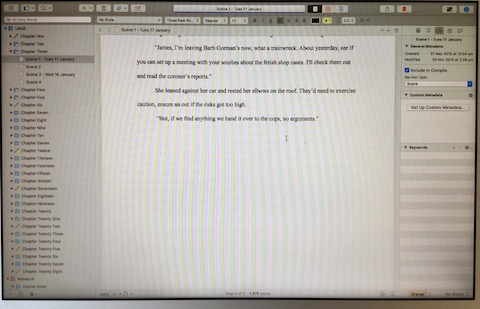
Scrivener is a writing software tool designed to support long-form writing, developed by software company Literature&Latte. Scrivener provides a single container to store all your your research (including a neat function to upload documents or webpages), and to organise large documents, notes and references in a single carrier. The program uses the metaphor of a ring binder that allows you to break manuscripts down to chapters and scenes that can be re-arranged with ease.

There are several documents templates to choose from, including for longform fiction, non-fiction and screenwriting. The program also has functionality to create your own templates. Custom icons and color coding features help arrange folders for easy recognition and compartmentalise different elements of your manuscript.

The program provides many ways to view a project – an obsessive organisers dream. The ‘corkboard’ acts like index cards attached to every section of a project. You can shuffle index cards as you plan and plot, its a handy feature for a structural edit. The inspector is a place to plan, create synopsis or notes, references, keywords, metadata or snapshots. An outliner allows you to work with an overview of a chapter and the folder and subfolder structure. You can also view the same or two documents side by side.

Scrivener has some neat features to motivate your writing too. You can set targets by word count, date or time and once you’re finished you can compile and download the whole manuscript into a number of formats. I found the target setter useful at a point in my earlier drafts when I wanted to write one thousand words a day, the ping when you hit your word count is most satisfying.

The program has desktop and iOS versions, so if you save to the cloud you can sync your work and take it anywhere – but you need to make sure you don’t have both open at once as you can end up with annoying syncing problems. I particularly love the cross platform options as I do a lot of writing on my iPad during the week when I am mobile, such as on public transport, and then work on my laptop at home.

The software company provides excellent guidance and help in the form of videos, user manuals, forums, a blog, faqs and product support. This is particularly important as the product has loads of features that require some time and effort to learn in order to get the best from the product. Scrivener has a free thirty day trial and at the time of writing cost AUD$77 for macOS and AUD$20 for iOS for iPad. I’m a convert.

Hemingway editor

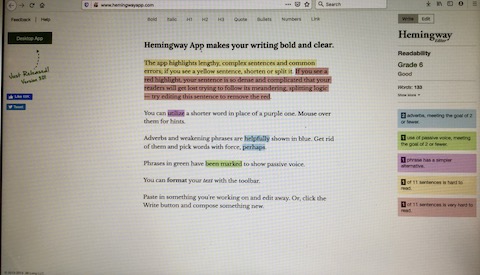
Hemingway is a neat little tool that is free to use online. You can also download a desktop app for AUD$20 making it more affordable than Grammarly or ProWritingAid, with many of the same features.
When you paste text into the tool it helps make your writing clear by checking grammar and highlighting areas for improvement using a color code system:

  • Adverbs highlighted blue
  • Passive voice highlight green
  • Phrases with simpler alternatives highlight purple
  • Hard to read sentences highlight yellow
  • Sentences very hard to read highlight red

The app also delivers readability, word count and read time statistics and has a capacity for large quantities of text – I have loaded a 90,000 word manuscript and analysed it without any issues. Once complete you can export and save your edits. I have found Hemingway a handy tool.

After the Deadline

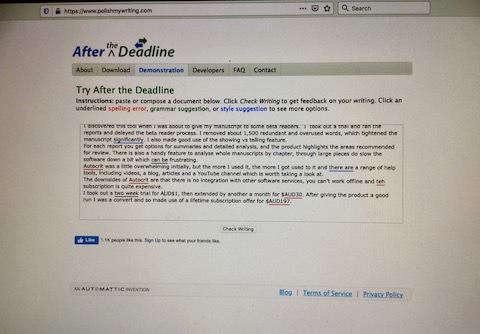
After the Deadline is a free online spelling, style and grammar check. It’s an open source software available for French, German, Portuguese, and Spanish and can be used by developers to add to web applications. For general use, paste text in, select check writing and the program uses color coding to underline parts of the text it thinks you need to check, by selecting the highlights the product offers alternative suggestions. It’s main downfalls for me are it uses American English, it struggles a bit with large quantities of text and you have to copy and paste your corrections when done as you cannot download them.

Expresso

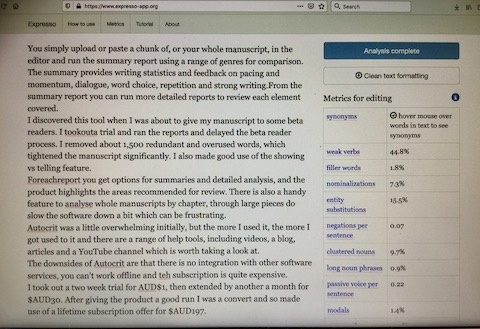
Expresso is a free online tool to analyse, edit and compare text styles in English for blocks of up to 5,000 words. The tools metrics include synonyms, weak verbs, filler words, normalisations, substitutions, negations, cluster sounds, long bound phrases, passive voice, modals, rare words, sentences that are too long or too short, fragments, and frequent word statistics, as well as general text metrics. When you select one of the metrics, the program highlights those sections in the text and suggests alternatives.

Autocrit

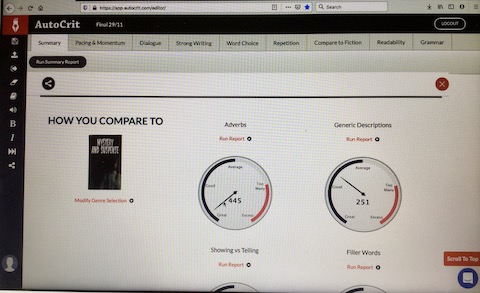
Autocrit is the rolls royce of cloud based writing software for fiction writers designed to help identify all those little problems that will jar readers out of your story. At the heart of AutoCrit lies its unique ability to directly compare your writing with the proven standards of successful, published fiction. The AutoCrit system is built using data from thousands of successful books, all fed in and averaged to provide a benchmark for manuscripts across multiple key areas. Once you load your work, you can pick the genre to run reports against.

The editor runs the summary report using your selected genre for comparison. The summary provides writing statistics and feedback on pacing and momentum, dialogue, word choice, repetition and strong writing.From the summary report you can run more detailed reports to review each element covered.

I discovered this tool when I was about to give my manuscript to some beta readers. After taking out a trial and playing with the product, I delayed the beta reader process. I removed about 1,500 redundant and overused words, which tightened my manuscript significantly. I also made good use of the showing vs telling feature.

For each report there are options for summaries and detailed analysis, and the product highlights the areas recommended for review in your manuscript. There is a handy feature to analyse manuscripts by chapter, though large pieces do slow the software down a bit which can be frustrating.

Autocrit was a little overwhelming initially, but the more I use it, the easier it is and there are a range of help tools, including videos, a blog, articles, and a YouTube channel which is worth taking a look at.

The downsides of Autocrit are that there is no integration with other software services, you can’t work offline and the subscription is quite expensive. I took out a two week trial for AUD$1, then extended by another a month for $AUD30. After giving the product a good run I was a convert and so took advantage of a lifetime subscription offer for $AUD197.

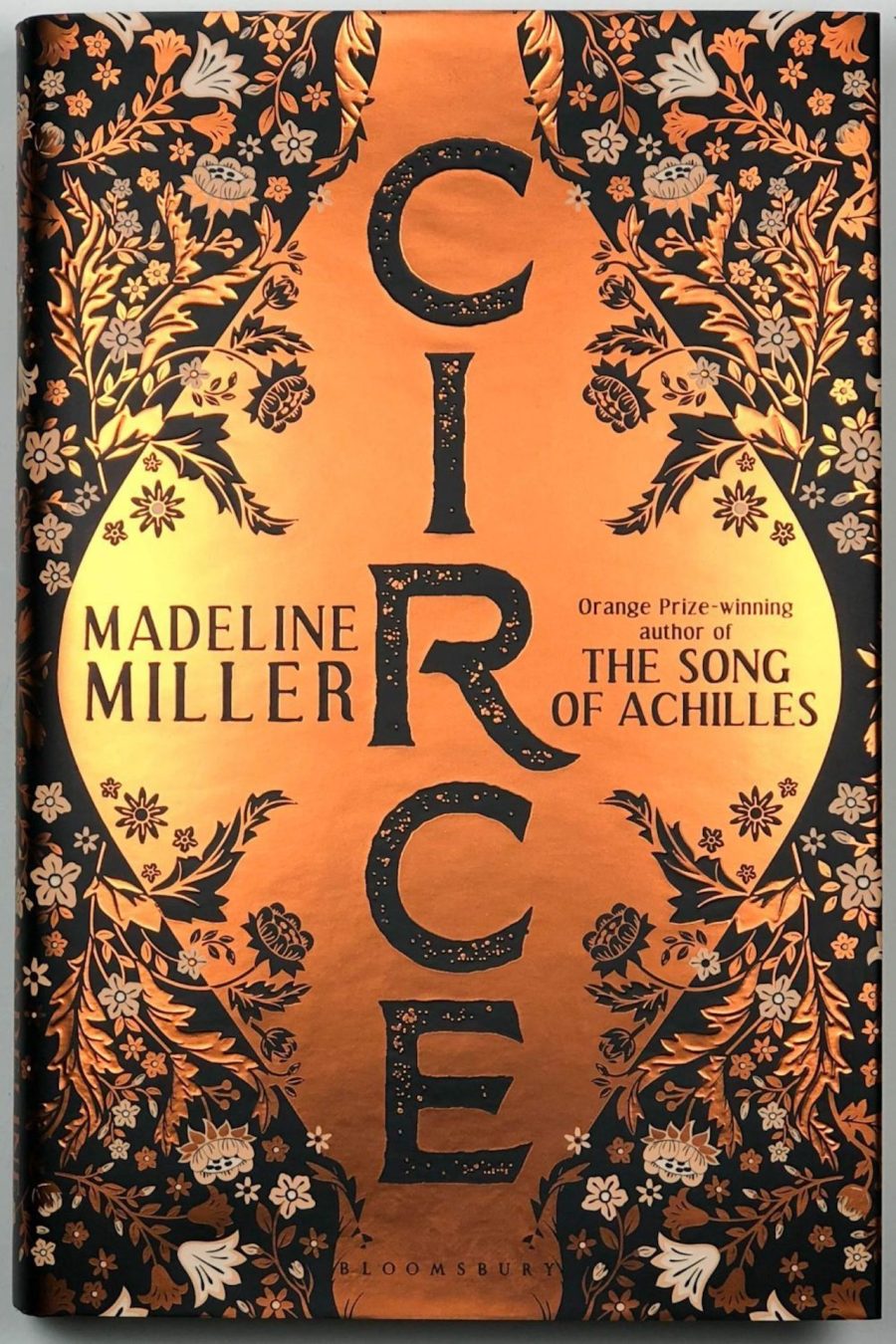
Book review: Circe by Madeline Miller

They say that writers should read widely, so not all my book reviews will be crime, though bloodshed may prove to be a common theme. Recently I dived into Greek Mythology. Madeline Miller’s Circe is a feminist spin on the epic tale of the immortal nymph sea witch by that name. Circe appeared as a minor character in the Homeric poem, The Odyssey.

Circe, the protagonist is the daughter of Helios, the sun god. As a child she is made brutally aware of her inferior status by her family. She was not born a god, is plain to the eye, and has the voice of a mortal. In her youth she was tormented by her siblings and barely seen by her parents.

I asked her how she did it once, how she understood the world so clearly. She told me that it was a matter of keeping very still and showing no emotions, leaving room for others to reveal themselves.

In coming to know love, jealousy and rage, Circe discovers her sorcerer powers, which she unleashes on her sister, a beautiful sea nymph, and the object of her envy. As punishment she is exiled to a picturesque, unpeopled island called Aiaia by her father.

Humbling women seems to me a chief pastime of poets. As if there can be no story unless we crawl and weep.

Circe eventually comes to revel in her solitude and spends her time developing her occult arts and witchcraft, and taming the animals of Aiaia for company.

This was how mortals found fame, I thought. Through practice and diligence, tending their skills like gardens until they glowed beneath the sun. But gods are born of ichor and nectar, their excellences already bursting from their fingertips. So they find their fame by proving what they can mar: destroying cities, starting wars, breeding plagues and monsters. All that smoke and savor rising so delicately from our altars. It leaves only ash behind.

It is on the island, surrounded by tame wolves and lions and pigs – the latter formerly sailors who she turned to swine after they tried to attack her – that Odysseus comes across Circe. He becomes her lover and she bares his child.

I was captured by Miller’s lush poetic prose, which is like reading a song. Her reimagining of the myth brings one of the women from the original tale into the light. Her work was criticised by a few crusty old blokes for historical inaccuracy, perhaps because they prefer the original misogynist fantasy, but I found a beautiful remake of Homers epic poem in Circe. The novel gives a nod to other myths as well, including Daedalus and Icarus; Medea and Jason with the Golden Fleece.

I loved Circe’s chutzpah, she is a woman who will not be silenced and turns an ancient tale of female subjugation into one that is teeming with contemporary reverberations of empowerment and courage. Circe is Miller’s second novel and rivals her first, The Song of Achilles, a stirring reimagining of another of Homer’s epic poems, The Iliad. The Song of Achilles received the Orange Prize for Fiction in 2012.

I highly recommend Circe, which was shortlisted for the Women’s Prize for Fiction this year. It’s a particularly good read for writers who seek inspiration, and to broaden their writing technique, style, and craft skills.

No wonder I have been so slow, I thought. All this while, I have been a weaver without wool, a ship without the sea. Yet now look where I sail.

Grand dames of crime: Ngaio Marsh

In a previous post I wrote about Charlotte Jay and a session at the Terror Australis Readers and Writers Festival inspired me to investigate more of the grand dames of crime fiction. This week I take a look at Dame Ngaio Marsh.

New Zealand born Ngaio Marsh (1895-1982) has ancestry that traces back to the twelfth-century de Marisco family of pirate lords operating from Lundy Isle (at the entrance to the Bristol Channel). This might be where she inherited her Amazonian appearance from. It is said she was a charismatic woman with a deep powerful voice, a powerhouse, domineering and determined, characteristics she no doubt needed as a single woman to make it in a mans world.

Marsh was the only child of unconventional parents, raised on a diet of Shakespeare and Sherlock Holmes. Her governess Miss Ffitch would often read her The Tragedy of King Lear, so little wonder she grew up to be one of the original queens of crime and well as a theatre director.

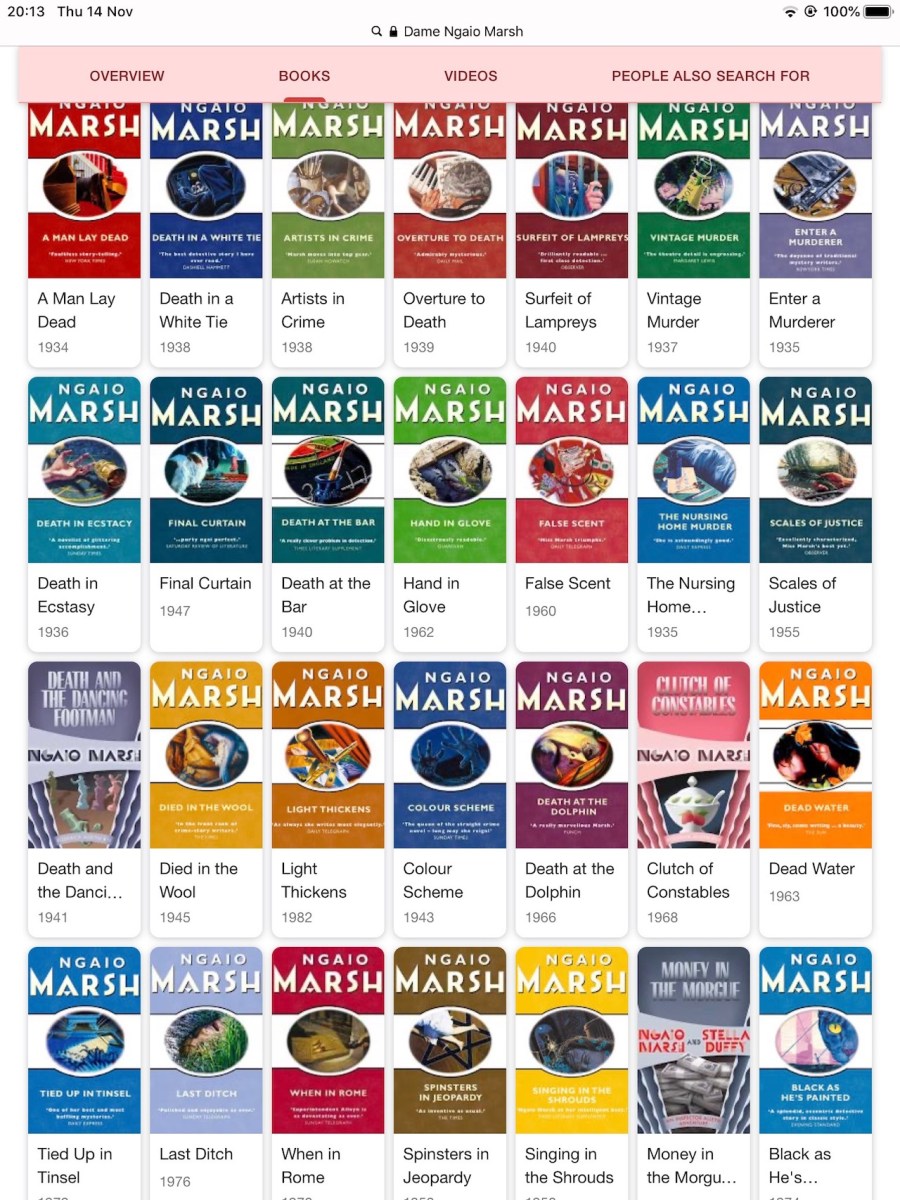
She painted, wrote and acted all through school but her writing career took off after she sailed to the UK in 1928 and started to carve out a name as a crime fiction author alongside other greats such as Agatha Christie, Dorothy Sayers and Margery Ellingham. Marsh’s first novel A Man Lay Dead, written in the depths of the Depression, introduced Roderick Alleyn, a tall, cultured, detached, thorough Scotland Yard Detective Inspector. An objective man with a poor memory which meant he kept a small note book of important facts on hand constantly.

Marsh went on to write thirty two crime detective novels mostly set in English theatres and country houses, plus four in New Zealand, thirty-two with the Alleyn character. More popular than Agatha Christie at the peak of her career, one million copies of ten of her titles were released by Penguin and Collins on the same day in 1949, all of which sold.

When Marsh returned to New Zealand to care for ailing parents the second world war broke out. During the war period she volunteered as a Red Cross ambulance driver ferrying repatriated soldiers around for Christchurch’s Burwood Hospital, and continued to write novels, producing four book during the war period (Death of a Peer, Death and the Dancing Footman, Colour Scheme and Died in the Wool).

A woman with energy and an appetite for productivity she also began an association with the Canterbury University College Drama Society during this time which enabled her to invigorate her love of Shakespeare. The association resulted in more than twenty full-scale Shakespearean productions, from her 1943 modern-dress Hamlet to A Midsummer Night’s Dream (starring Sam Neil) in 1969. Marsh’s last theatrical effort was to write and produce a one-man show in 1976 on the Bard of Avon, Sweet Mr Shakespeare.

Marsh never married or had children and was fiercely protective of her private life. She enjoyed the close companionship of women including her lifelong friend Sylvia Fox, and a coterie of handsome gay boys, but denied being a lesbian. She was generous with her knowledge and skills and nurtured many young writers and actors, splitting her time between New Zealand and the UK.

Marsh’s autobiography, Black Beech and Honeydew was published in 1965 to no great acclaim, then in June 1966 she became Dame Ngaio Marsh (Civil Division) in the Queen’s Birthday Honours. In 1978 four of her novels were adapted for New Zealand television, and she received the Grand Master Award for lifetime achievement as a detective novelist from the Mystery Writers of America. She just just managed to complete her final work, Light Thickens, a mere six weeks before her death from a cerebral haemorrhage and eight weeks before her eighty-seventh birthday. She died in her own home, which was subsequently turned into a museum.

Marsh’s elegant writing style and well crafted characters set in credible settings was said to have helped raise the whodunit detective novel to the level of a respectable literary genre. Harper Collins published a biography of Ngaio Marsh by Joanne Drayton in 2008 (Ngaio Marsh – her life in crime) which is said to have bought Marsh to life removing her from the cardboard cutout of respectability and decorum she presented publicly to the world to reveal a more textured and fascinating story of a woman with ambiguous sexuality who revealed in the abandon of the Bohemian Riviera and enjoyed her place at the table of the English in-set.

More information:

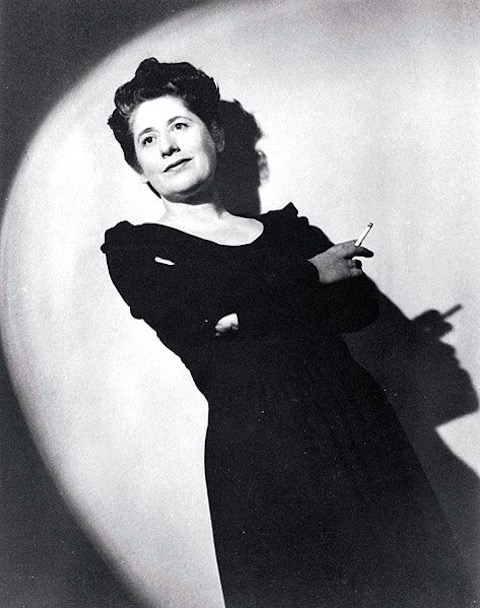
Images from the web: Book covers; the woman herself; immortalised on a New Zealand stamp.

After the terror…Terror Australis Readers and Writers Festival

What would you call a large group of crime writers?…a band of bards; a gang of thieves; a law suit; a table of trouble; an anthology? I’m not sure, but they were certainly learned owls at the Terror Australis Readers and Writers Festival.

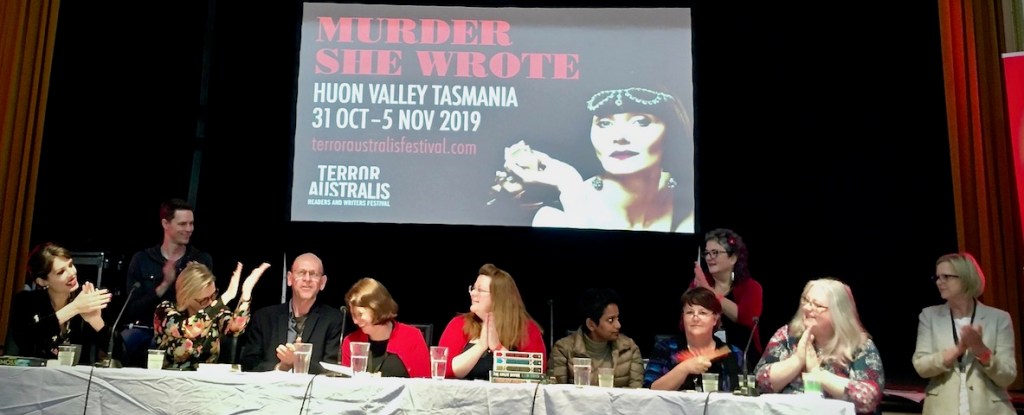
Table of trouble

I boarded the Terror jet on Thursday and headed south for some serious sleuthing. Tasmania is the perfect spot for a dark crime and Cygnet put on a feast, there were bodies everywhere…mwahahaha.

Tiny Hobart, the artsy capital of the isolated island state off Australia’s south coast, has murderous intent lapping at its doors, and who knows what those creative types might get up to? Hobart is sandwiched between the wilderness to the west and the southern ocean – nothing much between it and Antarctica except whales and spooky stories.

I am fortunate to have friends who live in Battery Point, Hobart who let me set up base at theirs, which by the way has fabulous views over Sandy Bay AND Mount Wellington, so if you’re looking for a great Airbnb with fabulous hosts, check out Katrina and Susan’s Hobart Loft.

By coincidence, on my first night in Hobart, Katrina was taking part in an old-fashioned murder mystery radio play, Battery at Battery Point, performed at the Battery Point Community Hall. It was a hoot and a terrific event to kick of my crime weekend, not to mention the mouth watering Thai beef salad and delicious Tasmanian wine my friends provided.

On Friday we all piled into the car and headed to Cygnet (Port of Swans), a tiny town in the Huon Valley south of Hobart with less than 2000 inhabitants. It’s a magnate for creative types and has an oversupply of gourmet food for its size. Cygnet punches above its weight and was a perfect location for Terror Australis Readers and Writers Festival, Australia’s newest crime writing festival.

My first stop was a MasterClass with Angela Savage, award winning author and director of Writers Victoria. She wore a themed black dress with white swans printed on it – for swanning around at festivals she said. If you ever get an opportunity, pop along to one of Angela’s sessions because she’s an excellent presenter who delivers engaging and thoughtful sessions with practical advice and useful exercises to develop your own writing.

I also attended a MasterClass with historical crime writer Meg Keneally, coauthor of the Monsarrat series with her father, and author of Fled. Meg provided some great advice on research, use of language for historical fiction, character development and choosing your weapon, or poison to bump someone off. The criminal mood of the session was enhanced by an impressive thunderstorm which probably left Meg horse after trying to make sure we could hear her over the noise.

Dodgy characters at Noir at the Bar

Cygnet folk like to dress up and Friday night was Noir at the Bar 1920’s style. Local gourmet providore’s provided delicious offerings with local beverages for accompaniment, and it was a cracking night. I presented a spoken word piece to the crowd and was pretty chuffed to be able to deliver Feet of Clay freestyle for only the second time I’ve performed it.

Saturday and Sunday were two days packed with the queens and (some) princes of crime led by international guest and author of the Inspector Singh Investigates series, the hilarious and fascinating Singapore based Shamini Flint; Canadian-Australian and vintage dress aficionado, author Tara Moss; and actress Marta Dusseldorp (aka Janet King Crown Prosecutor from the ABC drama). They were accompanied by a plethora of impressive Australian crime writers. The author panellists hosted two days of intriguing discussion on a range of topics, shadowed by the PEN empty chair to symbolise writers who could not be present because they are imprisoned, detained, disappeared, threatened or killed.

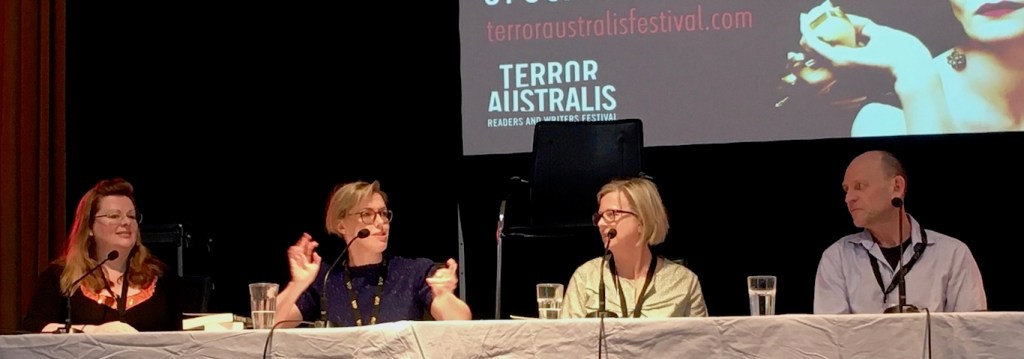
Tasmania’s finest – L.J.M. Owen, Joanna Baker and David Owen talk to Angela Meyer

Below are some snippets from the panels to give you a flavour of the discussions:

  • You can fix rubbish and you can delete rubbish, but you can’t do anything with a blank page.
  • Sherlock Holmes – a supercomputer hooked up to a dot matrix printer…lacking the interface
  • Recorrections’ of gender stereotypes can be as damning as the tropes they ostensibly challenge, e.g. damsel in distress becomes gun-toting fighter
  • Fictional crime is often a vehicle to discuss contemporary societal issues, it’s not about the actual crime in the way true crime is
  • I’ve never had a thought that didn’t end up in a book
  • Jack Heath asks his Facebook friends for advice on how to poison people but still ensure the body is perfectly safe to eat
  • So little diversity in crime writers they can be counted on one hand
  • I don’t believe in writing carefully. I do believe in writing thoughtfully – show your work to a range of readers as part of the writing process
  • The Bechdel Test — the measure of women’s representation in fiction
  • Why is it so hard to get men to view films/TV and/or read books with female protagonists? Jack Heath was inspired to write because genres for young male readers were all cars, sport and farting.
Angela Meyer’s , First Dog on the Moon and whiskey

Some of the other highlights for me included:

  • Mantra Dusseldorp reading from LJM Owen’s The Great Divide – gave whole new meaning to bringing story to life – gave me chills.
  • A discussion about whether Sherlock and Miss Marple would get along
  • The homage to the Golden Age dames of crime…Dorothy Sayers, Dame Ngaio Marsh, Margery Allingham, Mary Roberts Rinehart, Patricia Wentworth, Helen de Guerry Simpson, Baroness Emma Orczy, Ethel Lina White,Josephine Tey, Agatha Christie.
  • All the panels with Shamini Flint because she’s very funny
  • The final session Whiskey and Words – First Dog on the Moon launching Angela Meyer’s novel Superior Spectre over a whiskey tasting

LJM Owen was the powerhouse behind the festivals birth and she and the team of organisers and volunteers did a fantastic job. The event was professionally organised and had great content. Terror Australis Readers and Writers Festival is mooted to be a biennial event – I highly recommend you keep your calendar free and go along in 2021.

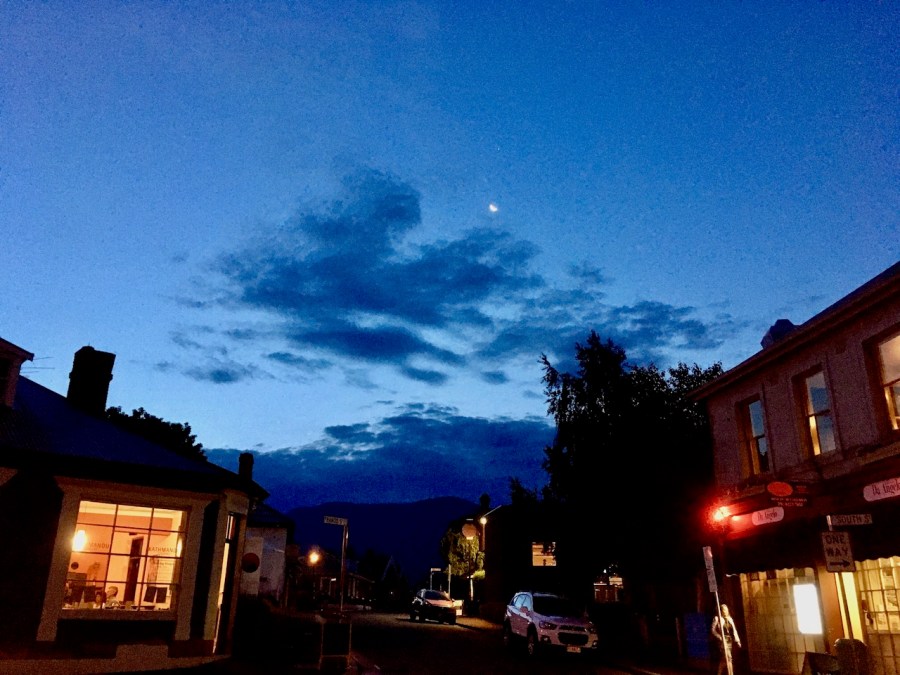
Main image: Battery Point by Moonlite

Online course review: Pitch Your Novel: How to Attract Agents and Publishers

It the second Australian Writers Centre course I have completed this year. I signed up for Pitch your novel: how to attract agents and publishers as I thought it would be a good companion course to Inside Publishing which I reviewed in August, and I was right.

The online self-paced course was created by historical novel writer Natashia Lester and includes nine modules. As with Inside Publishing purchase of the course gives you twelve months access to it online, and allows you to download the resources. The course presents advice on strategy and practice tips to get yourself pitch ready.

Module one focuses on developing a writing CV which includes building an author platform, an overview of relevant writers societies, creating a pitch package and putting yourself out there to build a writing network.

In the second module Natashia provides advice on how to make your manuscript pitch ready including what professional services are available to provide assistance, and free sources you can tap into for help.

Module three focuses on literary agents – what value they add, why your should consider pitching to agents before publishers, how to identify agents to pitch to, developing a pitch and keeping track of your approaches to agents.

The fourth module focuses on the pitch itself. Natashia provides advice on developing three different types of synopsis and when to use them, including examples from her own work.

Module five covers preparing a pitch package. It explains what research you need to do to develop your pitch package, what to include in the package and in what order.

In modules six and seven you’ll find out about what to do when you get a response from an agent, other than get excited. These modules provide practical advice about how long the process might take and what to do if you receive feedback from an agent.

Module eight moves onto pitching directly to publishers including which publishers are out there, how to find them and decide whether you should pitch to them. Practical advice about submission guidelines, how to organise your material and decide in which order you should approach publishers.

Natashia explores other ways to get published in module nine, including entering competitions, how to find these opportunities, information about some of the main ones in Australia and things to consider when submitting to these programs and prizes.

The final module looks at what to do if you get an offer including some basic advice about contracts and when and how to get help (I recommend Inside Publishing for more detail on actual contracts), as well as dealing with rejection because we all know we’re going to get some of that.

After completing a couple of the Australian Writers Centre online course, I’m a convert. They are professionally constructed, practical and chock a block full of good advice and resources.

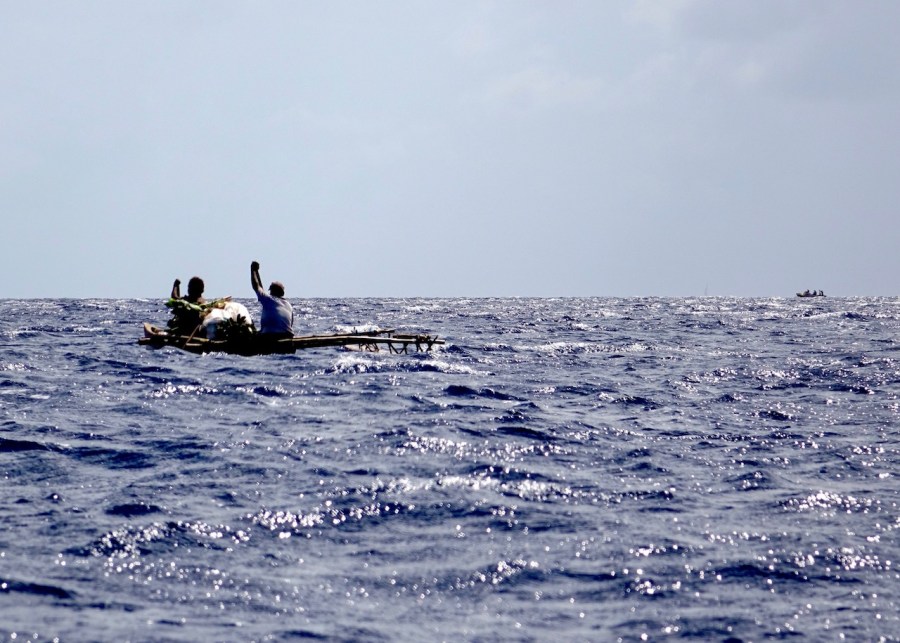
Main image: Everything You’ve Got, Epi Island, Vanuatu

Be Afraid: Terror Australis Readers and Writers Festival

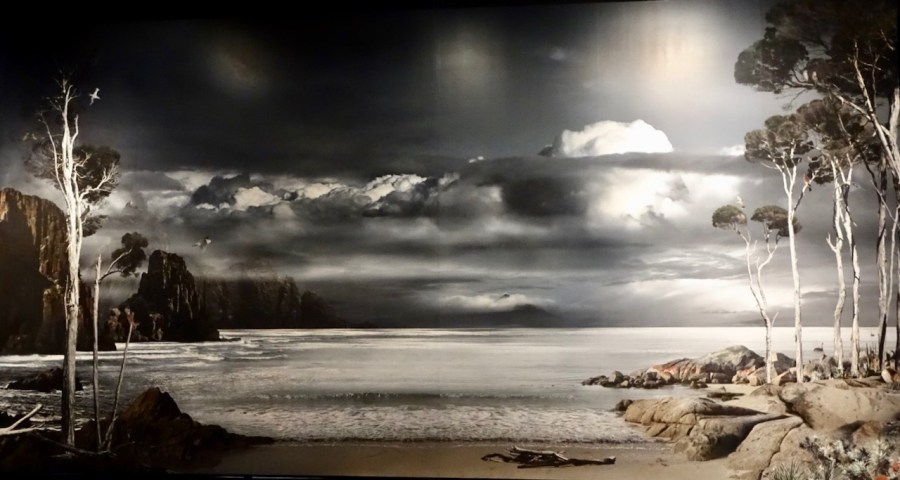
‘Prospero’s Island’, Valerie Sparks

If you’re not into horse racing, bypass Melbourne and head straight down to Hobart over the Halloween – Melbourne cup weekend. Terror Australis Readers and Writers Festival (TAF2019) is a new biennial literary festival to be held at Cygnet in the beautiful Huon Valley 31 October – 5 November. I’ve been looking forward to it for months.

The festival celebrates the work of female crime writers with the theme “Murder She Wrote,” inspired by a visit to Tasmania by Agatha Christie. Christie was on a ten month tour of the British empire taking in South Africa, Australia, New Zealand and Canada in 1922. The correspondence of her travels was published in The Grand Tour: Around the World with the Queen of Mystery. She was so enamoured by Tasmania apparently she said she’d like to live there one day. I’m with Agatha – Tasmania is one of my favourite places also.

“From Australia we went to Tasmania, driving from Launceston to Hobart. Incredibly beautiful Hobart, with its deep blue sea and harbour, and its flowers, trees and shrubs. I planned to come back and live there one day. From Hobart we went to New Zealand.”

– Agatha Christie
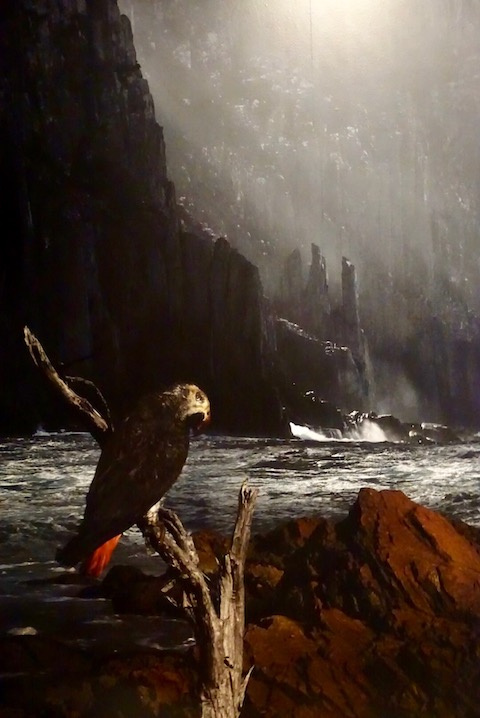
‘Prospero’s Island’, Valerie Sparks

I heard someone comment at a writing event I attended a while ago that crime writers are the most fun, and looking at the TAF2019 program, I can see why. The festival kicks off on Thursday and Friday with two days of writing workshops and masterclasses, as well as pitch to the publisher sessions. I’ve booked in for two masterclasses on Friday – one run by Angela Savage and the other by Meg Keneally. I’ll also be performing a spoken word piece at Friday night’s Noir at the Bar – a night of speakeasy jazz, spoken word and cocktails hosted by Naomi Edwards with a 1920’s theme.

Saturday and Sunday hosts a cracker line up of panellists celebrating and exploring crime fiction. I’m looking forward to hearing what some of these folk have to say – Tara Moss, Angela Meyer, Jack Heath, Tansy Rayer Roberts, Meg Keneally, Margaret Keneally, Shamini Flint, Angela Savage,Lindy Cameron, Joanna Baker, Marta Dusseldorp, David Owen, Debi Marshall, Livia Day, Sulari Gentill, L.J.M Owen, and more.

The weekend will be broken up by a Murder Mystery immersive whodunit dinner party on Saturday night set on an archaeological site in 1920’s Cairo. The theme is Curse of the Sphinx in a nod to Agatha Christie’s Death on the Nile. Guests will inhabit a character and try to solve a murder over dinner before coffee is done. Apart from the writers panels and the dinner I’ll also be imbibing a literary whisky with First Dog on the Moon and Angela Meyer on Sunday afternoon while they chat about Angela’s 2018 debut novel, A Superior Spectre.

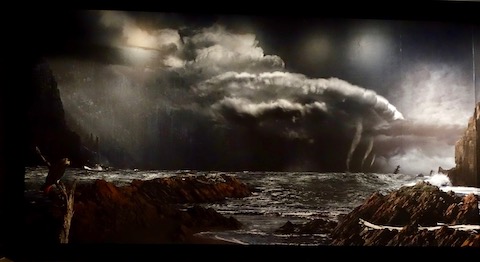
‘Prospero’s Island’, Valerie Sparks

For those who haven’t had their fill on the weekend, its bookended by two days of food and wine inspired, mouth watering culinary events on Monday and Tuesday. As part of Trail of Writers Tears, you can eat and drink your way around the region, learn bookbinding, making Chinese dumplings, Italian food, or go and visit Fat Pig Farm for lunch.

For more information check out the TAF2019 website and listen to an interview with Festival Director, Dr L.J.M Owen with David Milne here. See you on the other side Bwa ha ha ha…

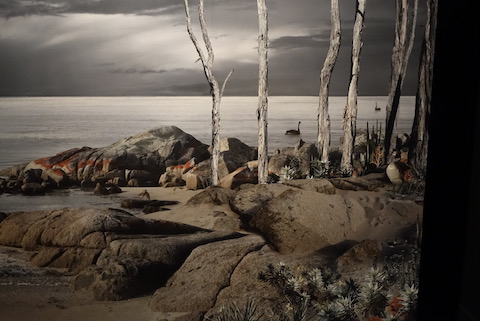
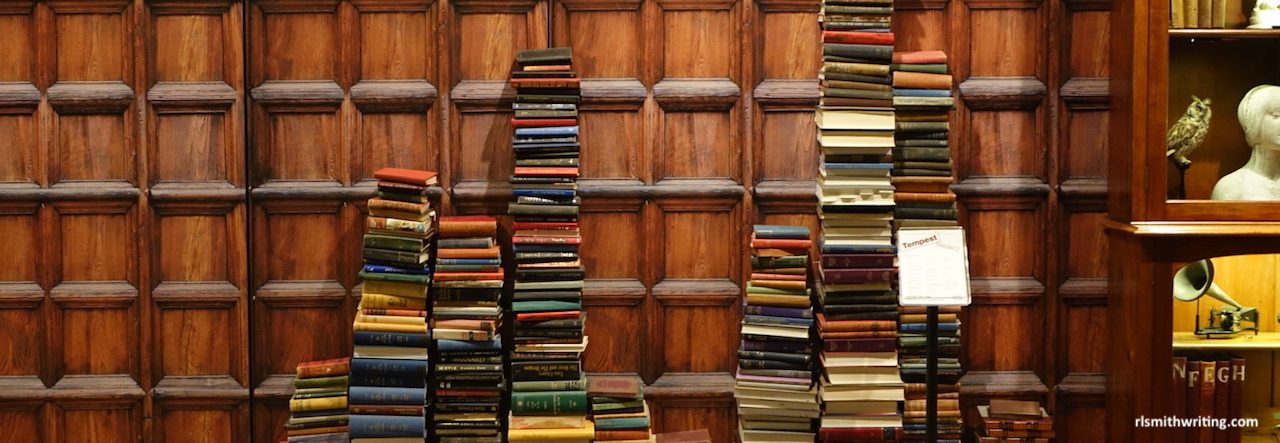
Images: ‘Prospero’s Island’ (2015-16) by Valerie Sparks. Commissioned by TMAG for Tempest

On writing style: Patrick White and Peter Carey

I was captured by the style and writing rhythm of two audio books I listened recently, even more so than their stories. Both The Twyborn Affair by Patrick White published in 1979, and My Life as a Fake by Peter Carey published in 2003 explore identity. In each the authors distinctive styles paint rich pictures of their characters and they were beautiful to listen to.

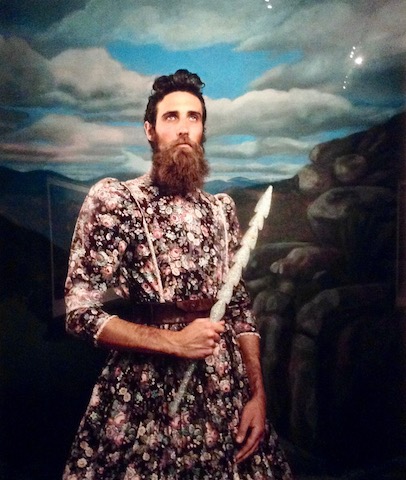
The Twyborn Affair is written in three parts. One set in a villa on the French Riviera pre-world war one, the second on a sheep station near the Snowy Mountains in the inter-war period, and the third in London just before the second world war. The title of the novel, also the core characters name, provides a clue to the novels story – Twyborn meaning twice-born, and Affair eluding to the characters various love affairs. The story charts the transmigration of a soul throughout three different identities – Eudoxia, Eddie and Eadith – a man bookended by two women. It explores transvestism, split personality and the loss of identity through death and re-birth. It places the anxiety and uncertainty of the human condition under a microscope, expunged of the dichotomy of gender.

It was still impossible for the watcher to decide whether the hair, illuminated by sudden slicks of light, was that of a folle Anglaise or pédéraste romantique, but in whatever form, the swimmer was making for the open sea, thrashing from side to side with strong, sure, professional strokes. It must be a man, Monsieur Pelletier decided, and yet there was a certain poetry of movement, a softness of light surrounding the swimmer, that seduced him into concluding it could only be a woman.

White’s writing style is dense, vivid and beautifully poetic to read. He applies a rhythmic lyricism and elaborate imagery drawing on myth, symbolism and allegory to explore ambiguity, identity, isolation and the search for meaning.

Yet whatever form she took, or whatever the illusion temporarily possessing her, the reality of love, which is the core of reality itself, had eluded her and perhaps always would.”

My Life as a Fake is set in 1972. An editor of an English poetry magazine goes on a junket to Kuala Lumpur and comes across a white man in a bicycle repair shop with ulcers on his legs. He is reading Rilke. The editor discovers that at the end of world war two this man was responsible for a great Australian literary hoax.

Remember, this is the country of the duck-billed platypus. When you are cut off from the rest of the world, things are bound to develop in interesting ways.

Carey toys with mythology in this novel inspired by a true story – the Ern Malley Affair. It explores identity, authenticity and the cultural anxieties of colonial societies. The Ern Malley Affair was a literary hoax involving the publication of poems dashed off as a joke to show that meaningless balony could get taken seriously by the avant-garde. The poems were subsequently published to great acclaim in the Autumn 1944 issue of Angry Penguins. The publication resulted in the humiliation and prosecution of Max Harris, the editor and a champion of modernist poetry, for publishing ‘indecent matter’. Carey draws on original source material but swaps out identities and names of the protagonists and adds in some wholly fictional characters.

I went to bed with the disconcerting knowledge that almost everything I had assumed about my life was incorrect, that I had been baptised in blood and raised on secrets and misconstructions which had, obviously, made me who I was.

Carey plays with Malaysian English slang and the work overflows with literary references including Frankenstein, Milton and WH Auden amongst others. There is a truly distinct use of narrative voice in My Life as a Fake from the crisp upper-class intellectual prose of Sarah, to Slater’s British bluff and effrontery, Chubbs defensive punctuated mash up of Australian and Malay, an aggressive Chinese-Malaysian woman with fractured English, and the elaborate deference of Mulaha. In the written text, one characters dialogue blends into another and folds into the narrative without the benefit of quotation marks.

He is right, he said quietly. The hoax misfired. I wished to make a point, but only to a few. Who cares about poetry? Fifty people in Australia? Ten with minds you might respect. Once Weiss had declared my fake was a work of genius, I wished those ten people to know. That was it, Mem. I never wanted the tabloids. Who would expect the Melbourne Argus would ever be interested in poetry. This was not their business, but what a caning-lah, what a public lashing poor old Weiss was given. I could never have foreseen that.

Both White and Carey have distinctive voices, original styles, and make great use of vocabulary and literary techniques, authors worth studying for any writer.