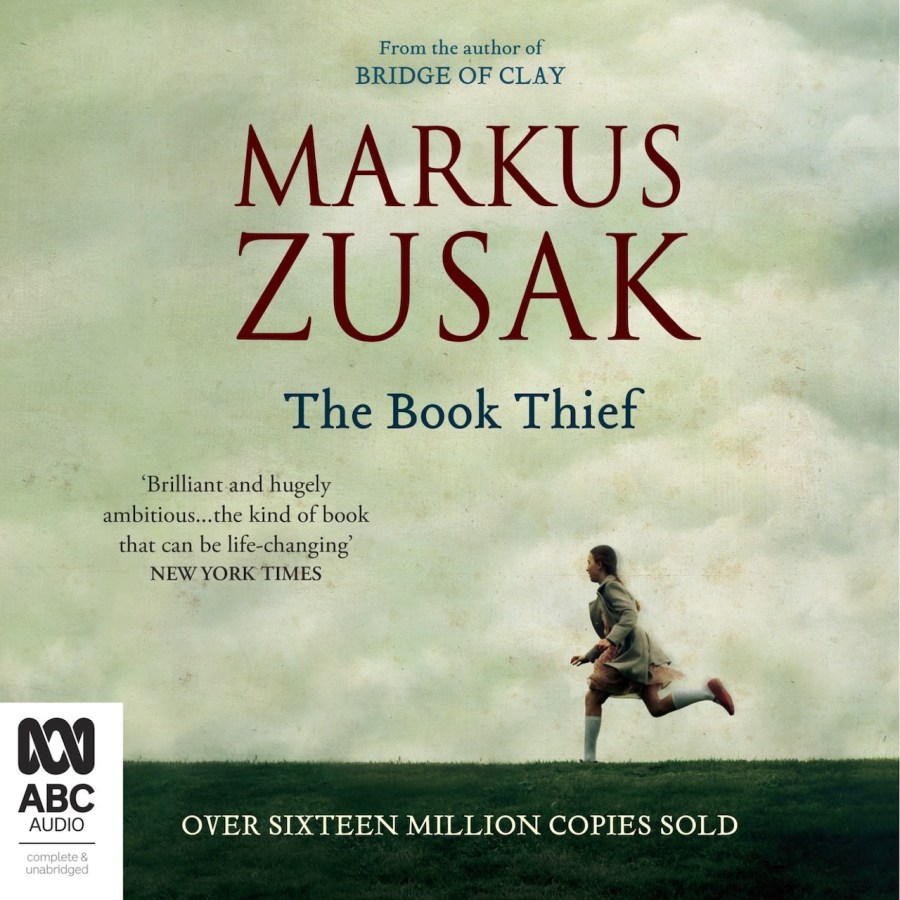
Set in Nazi Germany at the beginning of World War Two, The Book Thief by Markus Zusak is narrated by Death, a philosophical, sentimental, melancholy grim reaper. Death shares his observations of humans as he collects souls throughout the story.
I wanted to tell the book thief many things, about beauty and brutality. But what could I tell her about those things that she didn’t already know? I wanted to explain that I am constantly overestimating and underestimating the human race—that rarely do I ever simply estimate it. I wanted to ask her how the same thing could be so ugly and so glorious, and its words and stories so damning and brilliant.
The Book Thief tells the story of ten year old Liesel Meminger, beginning when her father is captured and her brother dies, and she steals her first book (The Gravedigger’s Handbook) just before her mother gives her up for adoption.
When she came to write her story, she would wonder when the books and the words started to mean not just something, but everything.
Liesel’s new parents are Hans Hubermann an accordion playing man who teaches Liesel to read, and his wife Rosa, a stern woman who beats Liesel with a wooden spoon intermittently. Neighbour, Rudy Steiner, becomes Liesel’s best friend and the two get up to childhood mischief.
A snowball in the face is surely the perfect beginning to a lasting friendship.
Reading helps Liesel connect with the living and the dead and she learns how words can heal and instil hope. She develops a penchant for stealing books, taking them from the mayor’s wife’s library by climbing through an open window, and at Nazi book-burnings she shoves books up her shirt while still hot.
The words were on their way, and when they arrived, she would hold them in her hands like the clouds, and she would wring them out like the rain.
When Max Vandenburg, a young Jewish man grappling with guilt for leaving his family to save himself, is taken in and hidden in the basement, Liesel’s life changes as she has to keep him a secret in order for them all to be safe.
In years to come, he would be a giver of bread, not a stealer – proof again of the contradictory human being. So much good, so much evil. Just add water.
There is intense emotion in The Book Thief, a blend of humour, sadness, and hope personified by Liesel in stark contrast to the persecution, propaganda and violence around her. The characters are compelling, the benevolent Death strangely likeable, and the ending will drag tears from your eyes. The Book Thief was made into a film in 2013.
One was a book thief. The other stole the sky.

 R L Smith