Book review: Before the Coffee Gets Cold by Toshikazu Kawaguchi

Who hasn’t asked the question, what if I could go back and say something different, at some point in their life?

It takes courage to say what has to be said.

Before the Coffee Gets Cold is a gentle story about human frailty, relationships, loss, regret, empathy, containment and time travel. It is the debut novel of playwright Toshikazu Kawaguchi, and would make a great stage play. The story is set entirely in a quaint tiny basement cafe called Finiculi Funicula in a back alley in Tokyo that has been serving brewed coffee for over one hundred years.

But Kazu still goes on believing that, no matter what difficulties people face, they will always have the strength to overcome them. It just takes heart. And if the chair can change someone’s heart, it clearly has its purpose.

Customers who come to the cafe have something to say to a person in their life to whom they cannot speak – the boyfriend who left, the husband with Alzheimer’s, the sister who died, the daughter never met. Each chapter focuses on one person’s desire to revisit a different time to say what they failed to, in order to create a connection with a loved one after a missed opportunity.

The present hadn’t changed—but those two people had. Both Kohtake and Hirai returned to the present with a changed heart.

There are strict protocols in the cafe’s time travel offering, and nothing you say or do will change the present. You must sit, and stay seated, in a particular seat (occupied most of the time by a ghost you cannot force to move) and you must return to the present before the coffee gets cold or risk being trapped evermore as a ghost yourself.

Just remember. Drink the coffee before it goes cold.

Each character who visits the cafe to sit in the chair is troubled by a regret about what they failed to say to a loved one. The time travel offers them the opportunity to remedy their mistakes, hurts and losses and the sweet relief of closure.

If I return to the past, I might be able to set things right..

Before the Coffee Gets Cold is a gentle journey of sadness, second chances, facing reality, and relief through the vehicle of magical realism. The story is a quick and easy read, though I recommend listening to the audio book as I think this format suits it better.

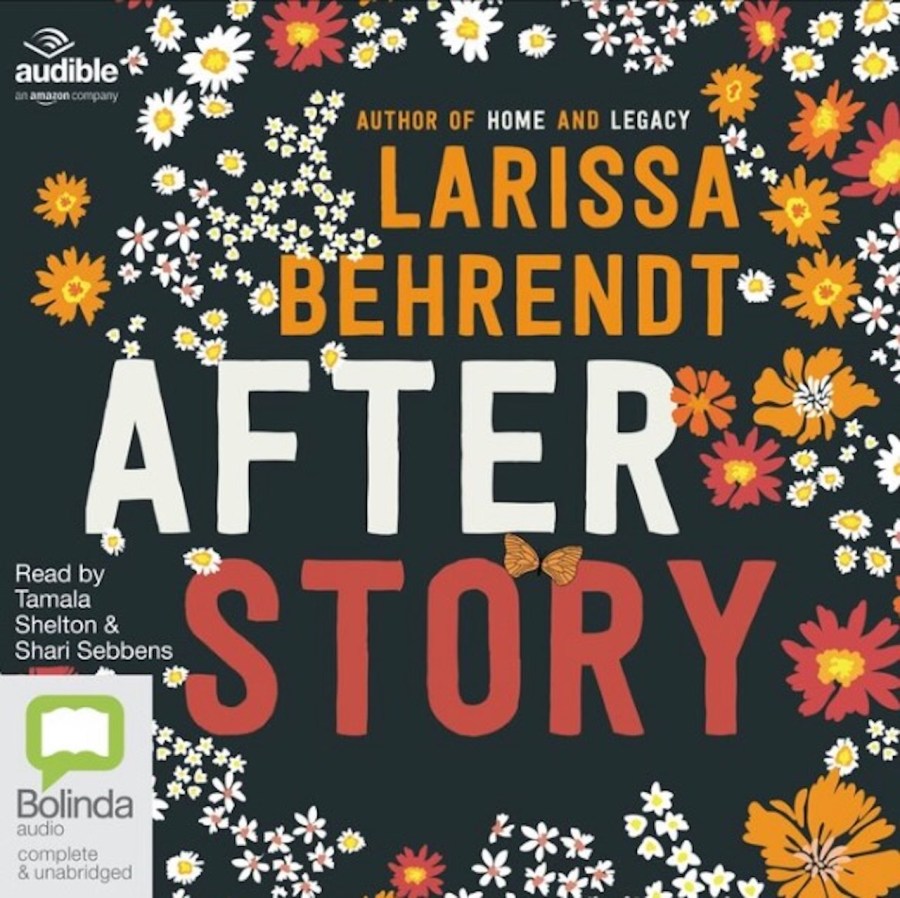
Book review: After Story by Larissa Behrendt

In After Story by Larissa Behrendt, Jasmine, a city lawyer, takes her rural mother, Della, on a ten day literary tour of England six months after the funeral of her father. The two Indigenous women have a fraught relationship, primarily as a result of a family history of trauma. They both want to improve their connection.

Aunty Elaine would remind me that there is more than one way to tell a story; there can sometimes be more than one truth. ‘The silences are as important as the words,’ she’d often say. There is what’s not in the archive, not in the history books – those things that have been excluded hidden overlooked.

Soon after landing in London they hear a story about a young girl going missing on Hampstead Heath. The news irritates the long held grief from the abduction and death of Jasmine’s older sister Brittany twenty-five years earlier.

The great revelation perhaps never did come. Instead, there were little daily miracles, illuminations, matches struck unexpectedly in the dark.

The story is told from the two very distinct view points of the women. Della, who knows nothing about literature and has never traveled, compares what she sees and hears with her own experiences and that of her ancestors – absorbing, learning and critiquing. Jasmine reflects on the lives of the authors and how their experiences influenced their work, which leads her to consider the impact of past trauma on one of her clients in Australia, gradually extending her contemplation to her own mother’s history.

Suddenly I found the museum stuffy. When Aunty Elaine would talk about it, our culture felt alive – the sewing of possum cloaks … the gift of telling stories. They were living and breathing, not relics of the past, frozen in time. Looking at the artefacts surrounding me, I couldn’t help but feel I missed an opportunity with Aunty Elaine to capture her knowledge.

After Story is beautifully written with a rich caste of supporting characters and plenty of humour to balance the more serious content – and who doesn’t love a literary themed novel. Other themes include family relationships, the justice system and racism. Highly recommended.

Book review: Out of Breath by Anna Snoekstra

The Australian outback is a beautiful, bizarre and dangerous place – where lots of people go to get away from their lives or themselves, or to find themselves. Out of Breath by Anna Snoekstra is a cultish psychological thriller about naive foreign tourists who disappear in the outback.

Jo’s life in England turned upside down when she was very young – she was rejected by her mother and bought up by an ambivalent father. At twenty-seven she is looking for a place where she feels she belongs. She drops out of Art school and a toxic relationship in London and travels to Sydney, Australia to start afresh.When her relationship with Eric in Sydney fails as well and she needs to fulfill visa requirements and working remotely for a period, she heads to a mango farm in northwest Western Australia.

Things soon start to get creepy and weird – can you hear the foreboding music?

He holds his nose and she sees his mouth open, a huge breath, then he’s under. She sees the bobble of his bum, his feet splashing the surface. Then nothing. Silence. Jo finds she is holding her own breath. After a few seconds, she lets it out. Ho-jin doesn’t come up. She scans the water, looking at the heads, the people sitting on the sand bed. No one is moving.

I thought Snoekstra did a great job of capturing the beauty, isolation, eccentricity and slight creepiness of the outback. It’s not surprise that around 40 people lose their lives in it each year.

There were many moments in this novel where I cringed at the naivety and stupidity of the main character who either had no common sense about the perils of the Australian outback – or simply didn’t care enough about herself to worry about them. Either way I think Jo’s near death experience in the desert made the idyllic community she stumbled into seem or the more utopian…but I guess that’s the vibe cult leaders set out to create.

What do you do when you have joined an paradisal tight knit isolated community and discover it is not what it claims to be? You’ll have to read this psychological thriller to find out…

Book review: The Lost Flowers of Alice Hart by Holly Ringland

The Lost Flowers of Alice Hart by Holly Ringland is an aesthetically beautiful book. Each chapter is represented by a botanical drawing of a native flower drawn by artist Edith Rewa. There is also poetry peppered through the text, juxtaposing the challenging terrain that the story covers.

In the weatherboard house at the end of the lane, nine-year-old Alice Hart sat at her desk by the window and dreamed of ways to set her father on fire.

Nine year old Alice Hart’s father made her a beautiful desk from eucalyptus when he was feeling remorseful after one of his rages during which he would beat Alice’s mother, Alice and any pets that got in the way. Alice and her mother walk on eggshells waiting for Mr Hart to erupt. The girl reads about the phoenix rising from the ashes and wonders how she could set fire to her father so that he could rise anew with only the good parts of himself in tact.

Wave after wave curled and crested, gathering strength as it raced towards her. She tried to crawl away, scrambling to get further up the beach, but she couldn’t get traction in the soft sand. Trapped, she turned, helpless as the ocean of fire wheeled over her, a swirling wall of flames. Pressure surged from her gut, but when she took a deep breath, all that tumbled from her lungs was a silent scream of tiny white flowers.

A tragedy strikes the family. Alice is the only survivor and is taken in by her gruff, Blundstone and Akubra wearing, whisky drinking grandmother and flower farmer, June. The workers on the farm (called The Flowers) are all troubled women who found their way to June’s refuge.

…life is lived forward but you only understood backward. You can’t see the landscape you’re in while you’re in it.

June teaches her traumatised granddaughter the language of flowers, which become her means of communicating when she can’t find words. Alice didn’t know she had a grandmother and starts to wonder what other family secrets exist, but June is tight lipped. Then, as a young adult, Alice experiences a betrayal at the hands of her grandmother and flees the flower farm to the desert.

Around them, the willowy needles of desert oak trees swayed in the pale orange light. Wafts of yellow butterflies fluttered low over acacia and mulga bushes.  The crater wall slowly change colour as the sun sank, from flat ochre to blazing red to chocolate-purple. The sun slipped under the dark line of the horizon, glowing like an ember as it threw its last light into the sky.

The Lost Flowers of Alice Hart is both beautiful and brutal. The beauty of the prose, the Australian landscapes and native flowers offset the brutality of themes of domestic and family violence, trauma, secrets and grief. It explores how friendship and language are so important to breaking past patterns. The book has been adapted to film and premiers in Australia on Prime from today.

Book Review: The Yield by Tara June Winch

The Yield is a meditation on Australian Aboriginal culture, the impacts of colonisation policies including the removal of children from families and dispossession, inter generational trauma, returning home, identity and a reclamation of traditional language. The story is fiction, but draws on factual historical records.

He was telling her that there was a lot to remembering the past, to having stories, to knowing your history, your childhood, but there is something to forgetting it too…There exists a sort of torture of memory if you let it come, if you invite the past to huddle beside you, comforting like a leech…a footprint in history has a thousand repercussions, that there are a thousand battles being fought every day because people couldn’t forget something that happened before they were born. There are few worse things than memory, yet few things better.

Three different point of view narratives are interwoven through this book. Wiradjuri Elder, Albert Gondiwindi who wrote a dictionary of traditional language, his granddaughter August, in her early twenties, who returns home for her grandfather’s funeral after living overseas for some years, and Reverand Greenleaf, an empathetic nineteenth century missionary who established Prosperous house for the natives to try and protect them from the damaging white policies.

There are plenty things I haven’t done, and it didn’t make my life any worse.

August’s sister who disappeared when August was young has a strong presence in the story also. She hovers, just out of view throughout the novel. The absence of her point of view emphasises the impact of her disappearance, and symbolises what was lost more broadly to NSW Aboriginal communities.

Since she was a girl the ache had scratched further inside her, for something complete to rest at her tongue, her throat. The feeling that nothing was ever properly said, that she’d existed in a foreign land of herself.

The central Aboriginal family in the novel live at Prosperous house at Masacre Plains. The area is under threat from a tin mine planning to gouge a hole two miles wide and 300 metres deep where August’s family home is located. After returning for her grandfathers funeral, she decides to stay and try to help save the town.

I was born on Ngurambang — can you hear it? — Ngu-ram-bang. If you say it right it hits the back of your mouth and you should taste blood in your words. Every person around should learn the word for country in the old language, the first language — because that is the way to all time, to time travel! You can go all the way back.

The Yield is a slow flowing story about reclaiming Aboriginal language, family, loss, the past and current legacy of colonisation, and returning. Despite the serious topics, the novel also makes room for humour and I thoroughly enjoyed it.

Book review: Bridge of Clay by Markus Zusak

Bridge of Clay is the second novel of author Markus Zusak who also wrote The Book Thief.

Five wild brothers, the Dunbar boys live unsupervised in a Sydney suburb amongst badly behaved pets. The eldest, Matthew, who supports the household and is guardian to his brothers, is the narrator.

Each boy stood, slouched yet stiff, hands in pockets. If the dog had pockets, she’d have had her paws in them, too, for sure

Matthew introduces his brothers – Rory who is prone to getting into fights, Henry who makes them all watch bad movies, Clay the dark horse who loves to run and is the central character through whom others are changed, and Tommy who collects stray animals including Hector the cat, Telemachus the budgie and Achilles the mule who has free range of the kitchen.

He, as much as anyone, knows who and why and what we are: A family of ramshackle tragedy. A comic book kapow of boys and blood and beasts.

One day the boy’s absent father, known to them as ‘the murderer’ reappears after disappearing into the outback, leaving his sons to fend for themselves after the death of his wife, Penelope, to cancer. He asks his sons to help him build a bridge. Clay goes to join him to the chagrin of his brothers. The bridge building threads through the 600 pages of the book and represents reconciliation after the destruction of grief.

She couldn’t ever see how broken he was, while the rest of us stood and watched them. She was in jeans, bare feet and T-shirt, and maybe that’s what finished us off. She looked just like a Dunbar boy. With that haircut she was one of us.

The novel tells the scrambled story of the Dunbar tribe starting with piano loving Penelope’s emigration as a teenager from Eastern Europe. Bridge of Clay is a tender, poetic, chaotic and sometimes violent patchwork story about a blush of boys bringing themselves up after they lose their mother to illness and their father abandons them. It is a story about family, grief, what makes a home, forgiveness and love. A complex, yet simply beautiful tale.

Book review: Unforgiven by Sarah Barrie

Going dark this week. Unforgiven is about a child victim turned vigilante and is not for the faint hearted, but if you enjoy gritty thrillers, this could be for you.

Lexi works part time as an escort, and part time as a hacker pursuing and trapping paedophiles she finds on the dark web to help her sister Bailee who works in child protection. Lexi is tough, street wise and drinks a lot of whiskey.

Things take an unexpected turn when Lexi, after breaking into his house, witnesses the murder of a man she has been tracking. She then agrees to help the guys wife (neither of them did it) dispose of his body, so they don’t get blamed.

On the edge of oblivion, images drift through the fog of my mind and hold, refusing to let go. Last night. The very dreamy Jonathan Davies of the chiselled features, stunning baby blues and long, dark lashes. A tall, muscular powerhouse, precision toned and sculpted to be appreciated. So commanding, so sure of himself. The images form into a memory and I groan in resignation.

‘Shit’. I have to get up. His body is still in the boot.

Detective Rachael Langley knew Lexi from her childhood. Langley was responsible for putting Lexis abuser, the Spider, behind bars. The two women cross paths again when someone claiming to be the real Spider emerges, and the pressure is on to catch him.

There are some great characters in this novel, I particularly liked Dawny, Lexis older neighbour who has a shady past, but a good heart. The two become firm friends over a deep freezer.

Unforgiven is a tightly plotted, fast paced, thriller set on the NSW Central Coast. The narrative alternates between Lexi and Rachael’s points of view, and whilst it isn’t an easy read due to the content matter – Barrie covers some confronting topics – there is not gratuitous violence or gory detail.

Book review: The Paper Palace by Miranda Cowley Heller

One day unfolds at the same time as Elle Bishop’s life unfolds in the dual narrative novel The Paper Palace. Elle is at the family cabin at Cape Cod where she has spent every summer of her 50 odd years.

I wonder if he would love me if he could see inside my head, the pettiness, the dirty linen of my thoughts, the terrible things that I have done.

I was quite blown away and discomforted by this story. In the first chapter, I thought…saucy…when the main character recalled her secret sex in the dark against the wall of the cabin with her friend from childhood, Jonas, whilst their respective partners were inside talking and Elle’s mother washed the dinner dishes.

There are some swims you do regret, Eleanor. The problem is, you never know until you take them.

But as the story unfolds, interweaving a series of past and present decisive moments in Elle’s life, her frailty is exposed and it becomes apparent that many of her decisions have been driven by tragic events buried in denial, secrets and lies.

But it’s what we do, what we’ve done for years now. We drag our past behind us like a weight, still shackled, but far enough back that we never have to see, never have to openly acknowledge who we once were.

I found The Paper Palace to be a beautifully written, emotionally demanding read. From the beginning Elle’s life is a series of trials that explore themes including failing marriages, blended families, abuse, trauma, lost opportunities, infidelity, and the complexity of intimacy and betrayal. It is dark, heart wrenching and wistful.

Does letting go mean losing everything you have, or does it mean gaining everything you never had?

Book review: The Poet X by Elizabeth Acevedo

I was so taken by Elizabeth Acevedo’s lyrical Clap When You Land that I sought out her debut verse novel, The Poet X.

I only know that learning to believe in the power of my own words has been the most freeing experience of my life. It has brought me the most light. And isn’t that what a poem is? A lantern glowing in the dark.

The Poet X is fifteen year old Dominican girl Xiomara’s diary. The story documents her experiences growing up in Harlem with conservative, religious parents, her transition into puberty, her rage, and her discovery of a love of poetry.

My parents probably wanted a girl who would sit in the pews wearing pretty florals and a soft smile. They got combat boots and a mouth silent until it’s sharp as an island machete.

Xiomara is a loud, large, ferocious, opinionated young woman who fights with her fists and struggles with her body, her religious upbringing and her relationship with the world. She exists in stark contrast to her gentle brother, Twin who is coming to terms with being gay. Her fiercely religious Mami presents challenges to both her children who don’t fit her mould.

My brother was born a soft whistle: quiet, barely stirring the air, a gentle sound. But I was born all the hurricane he needed to lift – and drop- those that hurt him to the ground.

Poet X is a story about ordinary life written in an extraordinary way – a bold, poetic, humorous, sensory delight.

Book review: Red, White and Royal Blue by Casey McQuiston

In Red, White and Royal Blue you will find out what happens when America’s first son falls in love with the Prince of Wales – it’s funny, romantic and sexy, with a good dose of awkwardness.

Straight people, he thinks, probably don’t spend this much time convincing themselves that they’re straight.

Charismatic Alex Claremont-Diaz is the son of the first female President of the US. He has a beef with his nemesis, Prince Henry and it’s proving to be a risk to US/British diplomacy. The young men’s parents and handlers hatch a plan to make them play nicely together.

‘You are’, he says, ‘the absolute worst idea I’ve ever had.’

At first they are all frenemies, but their attraction to one another soon becomes apparent when they find themselves locked in a broom cupboard together. Of course the world power’s leading men being gay presents a whole lot of other issues.

Love is like a fairy tale, it would come sweeping into your life on the back of a dragon one day.

Red, White and Royal Blue is a delightful, feel good, empowering love story with an imaginative premise. Highly recommend it.