
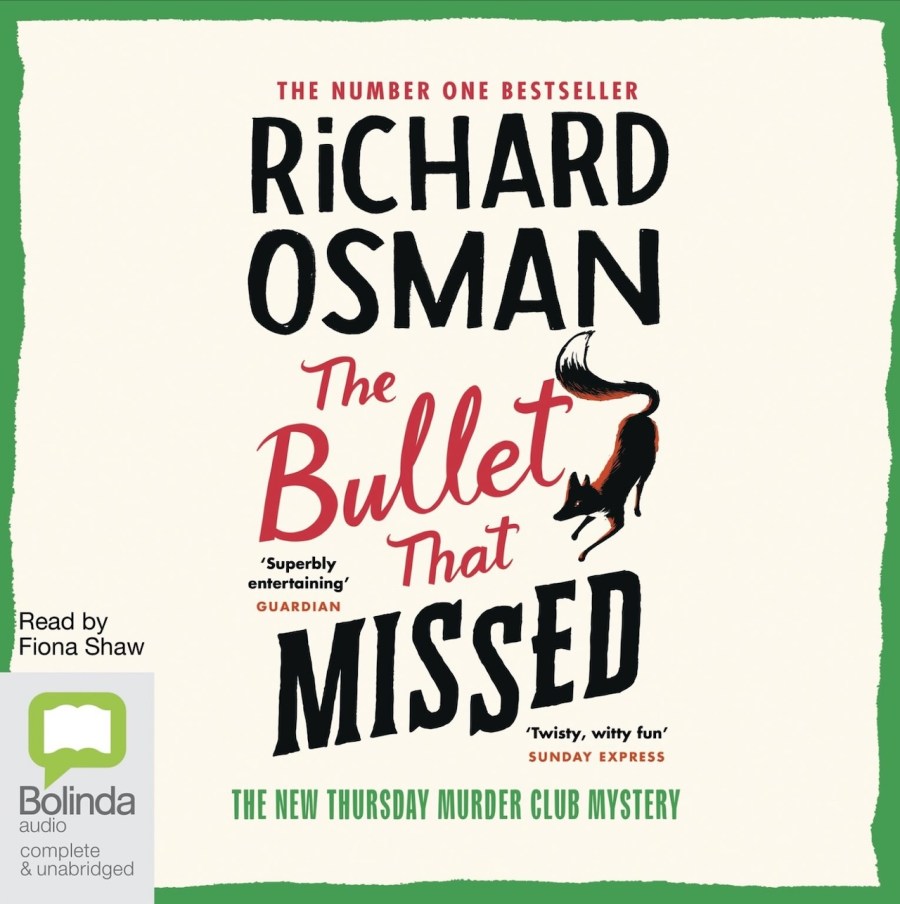
Richard Osman’s Thursday Murder Club series are great for cozy crime aficionados who enjoy a good laugh. And I do love stories about seniors who not only don’t let age get in the way of a good time, but use it to their advantage to get the upper hand. The Bullet That Missed is book 3, following The Thursday Murder Club and The Man Who Died Twice.
If murder were easy, none of us would survive Christmas.
Pensioners and amauteur detectives, Joyce, Elizabeth, Ron and Ibrahim take an interest in the case of television reporter Bethany Waites who’s car went over a cliff into the sea ten years earlier while she was investigating a tax fraud operation. Her body was never found, presumed consumed by creatures of the deep. The gang from Coopers Chase Retirement Village start to ingratiate themselves with people surrounding Bethany’s disappearance. Then their main suspect has a fatal incident with a pair of knitting needles.
Very few things are so important you would risk your life for them, but all sorts of things are important enough to risk somebody else’s life.
Meanwhile, Elizabeth has been receiving mysterious and threatening text messages that lead to her being kidnapped by a man who calls himself Viking. Viking threatens to kill Joyce unless Elizabeth kills a former KGB chief called Viktor. He gives her two weeks.
Very few things are so important you would risk your life for them, but all sorts of things are important enough to risk somebody else’s life.
Will Elizabeth commit a murder, and can the Thursday Murder Club solve two murder cases?
People drift in and out of your life, and, when you are younger, you know you will see them again. But now every old friend is a miracle.
The Bullet that Missed is a witty whodunit full of twists and red herrings and delightful characters interspersed with some of the very real challenges of ageing such as how Elizabeth battles with her husbands advancing dementia, the importance of friendship, and love in later life.
It’s the people, in the end, isn’t it?” says Viktor. “It’s always the people. You can move halfway around the world to find your perfect life, move to Australia if you like, but it always comes down to the people you meet.








 R L Smith