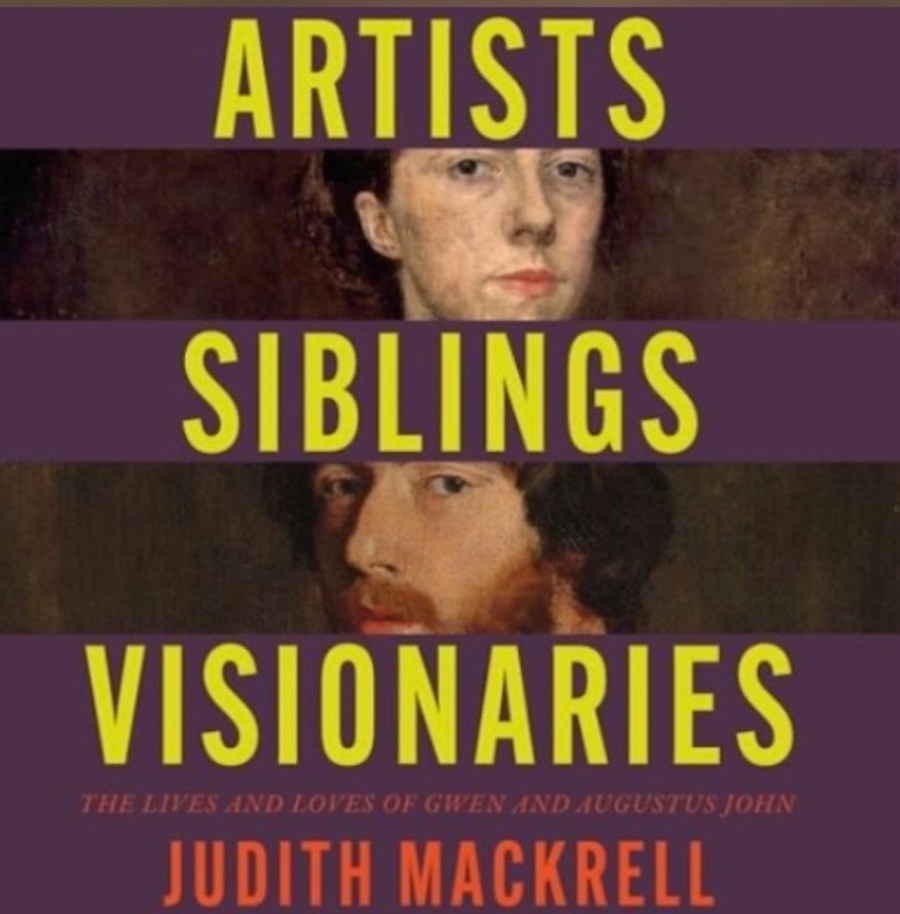
Judith Mackrell dives into the early lives of artist siblings Gwen and Augustus (Gus) John in her biography Artists, Sibling, Visionaries. It’s a wild ride. Set in early 20th century Britain, the artists are both socially awkward but John lived a notoriously bohemian life. He was an adulterer and bigamist who fathered a large number of children with multiple women. There were so many he seemed to lose track of them himself. In contrast, Gwen was an introvert. She was bisexual, fiercely independent, quiet and deeply private.
People are like shadows to me and I am like a shadow.
Growing up in Wales, the siblings had an inner turbulence in common. They attended the Slade School of Fine Art in London in the 1890s, the first art school to admit women. Later, Gus lived in England while Gwen settled in Paris.
Gwen and Gus had once thought that money was irrelevant. As students, they’d believed that all they needed was a roof over their heads, materials with which to paint—and their freedom.
Initially Augustus appeared to be the rising star. This was possibly in large part because he was an outgoing and handsome young man in a man’s world. However, his life became so complex that art often took a back seat. It was the shy introverted Gwen who was (posthumously) recognised as the greater painter of the two.
Even now, at twenty-one, Gwen had no control of her own money; as an unmarried woman, she was barred from opening a bank account.
Gwen was the muse and lover of Rodin, 36 years her senior. The relationship was a source of both pain and joy for Gwen and the most significant of her life. It was only after converting to Catholicism she was able to break free of the hold Rodin had over her. Her subsequent, largely solitary, existence in life was marked by a fierce loyalty to her art.
In 50 years’ time I will be known as the brother of Gwen John.
The creative struggle and its tension with commerce are alive throughout Artists, Siblings, Visionaries. The bond and rivalry of siblings pursuing the same profession was also a strong theme. The book focuses centrally on Gwen’s struggle to live a creative life, often relying on her brother for financial support. It highlights how constrained the world was for women of the times. This created tension throughout the book. In Artists, Siblings, Visionaries, Mackrell makes the humans behind the artwork visible with all their dreams, fears, and flaws. It was wonderful to read.
 R L Smith