
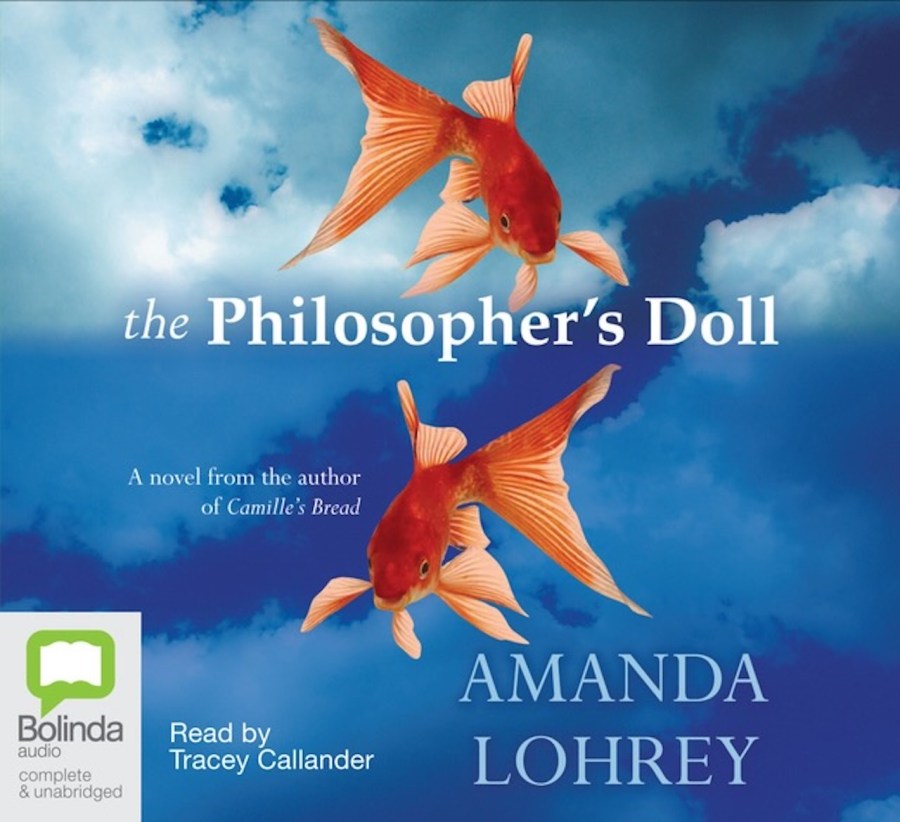
Book Review: The Philosopher’s Doll By Amanda Lohrey

The Philosopher’s Doll by Amanda Lohrey is about domestic politics and conflict between the head and the heart. What happens when a woman’s biological clock is ticking and her partner is reluctant to commit to children?

I was fascinated by this novel, in part because I have never experienced the biological clock phenomenon, though I have been witness to it in friends. The Philosopher’s Doll delivers a deep three-dimensional dive into the inner thoughts of couples grappling with the issue.

Lindsay, a Melbourne philosophy academic and Kirsten, a counsellor are renovating their house. Their divergent priorities lead increasingly to arguments and perverse behaviours. He has other plans he wants to pursue, including completing the house renovations before committing to having children. He decides, without telling her, to buy Kirsten a puppy as a kind of substitute. Kirsten’s biological clock is getting louder, and after a drunken night of sex, she falls pregnant and finds herself with a conundrum. She is unable to tell Lindsay and unable to decide to terminate her pregnancy.

But now she is even more withdrawn from him, and has taken to compensating for her indecision with a series of ruthless fantasies. She will deliver an ultimatum and if he reacts badly, she will leave him. She will live somewhere in a small, light-filled apartment and it will just be the two of them, mother and child. The sperm has flown to the mark: the father has served his purpose and he can be dispensed with. These fantasies come to her like little jabs of false cognition, and then fade

As the story unfolds, Kristen and Lindsay reveal less and less of themselves to each other and more and more to the reader through their inner narratives. There is then an abrupt entrance of a third narrator some ten year later, Sonia, a student infatuated with Lindsay, who reveals what happened after the events, the decisions Lindsay and Kristen made, and who they became.

The Philosopher’s Doll is a rich, multi-layered dive into a very real life conundrum and how people grapple with very personal decisions when life throws them wildcards. Lohery is also author of The Labyrinth, which won the Miles Franklin Literary Award and the Prime Minister’s Literary award for fiction in 2021. Her writing is not light, but it is elegant and marked by profound characterisation and is beautifully meditative to listen to in audiobook form. Her work is born out of deep thought, clashing personal narratives, vexed choices, and meditations on the complexity of interpersonal relationships.

Book Review: The Labyrinth by Amanda Lohrey

The cure for many ills, is to build something.

A Labyrinth is often used as a walking meditation. The meandering path that leads to the centre creates a symbolic journey for personal, psychological and spiritual transformation.

The novel by that name written by Amanda Lohrey is a story of a personal journey, of taking oneself out of ordinary life to reflect and make space for change, to surrender to forces greater than oneself. A space to meditate on past patterns and symbolism, where outsiders gravitate in to become friends, catalysts or allies who help heal and find a new footing in the world. There is something almost gothic about the story. The reading is of itself meditative, and it demands to be read more than once in order to plumb it’s depths.

Time is a disease of the human psyche. One of my father’s precepts.  Sane people live in the moment, they do not dwell on the past and they do not succumb to fantasies about the future.  But on other occasions he would contradict himself.  When people go mad, he would say, they step out of time because time has become unmanageable and everything is chaotic flux.  They cannot put one foot in front of the other in any meaningful way.  Nor can they make a decisive intervention in the sequence of time as measured in units by the society around them. Chronology defeats them.  One disease generates another.  The larger social disease—generates the smaller private one: a mad resistance.

Erica Marsden abandons her urban life to be near her artist son housed in a jail near the NSW coast for manslaughter. Her visits to Daniel are torturous, but in between Erica tries to piece together a new life, separate from, yet drawing on reflections of her earlier years.

The walls of the visitors’ room are a violent mustard yellow,  On one wall there is a huge mural of crudely drawn trees and boulders in shades of muddy orange and greenish brown.  It has the quality of sludge.  Two warders escort me to a steel table, bolted to the floor, and I sit on a steel chair, also bolted to the floor.  Everything here is steel and concrete; even the air has a metallic taste.

Erica buys an old shack on the beach and decides to build a labyrinth like one she remembers from years ago. Abandoned by her mother as a child, she grew up on the grounds of a psychiatric institution were her father was the chief psychiatrist. She seeks meaning in her own existence as well as for why her son turned out the way he did. In this isolated town filled with other isolated people, Erica starts a new life and befriends those she would never have encountered in other circumstances.

Jurko, an outsider and illegal immigrant with the stonemason skills she requires to build the labyrinth appears in Erica’s orbit and the two form an unlikely alliance, then friendship through the building of the structure. In The Labyrinth, as in life, there is no neat ending just an unfolding that speaks to the complexities of existence and how one continues to unfold in the wake of disaster. It is a powerful and subtle story worthy of more than one visit.

I have learned that a simple labyrinth can be laid out by anyone, unlike a maze, which is a puzzle of mostly blind alleys designed for entrapment.  The maze is a challenge to the brain (how smart are you), the labyrinth to the heart (will you surrender).  In the maze you grapple with the challenge but in the labyrinth you let go.  Effortlessly you come back to where you started, somehow changed by the act of surrender.  In this way the labyrinth is said to be a model of reversible destiny.