One day last week I left a one hour long meeting at work to discover I had received thirty emails. All demanded immediate attention. The pace at work has been frenetic due to a period of high volume competing demands, clashing deadlines and reduced staffing. My back yard has been teeming with builders working on repairs for several weeks as well. Not a lot of creative writing had been done. As the saying goes, I was over it and craving some down time. So how lucky was I that a member of my writing group invited us to her new place in Warburton for a writing weekend.
You are not a drop in the ocean. You are the entire ocean in a drop – Rumi
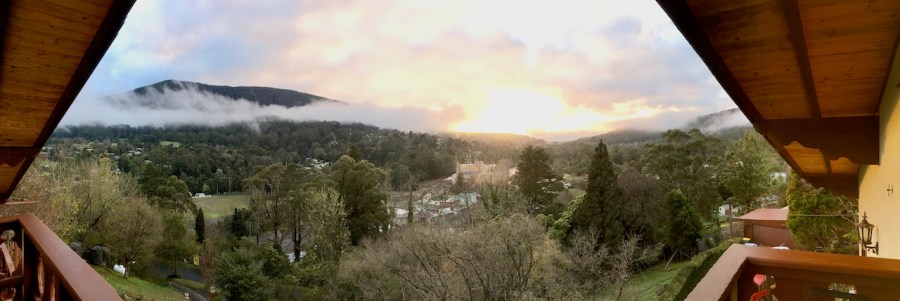
I trundled up there late last Friday after cooking some food and arrived just after dark to a beautiful meal and long chats about writing and books over red wine. My room was in an apartment at the top of the main residence set high up on a steep hill. I woke to a view to die for (as you can see from the main picture), and took a long deep breathe. The cult of busyness, so antithetical to considered thought, melted away as I absorbed the peace of the place.
An entire weekend dedicated to nurturing writing seemed quite decadent, but there is a lot to be gained from interacting with other writers and having a chunk of uninterrupted time to work. Over two days we read and critiqued each others work, discussed approaches to writing, and the publishing industry in between disappearing to our own corners to connect with our works in progress.
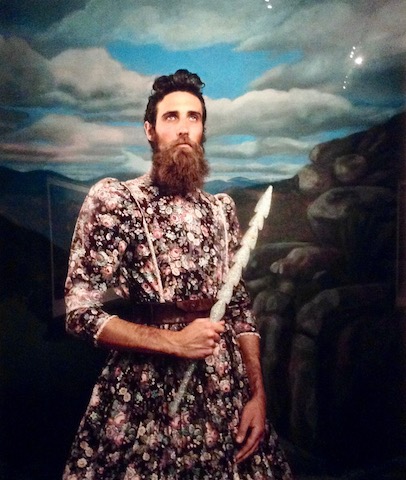
A sheep in wolf’s clothing
The first signs of spring are here and I sense the frenetic pace subsiding for a while. I shall try and take my lead from the wolf and chill in this lovely weather. Needless to say this post is visual heavy and text light as I’m keen to make the most of the sunshine.
She turned to the sunlight
And shook her yellow head,
And whispered to her neighbor:
“Winter is dead.” – AA Milne, When We Were Very Young
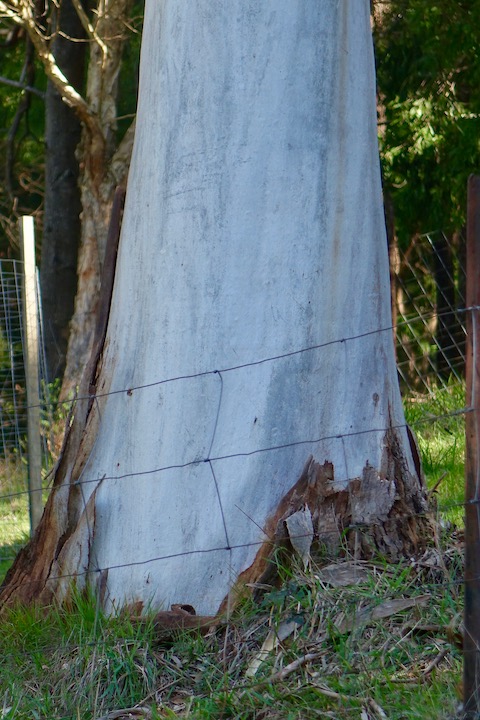
What happened when you saw the main image on this post? Did you automatically think palm trees and cows?
Humans love to organise, categorise and classify. Slapping a label on things helps us make sense of the world, and prevents us from becoming overwhelmed by it. The publishing industry is no different. There is a preference to categorise authors – mystery, romance, literary, science fiction, speculative fiction. Apparently they like authors to ‘stick to their genre.’ Failing to do so might confuse readers, not to mention the marketing team.
I can’t blame you for trying to categorize me. It’s a human instinct. It’s why scientists are, to this day, completely flabbergasted by the duck-billed platypus: it’s furry like a mammal, but lays eggs like a bird. It defies conventional classification.
Jeff Garvin, Symptoms of Being Human
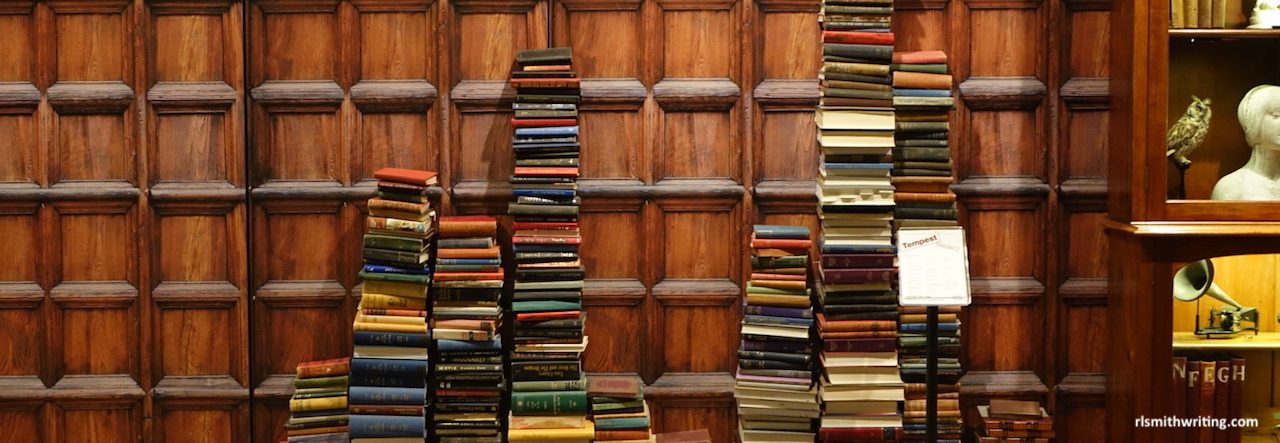
Categories can be hot air, Instrument Museum, Prague
It’s an interesting perspective given one of the other key pieces of advice for writers is to read widely across genres. Reading improves vocabulary, teaches us how to build narrative structure and tension, create interesting characters, and construct dialogue. Reading broadly also provides inspiration. If our creativity is enhanced from reading across genres, the result presumably includes some leakage from what we absorb to what we produce. Novel ideas emerge and the genre lines start to blur.
I just finished reading Kate Atkinson’s A God in Ruins. It’s an absorbing read as well as a great title. A saga about postwar Britain told from the perspective of a single family over four generations. I was captivated by Atkinson’s use of language. Her writing is elegant, poetic and humorous. The story is an expertly plotted, time skipping narrative with rich three dimensional characters. It is rare that a novel will bring me to tears, but some of main character Teddy Todd’s reflections on life did just that.
A God in Ruins is a historical fiction novel written by an author previously best know known by her mystery writing about protagonist detective Jackson Brodie, and her earliest works were family sagas. Atkinson has definitely not stuck to her knitting. She is an author who is unbound by genre conventions, rules and categories. She even makes reference to the genre box in A God in Ruins when Viola, Teddy’s writer daughter is on her way to a literary festival in Singapore.
…she was also down for a couple of panel events as well. The role of the writer in the contemporary world, popular versus literary, a false divide. Something like that.
Kate Atkinson, A God in Ruins
Image: Jacqui Stockdale, Mann of Quinn from the series The Boho – 2015, Adelaide Biennial of Art, 2016. Art Gallery of South Australia.
Atkinson is not alone in the endeavour of writing in different genres. She keeps the company of well known names such as Stephen King (science fiction, fantasy, mystery, and suspense); Margaret Atwood (children’s books, literary novels, speculative and historical fiction); and JK Rowling (children’s and adult mystery)
I love that Atkinson has written what takes her creative interest, rather than what might be expected, regardless of genre, and she done it always using her own name.
Would you be brave enough to defy a genre category?
“She had become really quite expert, she thought, at listening as though she didn’t listen, at sitting in other people’s lives just for a minute while they talked round her.”
Katherine Mansfield, Miss Brill
I’m a fairly quiet person myself, but a good listener, and there are gems among the mundanities of everyday conversations. Sometimes I am overcome with a desire to write down what someone says before it is lost in the onslaught of babble. I wonder if any of my friends will recognise themselves in snippets from my novel. The characters are all fictional of course, but some of what they utter is not.
When I write I tend to lead with dialogue. I find my story in the conversations between characters, then go back and fill out the spaces and places and body language. In reality much of our daily prattle is nothing but fill that would bore people to death if we stuffed our novels with it.
“I love to talk about nothing. It’s the only thing I know anything about.”
Oscar Wilde
Credible interactions in fiction are a long way from the chaos of everyday conversations. Dialogue needs to be tight. Stripped bare of small talk and stuffing (like umm and yeah) till all that is left is plot, character reveal, subtext and a rhythm distinct to each speakers vocabulary. It needs to be pruned to reveal what people want from one another, and to dramatise their power struggles. If it doesn’t serve a purpose – cut it.
What is not said tells us something
What is not said is as important as what is said. Like all writing, dialogue is show don’t tell – feeling is conveyed through choice of words. Body language and inner voice interspersed around, or interrupting dialogue demonstrates the feeling where the words themselves do not.
“I can’t wait to see Jane,” he said excitedly.
In this sentence, the dialogue itself conveys excitement, there’s no need to explain it to the reader a second time with an adverbial dialogue tag – a tell rather than a show. Dialogue tags should only be used when its not clear who is speaking and for the most part, kept pared back so they don’t distract readers. He said, she said, said David, said Jane, is usually sufficient.
Body language conveys feeling
Every character has a unique way of talking. Good dialogue opens up our fictional worlds and offers a sense of place and time. It draws out characters personalities and relationships, creates conflict and moves the story forward.
People who deliver endless monologues in real life are dull, and the same applies on the page. Dialogue is like a dance between characters. It mixes up exposition, and exposition keeps readers grounded in time and place when interspersed with dialogue.
Unless you are being experimental, dialogue generally conforms to conventions:
paragraphs are indented
each speaker starts on a new paragraph
punctuation for what’s said stays inside the quotation marks
when dialogue goes over more than one paragraph, only the end of the last paragraph has end quotation marks, all have start quotation marks
when the person speaking is quoting someone else, use single quotes
Study the work of some great dialogue fiction writers to see how they do it:
Peter Temple – Truth
Toni Morrison – Jazz
Douglas Adams – Hitch Hikers Guide to the Galaxy
John Steinbeck – Of Mice and Men
Hilary Mantel – Wolf Hall
Raymond Chandler – Farewell My Lovely
Elmore Leonard – Get Shorty
Read your dialogue out loud, or get someone else, or your computer to read it to you. If it doesn’t sound right, or you stumble it probably needs more editing.
“A good story is life, with the dull parts taken out.”
I recently completed, the Australian Writers Centre’s online course Inside Publishing – What You Need to Know to Get Published, which delivers a comprehensive overview of the global publishing landscape. This is a must do course for anyone thinking about publishing a book and not already familiar with how the publishing industry works. The course is self paced and contains five modules, each consisting of videos, handouts and links to relevant resources, all of which you can download for future reference. AWC does a great job of breaking down complex legal and technical concepts and explaining them in accessible language. It offers a terrific overview of how the publishing world its together, as well as providing handy tips for writers about to launch themselves into it.
The first module is about copyright – boring right? Surprisingly I found it fascinating. It explains in plain language how copyright works and the curious way it is carved up across geography, languages, film, television and books. It delves into what you own, what is yours to sell and the role of agents in getting you the best deal. Learn about the structure of the global publishing industry, the professional roles of various people who work in publishing houses, and how they make decisions. There are also tips on what to look for and what to avoid in the industry.
Module two focusses on the broad array of book formats – hardcopy sizes, audio, ebooks, why different book formats are produced and what it means for the author. This module then goes onto to explain how different formats relate to book marketing, buying, distribution, audiences, how sales are measured and how this guides publishing decisions about printing, as well as what happens to books that aren’t sold. The module also touches on the differences between the traditional publishing route and indie publishing and things to think about when considering which way to go.
The third module goes in deep on author editor relationships from the time they pitch to the final proofread. It explains all the different types of edits, the difference between editing and proofreading and the value of a good edit. Of course first you have to submit a manuscript and this module covers the pros and cons of submitting to agents versus direct to publishers and what you need to think about with both of these approaches. The resources include sample pitches and submissions, dealing with rejection, how to use rejections to improve your work and what happens after your receive an offer from a publisher.
Module four gets down to the nitty gritty of offers and what you need to think about, including how advances work, marketing, royalties, public lending rights (libraries), and educational lending rights, and an introduction to some of the things to look for in contracts.
Contracts is the focus of module five, which sensibly comes with a disclaimer that it’s not a substitute for legal advice. Make sure you’ve had your morning coffee as this is the serious end of the business and requires some concentration. This lesson talks about negotiating contract terms and goes into quite a bit of detail about the various clauses in standard publishing contracts. It ends with a little reminder that publishing is a business, so you have to approach your author journey professionally and do your best to educate yourself about how the industry and the publishing process work.
I got a lot out of this course and one of the best things about it is that when you enrol, you get access to the online materials for twelve months. I’m confident I’ll go through it a couple more times before that time is up and will learn a bit more with each viewing.
Each winter Melbourne hosts Rare Book Week which delivers a program of free talks and events across the city to celebrate the importance of books, literacy and literature. Twice this week I fought my way through the dark, windy and desolate streets of Docklands to Library at the Dock, which is a fabulous library and community hub if you are ever in the area.
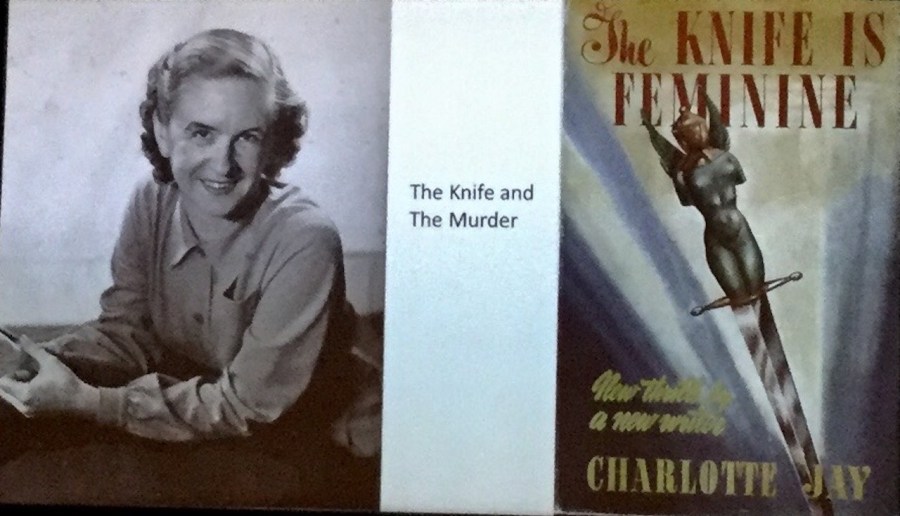
The events I attended were The Knife is Feminine about Australian mystery writer Charlotte Jay, and Portraits of Molly Dean in conversation with author Katherine Kovacic on her true crime book about the murder of Molly Dean in St Kilda in 1930. This blog is about those two events.
The Knife is Feminine
A dagger…it had a curious hilt shaped like a woman’s torso, with wings, only she had no face, just a visor like a knight.
The knife is feminine, Charlotte Jay
I’d never heard of Charlotte Jay, but as it turns out she was one of Australia’s best crime and thriller writers and I will certainly seek out some of her work to read now. Panel members for this event were Carmel Shute (one of the founders and national convener of Sisters in Crime), author Katherine Kovacic (The Portrait of Molly Dean and Painting in the Shadows), Abbe Holmes (actor) and Chris Browne (convener of Rare Book week, former academic and a book collector with 12,000 books and counting).
Charlotte was born Geraldine Mary Jay in Adelaide in December 1919, she chose the author name Charlotte because she thought it sounded literary. She married Albert Halls, an Oriental specialist who worked for UNESCO, and she spent much of her adult life traveling the world with him. Initially she worked as a stenographer for twelve “terrible years,” according to an interview Carmel Shute did with her in 1992. When she realised she had a talent for frightening people and telling a good story so became an author. Carmel observed that in life Jay had a liking for gin and tonic and a habit of snorting when she found others ideas ludicrous.
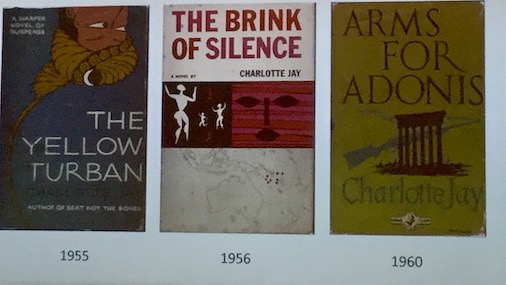
The author wrote seven crime novels as Charlotte Jay between 1951 and 1964, one as Geraldine Mary Jay in 1956, and seven as Geraldine Halls between 1967 and 1995. The stories in her novels included exotic settings like Papua New Guinea, Pakistan, Japan, Thailand, England, Lebanon, India, the Trobriand Islands, as well as Australia.
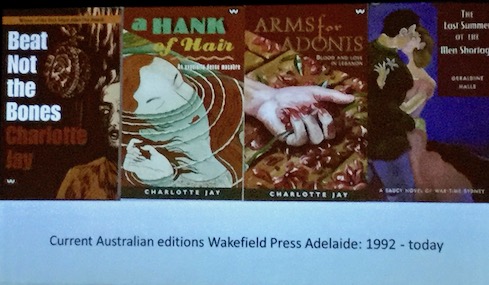
One of her books, A Hank of Hair was so risqué that Harper Collins refused to publisher it. The book was later picked up by Pan Publishing and released in 1964. Another novel, The Fugitive Eye written in 1953 was filmed for television and stared Charlton Heston. Her first novel, The Knife Is Feminine is out of print and there are only a handful of copies still in existence worldwide. We were lucky enough to get a couple of readings from one of those copies.
She wrote in the Gothic tradition and hearing her work, Charlotte Jay had a talent for the weird . She used slow, creepy build ups and detailed observations to tell cracker stories. She was the first winner of the Edgar Allan Poe Mystery Writers of America Award for Beat Not the Bones set in Papua New Guinea, which has some fascinating commentary on racism and colonial power in the 1950s. The following year Raymond Chandler won the award with The Last Goodbye.
The writer eventually returned to Adelaide and her last book was published in 1995, she died in October 1996. I for one shall look forward to reading some of her works, which are listed below.
Charlotte Jay novels
• The Knife Is Feminine (1951)
• Beat Not the Bones (1952)
• The Fugitive Eye (1953)
• The Yellow Turban (1955)
• The Man Who Walked Away (US Title: The Stepfather) (1958)
• Arms for Adonis (1960)
• A Hank of Hair (1964)
Geraldine Mary Jay novels
• The Feast of the Dead (US Title: The Brink of Silence) (1956)
Geraldine Halls novels
• The Cats of Benares (1967)
• Cobra Kite (1971)
• The Voice of the Crab (1974)
• The Last Summer of the Men Shortage (1977)
• The Felling of Thawle : a novel (1979)
• Talking to strangers : a novel (1982)
• This is My Friend’s Chair (1995)
Portraits of Molly Dean
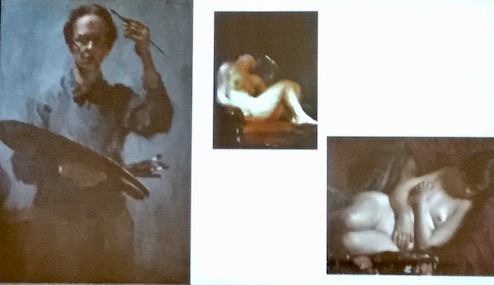
Mary (Molly) Winifred Dean (1905–1930) was brutally murdered in Elwood on 21 November 1930 near her home after walking home late one night. Author of The Portrait of Molly Dean, Katherine Kovacic first came across Molly when studying the art of painter and sculptor Colin Colahan and became fascinated by her life which seemed to have been reduced to a single sentence in a Colahan’s biography. Molly had been Colahan’s lover and one of his models.
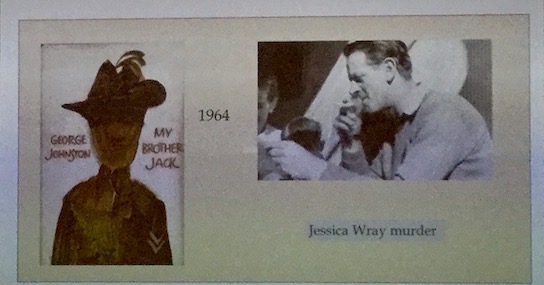
The historical mystery fiction, The Portrait of Molly Dean, was written to shine a light on Molly’s life, which along with her death feature in a number of other works. She was the subject of non-fiction A Scandal in Bohemia: The Life and Death of Mollie Dean by Gideon Haigh, and appeared in fiction works My brother Jack by George Johnston, and The Eye of the Beholder by Betty Roland, as well as the play Solitude in Blue, written and directed by Melita Rowston.
Molly Dean trained as a primary teacher and showed great promise for the profession but aspired for journalism and writing. She had had one long blank-verse poem titled Merlin published in a Melbourne publication called Verse.
Young Molly had a strained relationship with her widowed mother, Ethel Dean, who didn’t approve of Molly’s involvement with the Bohemians – the Meldrumites (followers of painter Max Meldrum) who Molly met when she became intimately involved with Colin Colahan, a well-known sculptor and painter of nudes.
On 20 November 1930 Molly went to the theatre to see Pygmalion with friends. She arrived at StKilda station on the way home, but missed the last tram, apparently due to stopping to make two phone calls to Colin from a phone box, so walked the two kilometers to Elwood along the tram route to the corner of Mitford and Dickens Streets. There were a number of sightings of her as she walked, but no witnesses to her attack. She was discovered early on Friday 21 November severely injured in a laneway less than two hundred meters from her home. She was rushed to hospital but she died of her injuries.
The police believed that due to the nature of the crime, Molly probably knew her attacker and the motive was most likely jealousy. An intense and exhaustive police investigation followed her death. A family friend, who was suspected of having an affair with Ethel Dean was investigated then dismissed. A man called Arnold Karl Sodeman, who confessed to four other killings, was also considered. His involvement was dismissed primarily due to his other attacks having very different profiles, and that he swore he wasn’t Molly’s killer. Sodeman was executed in Pentridge Prison in 1936 for the crimes he admitted.
The Crown Prosecutor did not proceed with the case and conspiracy theories abounded about Molly’s unsolved murder over the years. One theory suggested it wasn’t solved because she’d crossed paths with very powerful people in Melbourne, and they had shut down the investigation.
Artist Colin Colahan
Katherine Kovacic’s fictionalised account of Molly’s story is a fascinating tale of art, intrigue and murder, and Melbourne’s history. Her melding of fact and fiction patches together a coherent and sensitive narrative to re-tell a victim’s story and shine a light on her young life. It’s told from the perspective of a fictional art dealer called Alex who buys a painting in 1999 believed to be the last portrait of Molly Dean. Kovacic has released a second book Painting in the Shadows that also revolves around Alex, and a third is due out next year.
For the section of this blog on Molly Dean I have drawn on Kovacic’s talk at Rare Books Week and a piece published on the Public Records Office website by Dr Eric J Frazer about her murder.
Main image: Charlotte Jay and The Knife is Feminine
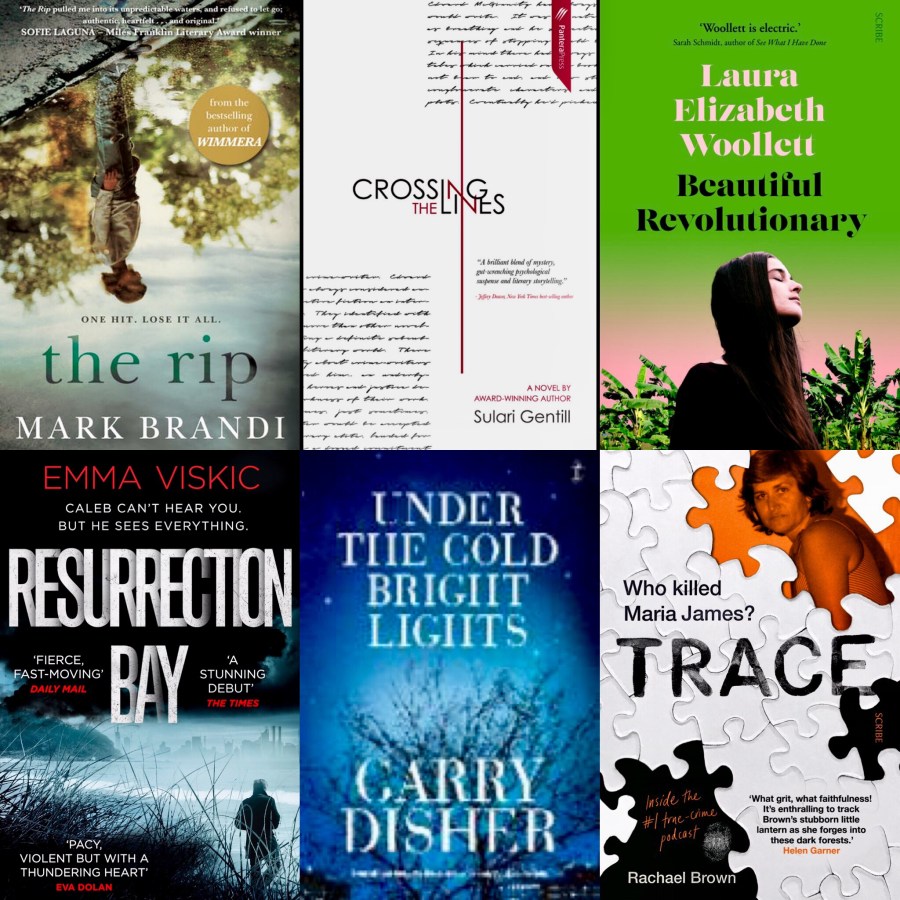
The Wheeler Centre are running a mini series to spotlight Australian genre writers. This weeks discussion focussed on crime writing and hosted an impressive line up of guests:
Emma Viskic, author of the Caleb Zelig series Resurection Bay, Fire Came Down and Darkness for Light (due out this year). Her debut novel won the 2016 Ned Kelly Award for best debut, as well as three David Awards.
Garry Disher has written two crime series (The Whyatt novels and The Challis and Destry Novels) as well as a number of stand alone crime novels (including Bitter Wash Road and Under the Cold Bright Lights), and a significant number of young adult, children’s, non fiction and short story works.
Sulari Gentill, author of historical crime series the Rowland Sinclair Mysteries, and fantasy adventure series, The Hero Trilogy and her most recent novel Crossing the Lines.
Rachael Brown, ABC journalist and creator of Trace, a true crime podcast about the cold case of the murder of single mother Maria James at the back of her bookshop in 1980. The series resulted in a new coronial investigation. Brown has also written a book of the same name
Laura Elizabeth Woollett, author of The Wood of Suicides, short story collection The Love of a Bad Man (shortlisted for the Victorian Premier’s Literary Award for Fiction and the Ned Kelly Award for Best First Fiction) and her latest novel, Beautiful Revolutionary.
Mark Brandi, author of Wimmera (winner of the Debut Dagger, UK) and The Rip.
The night opened with Emma Viskic speaking about the history of crime in Australia, that our map is a map of massacres and because of white mans beginnings we are a country of outsiders. It was pointed out that the outsider trying to decipher a crime and a place is a common trope in the genre.
Mark Brandi reflected that humans like to ask what it means to be a good person, and how to live a good life. We like crime stories, and they matter, because they are all about what it means to be good, and what it means to be bad. He wrote The Rip to help him make sense of his time spent working in the justice system.
Crime fiction is about the restoration of order, not the murders themselves. The authors discussed how crime fiction shines a light on the murky business of being human and can offer an understanding of why people do what they do to one another. These stories allow readers to sit at the shoulder of a evildoers and scoundrels from a safe distance and strive to understand. Readers are comforted that criminals are punished, or at least understand in noir and that when it all goes to hell, no matter how bad things get, someone will stand up and resist.
The best crime writing requires empathy, and for writers to see the world differently. A theme can drive a book and tell us something about human frailty and the world we live in, and we can delve into the political and social dimensions of crime in a deep way to foster understand, if we write with compassion.
Australian crime writing has the appeal of the different and dangerous, partly because of our landscape. There have been whispers around for some time that an Australian crime wave would replace Nordic noir in popularity, maybe it’s our time? The speakers thought Australian crime writing was of a good quality because authors don’t write for the money, it’s almost impossible to make a living just from writing, so they write because they have something to say – perhaps that makes it better.
There were some funny moments as well at the event, like when Sulari Gentill claimed crime writers as the cool kids of fiction and that she imagined they would be of more use than a poet if she ever need to fight her way out of a situation.
During question time one audience member asked who the authors favourite crime writers were (other than each other) and we got the following responses:
Peter Temple, Jock Serong, Harper Lee, Joyce Carol Oates, Helen Garner, John Sandford and Michael Connelly
Can you guess which favourite goes with which guest?
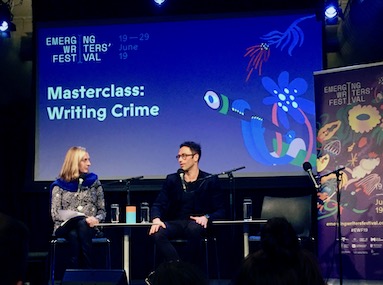
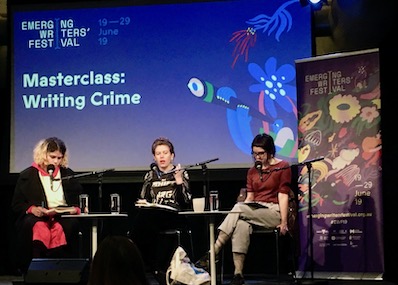
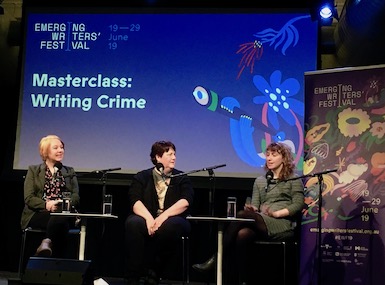
Last week I attended a crime writing masterclass as part of the Emerging Writers Festival held at the Wheeeler Centre in Melbourne.
Anna George and Mark Brandi
The day opened with Angela Savage, author and Director of Writers Victoria, delivering a keynote on Conventions of Crime. Angela took us on an engaging and entertaining gallop through the history of crime fiction. Then she explained the breakdown of crime genres from cosy mysteries like Alexander McCall Smith’s The No. 1 Ladies Detective Agency, hard boiled crime such as Raymond Chandler’s The Big Sleep, Australian noir including Peter Temple’s Jack Irish series and the social thrillers – think The Girl with the Dragon Tattoo by Stieg Larsson.
And here’s a couple of ‘did you know’ fast facts from Angela’s talk:
• Agatha Christie is the best-selling fiction author of all time with an estimated two billion copies of her books in print. Her work has been translated into more than 70 languages and she is outsold only by the Bible and Shakespeare. Not bad considering her first book was rejected by six publishers.
• Tart noir (originally called slut noir) is a branch of crime fiction characterised by tough, independent female detectives, who are also yielding enough to love a man with rough edges. Go girrrls.
• Mysteries, where the antagonist is revealed at the end to both the reader and the protagonist, are considered easier to write than thrillers, which require tight plotting to maintain suspense.
Nayuka Gorrie, Queenie Bon Bon and Gala Vanting
The second session had Mark Brandi (author of Wimmera and The Rip) and Anna George (The Lone Child and What Came Before) chatting about plotting and pacing and how they approached these in their own writing. It became clear that each book is different and your approach to plotting and pacing might need to be adapted to work for the project on hand.
Angela recommended Ronald Knox’s Ten Commandments of Writing Detective Fiction reproduced here by cosy mystery author Elizabeth Spann Craig.
In session three, Gala Vanting, Nayuka Gorrie and Queenie Bon Bon discussed the notion of Representing Criminalisation, a feminist perspective on writing socially aware crime fiction. This session wasn’t for everyone (a couple of blokes walked out), but I found it a fascinating discussion on the realities of criminalisation and how we might use our crime writing to look differently at societal power structures and the politicisation of marginalised communities. They challenged us to unpack our notions of ‘the criminal’ and ‘the victim’ and what we interpret as ‘good’ and ‘bad’.
Their discussion lent itself to activist crime fiction, or radical noir. Think Eva Dolan, This is How it Ends, Gary Phillips, The Underbelly, Kate Raphael, Murder Under the Bridge and John le Carré, The Constant Gardener.
(?), Lindy Cameron and Anna Snoekstra
After a bite to eat at the Moat for lunch, I settled in to listen to Anna Snoekstra (Spite Game and Mercy Point) and Lindy Cameron, Sisters in Crime President and founder of Clandestine Press, talk about to agent or not to agent, the importance of a good synopsis, and thinking beyond our own shores for publishing. They said all crime novels need a good sense of place, a twisty mystery, and engaging characters to attract the attention of publishers.
One of the most memorable suggestions was to try different elevator pitches with every person who asks you about your book to see which is the best one…lookout friends, is all I can say to that.
Here are some resources they recommended to assist with your publishing journey:
•Query Tracker – an international agent database, that is free to join.
•The Australian Writers Marketplace – a guide to the writing and publishing industry in Australia and beyond, it has over two thousand active listings in the directory. AWM is free to join for basic use of pay a one off $24.95 for complete access.
The final session, Killing your Darlings, was delivered workshop style by Kat Clay. We talked cliches about killing people in fiction, understanding the moral argument and symbolism of murder in fiction, and thinking about what death means to our characters in terms of their development – it’s a very different matter if they are afraid of their own mortality than if they live for the thrill of being close to death.
Kat’s resource tip was Anatomy of Story by John Truby
This week I went to see Gertrude Stein’s DoctorFaustus Lights the Lights. It’s the story of a scientist who trades his soul for electric light, obliterating the difference between night and day. It was an experience that required letting go – letting go of expectations of what to expect from a stage play. There was no neat plot to carry us through, and no temporal logic.
Guggenheim, New York
The piece was a beautifully executed avant-garde romp with ambiguous and fractured identities that transitioned through a struggle between good and evil, and grappled with the notion of the individual. The script was poetic with looping lines that were deliberately repetitive and sprinkled with short acidic words that blurred the boundaries between dialogue and narrative. I was left for much of the production with a sensation of hearing the voices inside someone’s head.
I am not talking about the terrifying voices that haunt the sufferers of severe mental illness and render them lost to themselves for periods of time, I am talking about the quieter voices that chatter away in our heads. The voices that self sooth or offer observations, instructions, praise or admonishments in a way that we understand them to be part of ourselves, or that spill out of us onto a blank page in a controlled way to tell our stories. The inner voices that can speak the unspeakable, threaten, challenge, or desire in ways we believe our true selves never would in real life. The voices that take us deep within ourselves whilst simultaneously suspending us from our own realities. The ones that cause me to look up from a page and wonder where the words have come from.
Museum of Contemporary Art, NSW
The conversations of the brain were once seen as mythic – the rumblings of gods or shamans, but in reality our inner voice is the stream of consciousness that speaks when no one is listening but us. For most of us it is rarely shared with anyone, except when it erupts in moments of stress, or we lay on the couch and expose it to a therapist in an effort to understand, tame, or change it.
Look around you at the people walking down the street in silence and imagine their inner worlds teeming with chatter, or notice them trying to drown it out by plugging their ears with music that carries them to other places. Imagine the anarchy if all that chatter and noise was unleashed on the world uncensored.
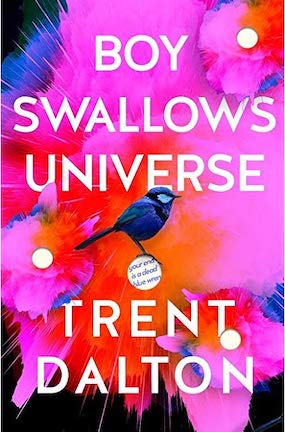
In fiction we often talk about finding our unique voice, the one that can tell a tale in a way that no other can, that leaps off the page and turns words into three dimensional characters. Fiction is a realm in which we seek the unfettered and extraordinary. The more outlandish, edgy or strange our voice the better, as we try to take our readers to the edges of believability or to interrogate matters we may not dare to in real life. In fiction the inner voice can put a characters humour on display in serious situations such as in Boy Swallows Universe by Trent Dalton:
Watch my language? Watch my language? This is what really shits me, when the clandestine heroin operation truth meets the Von Trapp family values mirage we’ve built for ourselves.
Boy Swallows Universe, Trent Dalton
The Metropolitan Museum of Art, New York
In fiction inner dialogue is like the voice within the voice. It is a mechanism that defines character in a way that dialogue and narrative cannot. It exposes our characters inner dilemmas, self perceptions, contradictions, humour and fears, making them available to the reader even though they are kept hidden from other characters. Inner dialogue invites us into stream of consciousness to bare witness to the fragmented, messy reality of what it means to be human.
Jack nodded vaguely. Merry was only recounting what she’d overheard, what she’d read, what she’d imagined down the years. He wondered suddenly if that’s how everyone constructed their own past – with the experiences of others, and photos, and headlines and snatches of reality, all mashed together into memories that they claimed as their own. For the first time he thought that the photo of them all, happy and with the wind in their hair, might never have existed either. Maybe it was all in his head and he’d only imagined it on the fridge, and the little frame he’d stolen from HomeFayre would be empty for ever.
Snap, Belinda Bauer
The Museum of Modern Art, New York
Inner dialogue is commonly used in written fiction and sometimes on stage, such as in Hamlet’s well known soliloquy which opens with the words ‘to be or not to be’. The mechanism is rarely seen on the screen, though one exception is the television show Offpring in which the main character’s inner world is put on display in all its anxiety ridden psychedelic glory in a way that blurs Nina’s inner and out worlds. It is the use of that technique more than the plot itself that has drawn me to the show. I love the way her inner world looms up and threatens to derail her with the suddenness of a gusty wind.
Of course the original story of the erudite Faust is that he was highly successful yet dissatisfied with his life as a scholar. He made a pact with the devil to exchange his soul for unlimited worldly pleasures and knowledge and surrendered his moral integrity for power and success. The devils representative was Mephistopheles who helped Foust seduce a beautiful and innocent girl called Gretchen who’s life was destroyed when she gave birth to Faust’s bastard son and drowned the child. One can’t help wonder if both Faust and Gretchen where victims of their own inner dialogues rather than some external other worldly force though.
Storytelling existed long before the printed page came into existence. The earliest known discovery dates back to around 14,000 B.C. to the Lascaux Caves in the Pyrenees Mountains in southern France. The story drawn on the walls of a cave in pictures depicted the hunting practices and rituals in the area. The first printed word story was the epic of Gilgamesh carved on stone pillars thousands of years later in 700 B.C.
Rock Art, Utah
Of course oral storytelling has been a central part of human cultures for thousands of years, but dating it exactly, like dating when humans first began to speak, is impossible because words leave no trace in the archaeological record. Over time stories have been used to preserve cultures across generations, to teach social norms and transmit knowledge, to create community cohesion, and to entertain. Storytellers were the healers, the spiritual guides, leaders, keepers of culture, entertainers or jesters, and they transmitted their tales in the form of songs, poetry, orations and chants.
In some senses humans are stories because we are made up of the narrative constructs of our lives. Stories are how we are remembered, and how we remember others. A narrative is a powerful tool, and lives can literally be changed by them. Remember the books that influenced you as a child and moulded the way you think today? Stories give children access to their rich imaginations and deep fantasy lives and build emotional literacy. They help us to make sense of our world as well as challenge us to think about the world beyond our own narrow limits.
Telling Tales, Lamen Island, Epi, Vanuatu
For writers who subject themselves to the monkish like isolation required to create stories, writing is an activity that takes us deep within ourselves and draws us out all at the same time. An idea is often seeded by something that happens in the world around us, but when I look at what I have written retrospectively I usually wonder where it came from.
While I edit I have been thinking quite a bit about the difference between the written and oral forms of storytelling, because I use reading my work out loud to help with editing. Reading out loud allows me to hear the cadence, pacing and rhythm of my work. It puts my writing on display in a way that the written word does not.
An editor I know recently suggested I actually get someone else to read my work back to me as part of the editing process. She says how you hear your work is different again coming from another person and the exercise can help to further improve it. Getting someone else to read your work is particularly useful for grammar as it makes your realise that commas are far from meaningless markers. They cause a pause, or a breathe in vocalisation that you would not always pick up in silent reading. Punctuation alters the tone of the words they punctuate by indicating a change of idea, an increase in detail, or a change of speaker. Used incorrectly punctuation can confuse the reader, and when we confuse readers we throw them out of our stories.
DOX Centre for Contemporary Art, Prague
I have been listening to a few audio books recently – and I do love an audiobook. They mean I read more because I can listen to them gardening, driving, walking, or when my eyes are too tired for the page. Though you do have to be wary of listening when you go to bed, because whilst it’s a lovely reminder of being read to sleep as a kid, there’s the risk of missing half the tale if you start snoring and the book keeps playing.
Well narrated audio books are an immersive experience that pulls you into the story when the reader infuses it with emotion. They can manipulate the pace by reading faster or slower, and vary tone and pitch for different characters to bring them to three dimensional life. You can’t skim an audiobook the way you can the printed word and in listening you can focus on the bricks of detail to notice how the writer has constructed the story. You can hear how they grab your attention and draw you deeper in, or do something that pushes you away, such as using large slabs of narrative that create distance.
I’ve been listening to Boy Swallows Universe by Trent Dalton this week. It was named book of the year at the Australian book industry award and won audiobook of the year as well as a string of other acclamations. The story is based on Dalton’s own childhood growing up in a suburban Brisbane housing commission amongst drug dealers and criminals. Dalton’s use of dialogue is often hilarious, and his prose is evocative. He uses colorful details and wordplay to describe the minutiae of life and the deepest inner thoughts of Eli, drawing out the young narrators surreal imagination and philosophical meanderings. I’m only about half way though the audiobook but suspect I may want to turn around the read the written version as well when I’ve finished to see what I can learn there.
Main image: DOX Centre for Contemporary Art, Prague
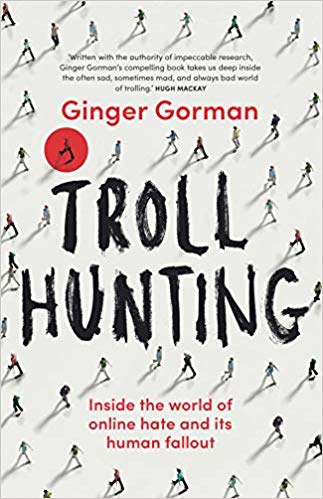
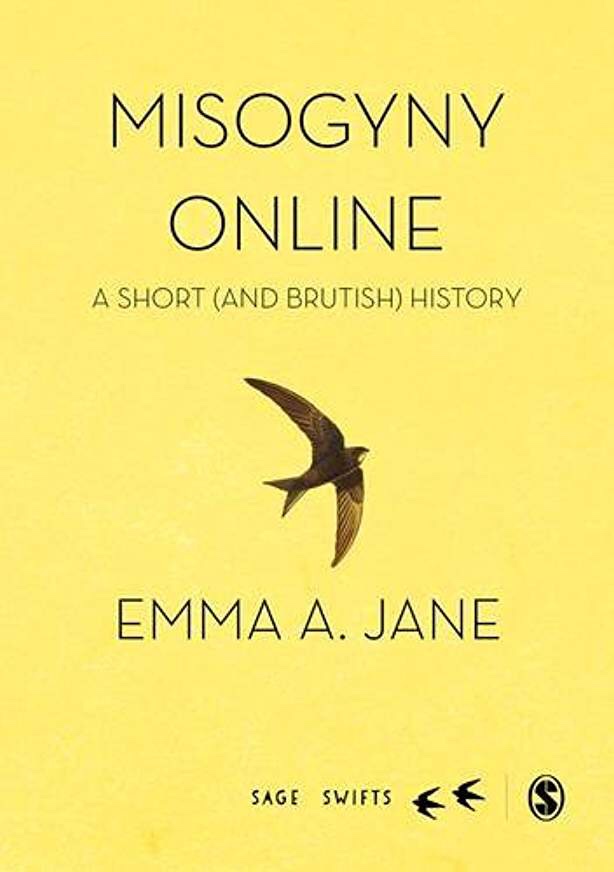
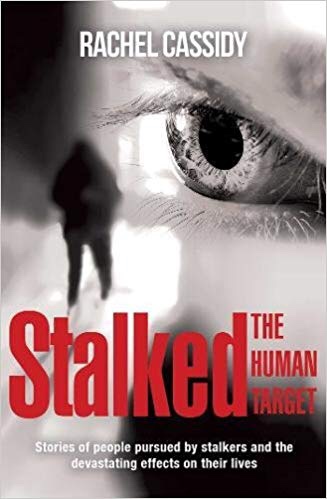
Sisters in crime hosted a Law Week event in partnership with Victoria University last week on the subjects of Stalking, Trolling and Cyber-Bullying. The Age journalist Wendy Tuohy, interviewed authors Ginger Gorman (Troll Hunting: Inside the world of online hate and its fallout), Emma A Jane (Misogyny Online: A short (and brutish) history) and Rachel Cassidy (Stalked – The Human Target) about predator trolls who use technology to bully, troll or stalk their victims to the extreme.
The author talks were reminiscent of Eileen Ormsby, author of The Darkest Web: Drugs, Death and Destroyed Lives, whom I listened to at Adelaide Writers Week. Ormsby talked about how the internet (her focus was the dark web) has created a safe place for bad people to meet, talk and normalise one another’s antisocial behaviour.
The Law Week speakers described the perpetrators of predator trolling as primarily narcissistic, entitled, anglo, straight young men. They often work in well organised, structured syndicates and find someone to target who they see as the ‘other’. They search for a targets weakness and then threaten harm or incite them to hurt themselves. They then set out to demonise, dehumanise and harm by choosing some characteristic (religion, ethnicity, gender, sexuality) to focus their harassment on.
Gorman drew the analogy that cyberhate is the modern day version of workplace harassment and domestic violence. It was an interesting observation on the internet as a social device. As a communication tool the internet can amplify both the good and bad of what has historically only happened in the school yard or the workplace. However, unlike the schoolyard or workplace, there is little, if any attempt to moderate or prevent harmful behaviour online and without moderation or regulation the internet can become like the island in Lord of the Flies.
Ginger Gorman was not entirely without empathy for some of the men she met online, despite having been the victim of trolling herself. She spent some time exploring the common characteristics of those who become predator trolls and found quite a lot of unhappy upbringings in disfunctional families, where parenting was outsourced to the internet and children were left vulnerable to grooming by other angry disenfranchised people online. An experience that perpetuated hate. She also found many trolls to be educated intelligent, but hateful men (mostly), some of whom were married with children and you probably wouldn’t connect with this behaviour if you met them in passing in real life.
When disenfranchised individuals get together in unregulated forums that enable anonymity, bad behaviour can snowball and become amplified. It’s a sad reflection on what’s broken in society if support structures aren’t available for either the disenfranchised youth who are destined to become predator trolls given the right set of circumstances, or the victims they harass.
Gorman has been heavily criticised by some for giving attention to the people she met online, but having been a victim of trolling herself I suspect she did not undertake the exercise lightly. It’s a complex area that will not change without shining a light on it.
It will be interesting to see if cybercrime starts to creep into more crime fiction narratives in the coming years as there’s certainly plenty of content for it. The three authors at Law Week have produced non-fiction works that will prove to be excellent research material for fiction writers with an interest in this area, and present some fascinating insights and plenty of food for thought. The take away message for me was a comment by one of the speakers at the end…













 R L Smith