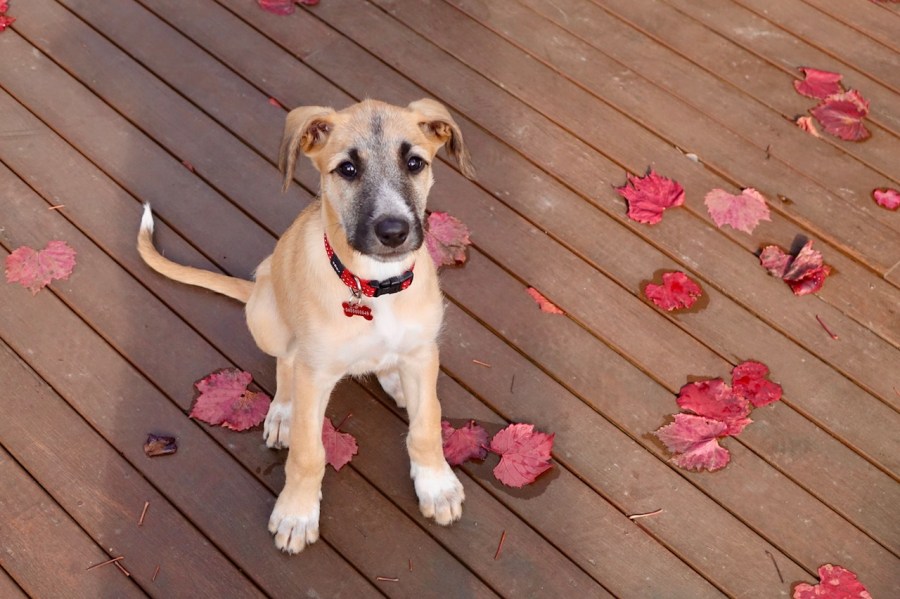
staghound cross puppy with autumn leaves

Animal Farm

Animal characters have had central roles in well known fictional stories. A personal favorite was the 1877 novel Black Beauty by Anna Sewell about the life, Harper 1tribulations and adventures of a sleek black horse. Black Beauty highlighted the issue of animal welfare and the importance of treating others with kindness, respect and sympathy. Important lessons for any child. Roald Dahl bought garden bugs to life in his 1961 novel James and the Giant Peach that explored the themes of friendship, death, hope, fear, abandonment, rebellion and transformation. I remember being fascinated by the giant caterpillar who had to tie the shoe laces on his many pairs of boots every morning. The book is still on my shelves and I pull it out and re-read it every now and then.

Stories with animals are not only for kids either. The epic 1851 classic Moby Dick by Herman Melville explores the 19th Century whaling industry in all its brutal glory and has the giant sperm whale as a central character representing nature’s wildness.  At times Melville takes on the non-human perspective imagining how appalling the whaling fleet must appear to a surrounded wounded whale.

There’s also George Orwell’s 1945 classic Animal Farm about the lead up to the 1971 Russian Revolution and the Stalinist era of the Soviet Union. The themes of corruption, class and abuse of power play out using the Harper 5allegory of the Manor Farm ruled by pigs. As power goes to their heads the pigs start to run the place on the premise that “All animals are equal but some animals are more equal than others.” They become so much like the humans they overthrew that eventually they transform into humans themselves.

Like any character, an animal in a story needs a reason to be there, and a reason why the writer chose an animal rather than a human character. It needs to have a place in the plot of the story whether it’s idealistic, political, satirical, comedic, allegorical or fun. Will the animal character appear clearly as an animal or take on human characteristics; will it be a pet or wild; what is the message it will convey?

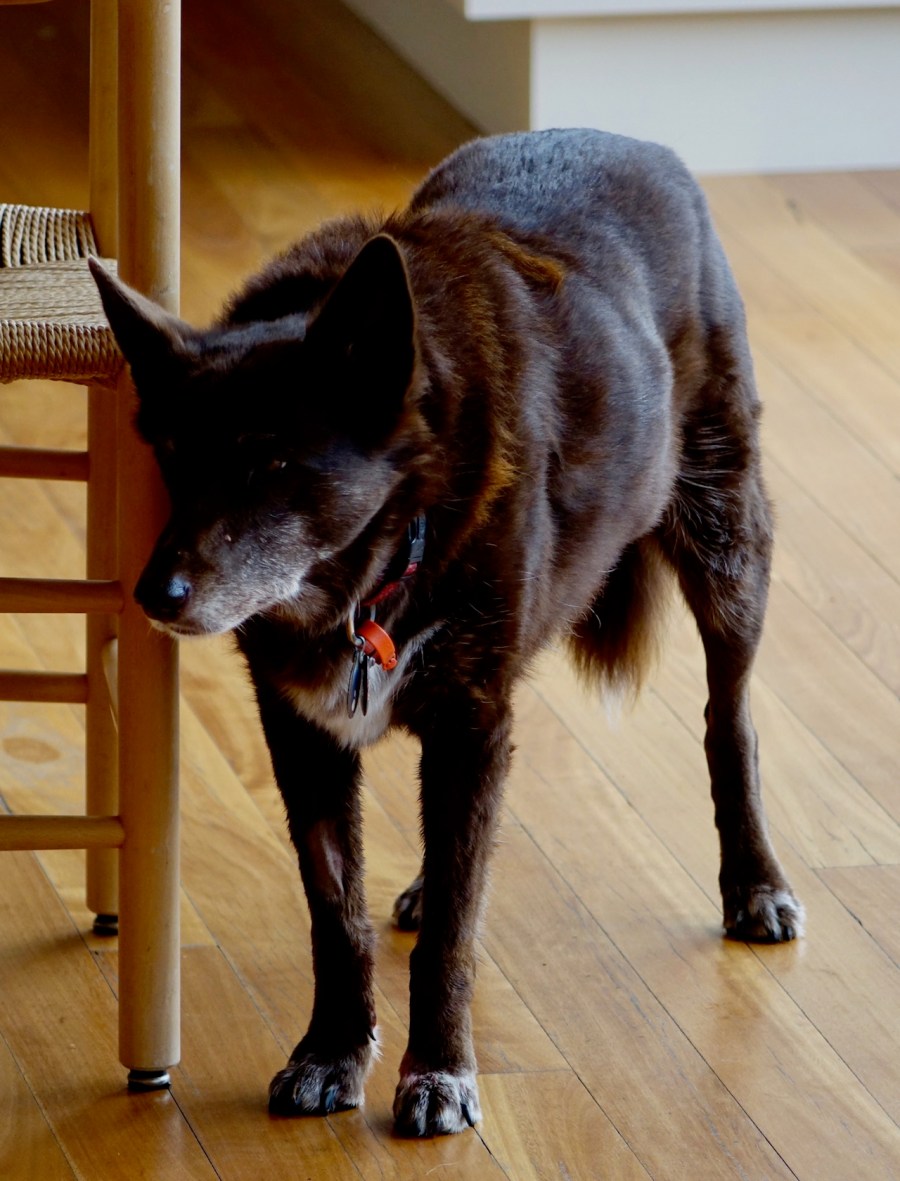
My own ability to write fell in a hole recently. It was not due to a lack of motivation, enthusiasm or ideas. There was no writer’s block and I did not fall ill. In fact it would be Harper 3fair to stay things were going swimmingly. I had established a great routine of writing early, doing some exercise then either writing again, reading or heading out into the garden depending on the weather.  Then along came Harper.

I was missing my old dogs company and started thinking about getting another one so I signed up to a rescue site called Petrescue. It’s like a dating site connecting up animal rescue organizations with people wanting to adopt a pet. Pictures of cute furry animals can be distracting and the real thing is a whole other level of disturbance.

Harper came from somewhere around Wagga Wagga via Seymour. The advertisement on Petrescue had very little information. Sweet little female mixed breed dog. Sleepy, playful and cute.   Several emails and a phone call to the foster home led to filling out the adoption papers and agreeing to meet.

Harper 6Many country dogs get adopted in Melbourne, and Seymour is a liaison point apparently. The industry is quite mysterious and I think there could be a great fiction story written about the rescue, movement and adoption of animals.

We drove to the rendezvous point in Kings Park and met a lady there with a car full of rescue dogs. I didn’t want another dog like Jarrah (my old kelpie), as it would have felt like I was being unfaithful to my old friend. The puppy was a leggy, sandy colored thing with a slightly worried look. An Australian Staghound crossed with something of unknown origin – probably some kind of cattle dog like a kelpie.

We weren’t sure about whether to take her or not. Then this guy from Pakenham turned up to look at Harpers brother. He picked up the puppy without hesitation, threw it over his shoulder and started filling out the necessary paperwork. He said he had a Harper 7Staghound-kelpie cross at home. “Best dog he’d ever had,” he said, “affectionate, trainable and not as energetic as a kelpie. Likes to lie around on the couch and watch TV.” Sounded like an ideal writing companion.

It does of course take some time to get from puppy to writing companion and after puppy Saturday all writing stopped and novel reading was replaced by books and blogs and videos on puppy wrangling and several days of utter chaos as we got to know Harper and visa-versa. Within three days she had gotten the hang of going outside to the toilet and would come, sit and drop as long as there weren’t too many other distractions. We had also introduced her to ceiling fans, hair dryers, vacuum cleaners, steel and wooden stairs, the shower, collars, coats, leads, a frisbee, tennis balls, new Harper 2people who dropped by and Bunning’s. Believe it or not Bunning’s has a very detailed dog positive policy and we were able to take Harper around the store introducing her to the weird and wonderful world of the great Aussie tradition of a trip to the hardware store.

We had our first day at puppy school to start our long learning adventure together. Each day consists of a cycle of eat, sleep, play, starting at about 6am. I’m particularly fond of the sleeping part and I am hopeful we will settle into a new routine soon so I can get back to some writing. My book does have two dogs in it so I look forward to Harper becoming an inspiration rather than a distraction.

What’s your favorite fictional animal character?

Image: Harper and autumn leaves
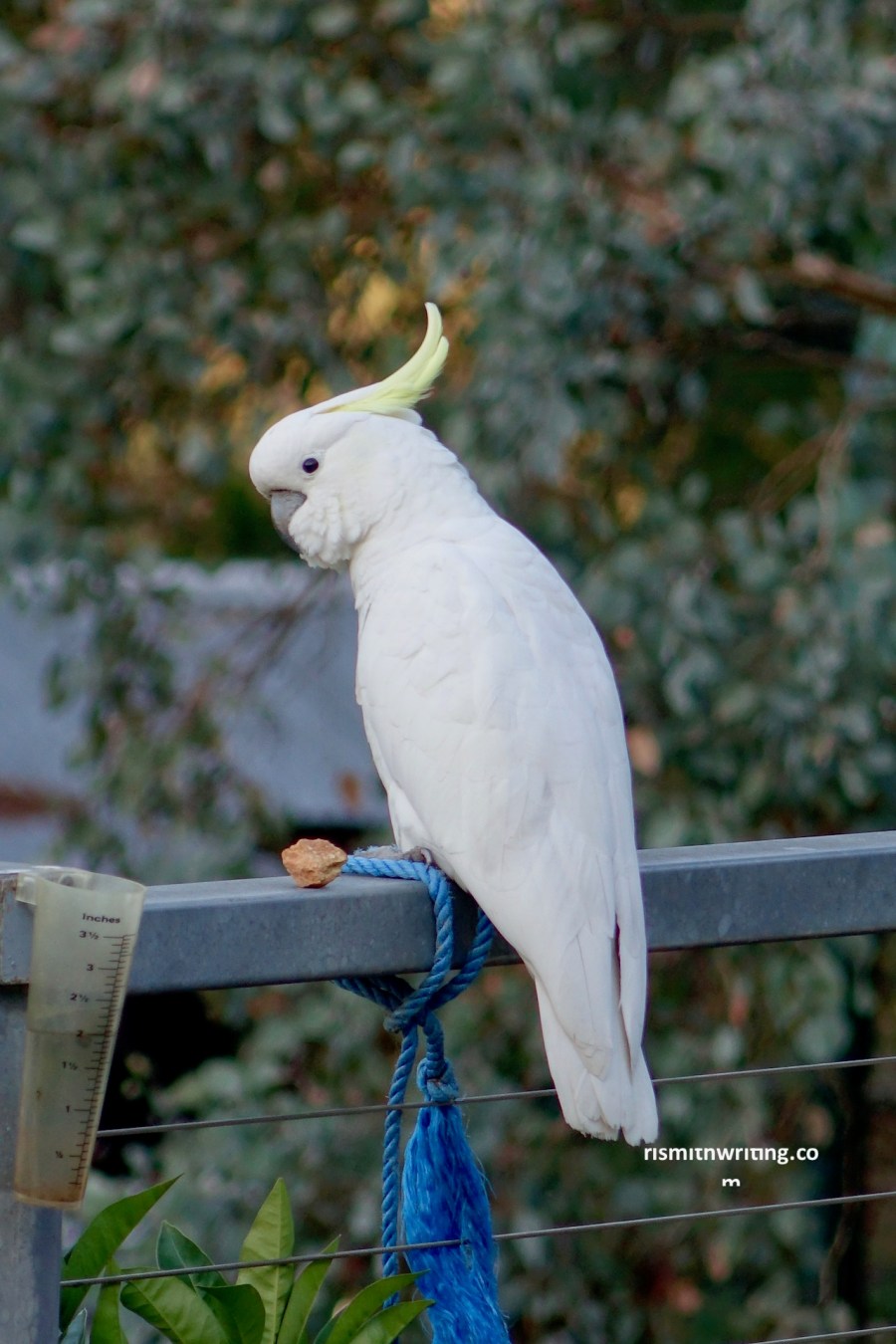
sulpher crested cockatoo

What a galah!

Oh, don’t you hate it when you get it wrong? Galahs are the pink and grey cockatoos. That is not the same as a sulphur-chested cockatoo like the marauder in the picture. He is not a galah, even though they are both cockatoos. And while a cockatoo is not a galah, it is a parrot. And those green and red ones we think of as parrots, like the king parrot, are not cockatoos or galahs even though all of these birds are parrots. Confused yet? It’s a hierarchical classification thing. I remember learning it in zoology.

The word cockatoo doesn’t just mean our white and yellow feathered friends either. In Australian slang a person who keeps watch whilst their mates undertake clandestine activities like gambling is sometimes referred to as a ‘cockatoo’. Probably because they’re expected to squawk if they see the coppers coming. And completely unrelated to birds or illegal activities, small-hold farmer are often referred to as ‘cocky farmers’ on account of real farmers not taking them seriously. Come to think of it I’m probably a bit of a cocky farmer myself. And lets face it, we can all get a bit cocky sometimes.

A couple of weeks ago, I found one of ‘those’ errors whilst working on my third draft. I’m not talking about spelling errors here. I’ve talking about the kind of error that makes you kick yourself for not picking it up in your very early research.  Because it’s the kind of blindingly obvious thing you should have checked. And it’s the kind of error that once seen, cannot be unseen. It demands a major rewrite of the start of your book. The kind of error that results in a dummy spit and self flagellation for your own stupidity. You consider giving the whole project up. Taking your bat and ball and going home.

We all have them. Those moments when we just want to throw in the towel and give up. After a good run and a few days of wrestling with my inner five year old demon I started pulling up my bootstraps. I couldn’t actually bring myself to return to the work immediately. Sulking does not after all produce good creative output. So I did the only thing I could and worked on something else completely unrelated to try and get my mojo back.

The short story format is wonderful for so many reasons. It can break the back of writers block and bad moods, give you a sense of accomplishment and remind you that you can actually finish things. And they are a great place to pump out all that animosity about an error. I went for a noirish mystery of the type where no one is spared. I killed off all the characters except for the opponent by poisoning them. It did a ripper job of getting the poison out of my own system too. Then I settled down and got back to the main game.

I re-plotted the first 9 chapters. It’s not entirely different. I just needed to find a different way into the story to deal with the error. And what do you know, the rewrite is actually going to be a better story than the original I think! Now there’s a good lesson for me: Never get too attached to what you’re writing, you may have to do a slash and burn – it won’t be the end of the world. The work I had already done won’t be wasted. I’ll cut and sort and paste and recycle the good parts that still work. The parts that I can’t use weren’t wasted either as they helped me develop the characters and the story which contributed to the improved rewrite. What a Galah hey?

What strategies do you use to deal with, and get over the discovery of major flaws in your work?


old brown kelpie

Writing for the love of a dog

As Queen Elizabeth II said, “Grief is the price we pay for love.” Lets face it the love of a dog is unique, as is their loss. If you’ve owned a dog you will appreciate the uplifting IMG_0450 (2)flutter of joy that comes with having a wet nose shoved in your face followed closely by a slobbery kiss and the crashing sound as a wagging tail knocks something off the coffee table. The bond is intense and unconditional.
I met the ‘brown dog’ in February 2003.  She was the flea infested runt of a litter we were told were labrador boarder collie crosses. A timid small brown moppet with a white waist coat, white tips on her paws and tail, and a look of surprise.

The labrador never did arrive, but luckily I loved kelpies and had owned one of these intelligent and tireless working dogs with the almond shaped watchful eyes before.

IMG_0088She came to be known as Jarrah due to her coat being the same color as the timber of that name with the hues of a Western Australian landscape. I did eventually suspect she may be a Western Red kelpie as that is the dog she most resembled.
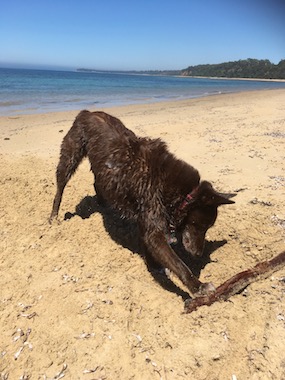
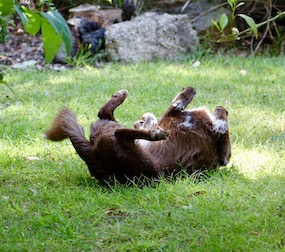
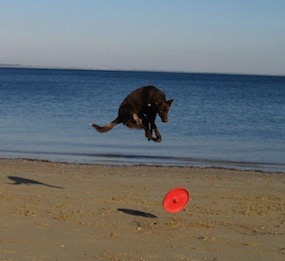
The thing kelpies need most is a job. Jarrah and I went to dog training and practiced what were learned. She became my exercise coach, running or cycling with me daily and nipping at my toes to try and get me to go faster. At 15 years she was still running about four kilometres a day, if at a more leisurely pace. Playing with the frisbee was her favorite game as a young dog and she could snatch a frisbee out of the air two metres above the ground returning it again and again andIMG_0425
again. She was also fond of ‘helping in the garden’ and would test the depth of holes I was digging by dropping her frisbee into them to get my attention.

The intensity of kelpie energy is matched by the intensity of their loyalty and Jarrah followed me everywhere, making friends along the way by demanding opportunistic pats from passing strangers. Car rides were exciting adventures, especially when the destination was the beach. The ground where we live is to too hard to dig but the beach is perfect and Jarrah dug as if she was making up for lost opportunities.

I sweated through fifteen summers, refusing to turn on the ceiling fans because Jarrah was afraid of them. I went for a run on days I DSC00563didn’t feel like it not wanting to disappoint that pleading face. I missed her on long holidays even though I knew my friend was taking great care of her. As she got older and wanted to go out in the night I got up as many times as she needed me to, knowing I would wake up tired in the morning. All for the love of that dog.

As the vigor of youth dimmed into old age Jarrah maintained her desire to help out by supervising my work in the garden.  She no longer wanted to chase the frisbee but would interrupt me for a cuddle or to let me know she thought it was time to go inside and lie on the couch. IMG_0656

Sadly this week, as the fine autumn weather gave way to the first signs of winter that beautiful vibrant girl succumbed to old age. This afternoon the vet came and euthanized her and we buried her with her frisbee in a hole in the front yard where she loved to potter around. I will miss my old friend.


Images: the brown dog

Jacqui Stockdale, Mann of Quinn from the series The Boho - 2015, Adelaide Biennial of Art, 2016. Art Gallery of South Australia.

Finding inspiration in the heart garden

We slipped past the Shrine of Remembrance and crossed Birdwood Avenue in the dark to Jardin Tan. A waxing crescent moon hung low over the Aloe barberae tree illuminating the observatory dome like an Istanbul mosque. The theme of the nights soiree hosted by Melbourne Writers Festival was the heart garden and is one of the monthly events around Melbourne leading up to the festival.

Approaching seven o’clock an array of exotic creatures began to arrive. They included a garden gnome, Aphrodite, and people wearing an variety of flower decorated costumes and head dresses. The guests wandered into the space and settled at tables decorated with leaves, flowers, fruit and vegetables.

The question was asked, what grows in the heart garden? On reflection my answer would have to be inspiration. Writing is a solitary pursuit, but the imagination needs stimulation and for that we must get out and feed our curiosity away from the keyboard or pen.

The practice of ekphrasis, creating another art form from one that already exists, is quite common in poetry writing. The creative act of subjectively reflecting on and narrating a story from another art work such as a painting expands and renews the meaning of the original work. Ekpharasis is an ancient Greek term. An early example is Homer providing a narrative description of the elaborate scenes embossed on the shield of Achilles in The Iliad.

The practice of ekphrasis can equally be used to inspire the narrative form of writing as it can poetry. And inspiration can come from animated as well as static art forms. Pay close attention with curiosity to the sight, sound, light, color, movement and feeling of an object or event. Then allowing yourself to experience it through your senses rather than your analytical mind. This enables us to recreate what we experience in new ways in our writing. In the performance arts, inspiration can be drawn from the performance piece itself, the artists presentation, or the feeling the act gives us as the observer.

The heart garden treated us to an evening of music, poetry and even a botanical drawing class. Whimsical events like the Book of Fete lend themselves to opening up my imagination in new ways and leave me with a sense of creative sustenance, ready to return to the solitude of the keyboard.

My main sources of inspiration are in nature, immersion in the arts and the complexity of everyday interactions. What inspires you?

Image: Jacqui Stockdale, Mann of Quinn from the series The Boho – 2015, Adelaide Biennial of Art, 2016. Art Gallery of South Australia.

Sign for second hand store "objects of desire" Istanbul

The writing odyssey begins

Odyssey: a long and eventful or adventurous journey or experience
– Oxford Dictionary

And so it begins. The ancient Greeks spoke of a time when heroes walked the earth performing superhuman endeavors, fighting monsters and consorting with the gods. They made up stories of men and women – neither gods nor humans – who became the heroes of Greek mythology.

Odysseus, the hero of Homer’s epic poem Odyssey, tricked the Trojans into bringing a giant wooden horse inside the walls of Troy. His army defeated the enemy and ended the Trojan War. In the epic Greek poem Odysseus spent many years traveling home from the Trojan war encountering monsters, cannibals, drugs, alluring women and he even visited the afterlife.

I have twelve months off work and I have noticed among friends and colleagues a hint of  expectation that like Odysseus I will set out an an epic adventure. Each year my annual leave has taken me on some new adventure around the world so surely a long break is the perfect opportunity for an extended trip. When I told people about my leave the immediate response has most commonly been where are you going? When I announced I was mainly staying home their faces often folded into confusion and disappointment. Who takes all that time off work to stay home right?

Yesterday was my last day of work for the year. I have decided to spend my time at home to focus on writing (try to finish that crime fiction novel I started two years ago) and my garden (finish all those half completed landscaping projects) – two of my passions. Other than a few short breaks this time will be an internal journey to learn new skills, flex and build my writing muscle and discover where my imagination can take me. That decision feels just right at this point in time. Building and launching this website and writing a weekly blog is also part of the plan. Follow me if you dare…

Image: Istanbul, Turkey

Microphone, Art Gallery of South Australia

Listening for inspiration

Discovering podcasts and audio-books was a revelation to me. Suddenly I could listen to a book or a favorite program out walking, gardening, driving the car and commuting to work. I could catch up on my favorite shows that I had missed and when my eyes were too tired from looking at a screen I could lie on the couch and someones silky voice would read to me. It reminds me of my parents reading to me at night as a child when I went to bed.

I wrote about writer skill building in my post on writing resilience. Podcasts can be a great (free) way to learn about writing and hear from more experienced writers how they go about their craft and what motivates and inspires them. You can also keep up with the latest books published.

My favorite podcast at the moment is So You Want to be a Writer. I discovered it when it was already in its third year, so have been binge listening on my way to and from work. Valerie Khoo and Allison Tait have a great formula with their show. These two writers make an entertaining and informative hosting duo. Their show delivers news, advice and tips on writing, writing tools, publishing and blogging. They interview a writer for each episode and their approach is both inspiring and motivating. Each show includes show notes and references published on the website.

For crime fans Valerie also hosts a pop-up podcast called Murder and Mayhem that explores the authors who bring us, well murder and mayhem. The authors they interview provide tips to improve crime and thriller writing. You can also get a free companion ebook linked to the series from the Australian Writers Centre website.

Other podcasts I enjoy include:

  • The Garret – cross genre program exploring how successful writers start, draft, complete and market their writing. Show notes and transcripts are published for each episode on website.
  • The True Crime Sisters Podcast – sisters Harry and Bill explore the touchy and tricky subject of true crime using cases from Australia and New Zealand. The series is supported by a blog.
  • Unladylike – Adele Walsh and Kelly Gardiner talk with women and non-binary people about writing and reading. The podcast focuses on women and non-binary people in all aspects of writing and publishing and the processes they use for thinking, planning, plotting, research, drafting and editing their writing.
  • Partners in Crime – English podcast for crime fiction fans
  • Writer Types – an American crime and mystery podcast series that interviews authors, industry professionals and provides book reviews
  • Writing Excuses – short (15-25 minutes) fast paced educational podcasts for writers by writers.
  • Grammar Girl – quick and dirty tips on grammar – can always improve on grammar
    The Bookshelf – ABC Radio National – to keep up with the latest fiction

All the podcasts listed can be downloaded via the podcast app or check out the links above to the websites linked to the podcasts.  I’ll also add to the list on my links page as new podcasts grab my attention.

Image: Art Gallery of South Australia

hair art at WOMAD 2015

Music to my ears

In March each year I make the pilgrimage to Adelaide to the alternative universe that is WOMADelaide (World Music, Arts and Dance Adelaide). It’s a four day global music festival in Adelaide’s Botanic Park. I usually don’t know most of the bands and there are always several new discoveries for me that get added to my play list. Without WOMAD I would not have found the desert sounds of Aziza Brahim whose roots are in the Sahrawi refugee camp in Algeria, the indie pop of Lake Street Dive and the uplifting South African a cappella group, The Soil. All of whom have enriched my music collection.

When the Adelaide thermometer is turned up high, WOMAD can be tough and dusty. There are times when you need to find a shaded spot away from the crowds and stimulation to chill out. The park provides plenty of beautiful big old trees under which you can park yourself and do some writing.

I generally prefer silence when I write, but have spent most of the last two years writing on the bus on the way to work and have learnt to detach myself from background noise. A creative space, like a music festival, can be quite stimulating for the imagination also. One day I will set a story at a festival I expect.

Many writers have found inspiration away from the desk. Gertrude Stein often wrote from the drivers seat of her Model T Ford, Agatha Christie liked to plot in her Victorian bath eating apples and my personal favourite Sir Walter Scott penned his epic poem Marmion whilst riding his horse through the Scottish hillside.

Some writers require a very specific environment in which to work, some must have silence, some noise. The writers idiosyncrasies about the place where they write is curious given that when fully absorbed and writing well the place disappears into oblivion altogether. One wonders if it is the place that creates the ambiance for writing or the writers superstition that they can only find their creative muse in a particular environment that drives attachment to a setting.

Perhaps it is the simple act of creating a routine and habit that is the key to a writers creative and productive endeavors and the place and physical trappings are simply props. As EB White, the author of Charlotte’s Web famously said, “The writer who waits for ideal conditions under which to work will die without putting a word on paper.”

Where do you like to write? What are your rituals and habits? How and why do they help your writing?

Image: WOMAD 2015

Pile of books on the floor at the Tasmanian Museum and Art Gallery, Hobart

Jane Harper: a resilient writer

I can report that I have successfully returned to bike riding without further incident. Sylvie (the new bike) is a great ride, and faster than my old one. Though I am being more cautious around that fateful corner the thrill of the ride has been restored.

Speaking of thrillers I have just finished binge reading The Dry and Force of Nature by Jane Harper. Both were definitely page turners for me. The Dry was dark and frightening, though not overly graphic. That part is left to the imagination. Jane wrote believable three dimensional characters that really gave the stories depth and presented an authentic rendition of the Australian bush and country towns. I love rural Australia with its great sense of community and harshness. I spent years living in the Victorian country side and I was convinced by her portrayal of it.

I was surprised by Force of Nature. Even though I disliked nearly all the characters, except the protagonist Falk, I still couldn’t put the book down. To keep people reading characters they don’t like is quite an achievement. I work in an office environment these days and no one likes a team building event. Force of Nature takes team building and turns it into your worst nightmare, being lost in the wilderness with a bunch of people you can’t stand. Its entire story is injected with creepiness by the insertion of the threat of a Milat style serial killer. The story keeps you guessing right to the end.

Admittedly Jane Harper has had what at least on the surface seems like a dream run, but in listening to interviews with her she clearly took a pragmatic and strategic approach to learning her craft and getting the work done. Dare I use that word resilience again?

Despite being an experienced journalist, when she decided to write a novel, Jane signed up for a 12 week online writing course in part to keep herself motivated and create some deadlines. No doubt the course also taught her much about the craft and skill involved in writing a novel as opposed to straight journalistic writing. A writing course can also create an instant writing community from which discussion can promote further learning and inspiration. Jane comes across as being extremely organized and disciplined, great attributes for a writer to ensure they sit down day after day to get the work done. She was still working as a journalist by day so had to snatch time in the evenings and weekends to work on her novel.

Jane has also noted in interview that she set out to write the kind of book she likes to read – great advice for a beginner author. She entered the unpublished manuscript in the 2015 Victorian Premiers Literary Awards as another learning experience for herself, and won.  She does not describe herself as a naturally gifted writer but clearly has the ability to apply herself to a task with pragmatic vigor. She is conscientious, hardworking and seeks to learn the fundamentals. In other words she is what I would call a great model of a resilient writer.  What writers do you admire for their approach to writing?  What is it about them you admire?

Image: Tasmanian Museum and Art Gallery, Hobart

pencil sketch of bike rider being attacked by Australian wildlife

Writing resilience

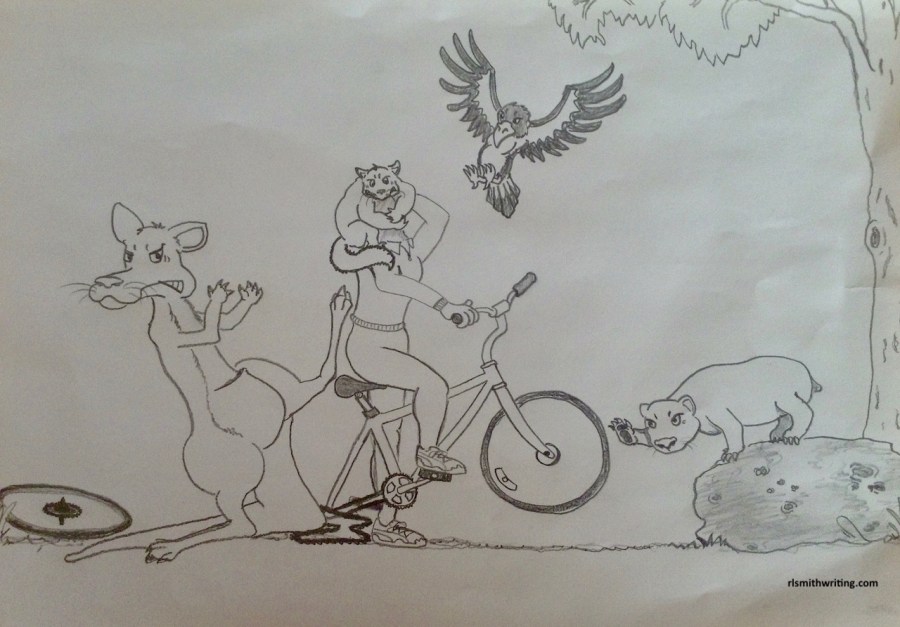
I fell of my bike three weeks ago. Well actually I was going too fast around a gravelly corner, lost the back wheel and skidded along the ground like a car on black ice. Except it wasn’t ice, it was gravel and my bare skin. That particular corner had claimed me before, but this time it was different. I sat on the ground until the initial shock passed and then got on and rode the rest of the way to work. I arrived covered in blood and people looked at me, cringed then turned away. The first aid officer at work patched me up and advised medical care, so I went to my doctor. The damage included opening up my knee and elbow and gravel rash down one side of my belly. The knee was stitched, but the elbow was too messy for stitches. The doctor scrubbed out the gravel under local anaesthetic and I had to go back every few days for three weeks to have it cleaned and the bandages changed. It also turned out I cracked the forks on my bike.

I cycle to or from work most days – about 30km. The first part of my route winds along the Yarra river through bushland inhabited by kangaroos and wombats that open up to fields with grazing cows and horses. There is a bridge I cross where I often see a platypus in the Yarra River. I move through the morning bird choral and hear frogs croaking as I cycle past billabongs.

For the second half of the ride I zip past people sitting in traffic in their cars and ride down Brunswick street where people hang out drinking coffee at Marios. I pedal past the housing commission flats and the people congregating outside St Mary’s House of Welcome waiting for breakfast, then past St Paul’s Cathedral and into the city proper. I pass the court precinct where nervous young men, uncomfortable in suits, smoke cigarettes and wait for their hearings, and through the red light district which is always quiet in the morning. I turn the last corner and get the blast of wind coming from the docks that sweeps away any lingering inertia.

I have had about one accident a year, none of which have involved cars. They have either been due to my own carelessness (recklessness?), or run ins with wildlife. I have been knocked off by a wombat on one occasion and a kangaroo on another.

Tomorrow I go to pick up my new bike. A silver lining after the last few weeks of discomfort, which brings me to what I wanted to write this blog about. Resilience. It was resilience that enabled me to get up and ride to work after the crash and it is resilience that will enable me to mount my new bike, battle scars healed and start riding to work again next week focussed on what I love about it, though perhaps with a little more caution around that tricky corner.

Writing is a practice that requires resilient thinking, particularly if we decide to take up writing novels. Writing is a long haul process and practicing resilience means we need to be in it for the journey, not just the destination. We need to be prepared to challenge and to tame our monkey mind in order to stay the course. Monkey mind is what the Zen Buddhists call the constant internal chatter that creates catastrophic ‘what-if’ scenarios, magnifies our fears and hurts, messes with our concentration and causes us to behave in ways that are less than our ‘best selves’.

Self Doubt is where the monkey mind really comes into play and you need resilience to manage it because it can be extremely persistent and unpredictable. Like when that magical writing fairy becomes elusive. It can be easy to catastrophize that your imagination has dried up never to return. You might as well give up. Self doubt leaves us sitting in front of a blank page or not even sitting down at the page at all. It takes resilience to keep going, even when what you write is crap. But if you push through just on the the other side of the crap is where the good stuff is.

Self doubt is good friends with procrastination. Your writing is not good enough yet – to go onto the next section or to let anyone else read it. Procrastination leaves us stuck in a perpetual loop of starting and never finishing like ground hog day. At some point you have to call it complete. Try entering some short story competitions with deadlines, its a great way to learn to finish. Welcome constructive criticism without being defensive or taking it personally. You will learn the craft of writing faster if you are open to feedback, particularly from those more experienced than you. If you take it personally or get defensive that monkey mind takes over very quickly and will fill you with self doubt. Make failure your friend. Think of it as a learning experience rather than an excuse to collapse into yourself. Remember that he who never made a mistake, never made a discovery.

You need perseverance to keep turning up at the desk and writing. To make writing a habit and sit down (or stand) every day, sometimes for many years, including when you don’t feel like it, to pump out those words. Because doing it day in, day out is the only way to get it done. Even if it’s only fifteen minutes at a time.

Bet you thought you could already write when you came up with your story idea right? Trouble is an idea isn’t a tightly woven plot, well developed characters with layered backstories, realistic dialogue, tension and conflict, and the right balance of description and action. Those are skills that you learn. An idea is a seed that needs to be planted just right, watered, fed, pruned and nurtured. Or it won’t bear good fruit. And you need to know exactly the right time to harvest it. That takes skill. Don’t be afraid of being a novice. Be open to learning and seek out guidance to learn what works and what doesn’t.

It takes perseverance to keep going when you get to the end of the first draft, only to realise that it is just the beginning. If you want to get published, a first draft won’t cut it. Your work has to be the best it can be and that means revising and redrafting over and over. Did I mention ground hog day already?

To try again, and again, and again in the face of rejection requires resilience. We invest so much of ourselves in our stories that rejection can feel like a personal blow. It isn’t. It could be a range of things. Your story isn’t the cup of tea of the reader, they are having a bad day, there were thousands of submissions and some of them were just more suited to the publication than yours, or maybe you still have some learning and polishing of your craft to do. And that is OK. I turned it into a game. I keep a spreadsheet of all my submission (yea, I’m a bit of a geek) and I collect the rejections as well as the acceptances. This is what it tells me. In four years I have made 64 submissions of poetry and short stories (wow that’s 16 per year – more than one a month on average) and I’ve had seven acceptances (that’s just under an 11% success rate). I’m pretty happy with that. It tells me I’ve worked hard and had some recognition for it – and this practice has helped me grow a thicker skin.

Writing is a lonely sport and it’s good to have someone in your corner cheering you on. Connect with other writers. Go to festivals, join a writing group in your town, listen to podcasts or engage with other writers on social media. These interactions, no matter how fleeting, can be motivating, inspiring and contribute to building our skills and our resilience. And you might make some great new friends.

Wow, this post is already much longer than I intended. What tips do you have for being a resilient writer? I’m off to get back on my bike.

Image: sketch by Peter Rode of me being attacked by wildlife

Books on shelf at Guggenheim, New York

Getting started

I’d been toying with the idea of writing a book about the two years I spent living in Portugal riding horses in my early twenties. I was lucky to become a working pupil of Maesto Nuno Oliveira, considered to be one of the last great masters of classical dressage (think Spanish Riding School if that term leaves you wondering). I started writing and developed quite a bit of material, but soon realised I didn’t really know what I was doing. How do I structure my ideas to craft them into an engaging story on the page?

I am practical and pragmatic about what I don’t know and love learning, so I sought out some help. I looked into a range of courses. I didn’t really want to do another university degree and soon found myself at the virtual door of The Writers Studio signing up for their introductory online course. It was great fun and I learnt a lot. That was in January 2016.

The second problem was that I kept experiencing an overwhelming urge to kill off characters. One of the questions the tutor asked was what type of books we liked to read. I like to read widely, but in reality mystery and crime fiction dominate my bookshelves. Start by writing what you like to read was the best piece of advice to really kick start my writing. My Portugal book went into a virtual drawer and I commenced a journey to write a crime fiction novel under the tutelage of The Writers Studio.

The first draft commenced in March 2016. I work full time in a fairly demanding job and commute for three hours each day, usually one way on a bus, one way on a bicycle. That meant about an hour and a half in transit each day on a bus with my iPad working through course notes and writing. I’d also snatch a few hours over the weekends in between other commitments.

I discovered Scrivener early on, which I love, I’m a bit of a tech geek and it allows me to work on the iPad or the laptop and sync between the two. I rarely write with a pen as my handwriting is almost illegible and I can type fast enough to keep up with my thoughts. When I do hand write it’s because I’ve become stuck and the switch to a pen can get the creative brain flowing again.

I started my third draft in February 2018. Reflecting on the last two years, the key things I have learnt:

• it takes more than a good imagination to produce a good story. It has to be harnessed by a sound, well planned structure to make it really engaging

• develop a writing habit, even if it’s only fifteen minutes a day, it adds up

• grammar matters a lot, if you missed out go and learn it

• seek outside objective feedback, it makes a world of difference

• practice patience – it’s a journey, settle in, enjoy the process and don’t worry about the destination

This is to be the year of writing for me. I will start long service leave from my job in April and take the rest of the year off to work on my novel and my craft. I have set up this website as part of my writing project and plan to post a blog post each Friday.  It’s a place to share some of my work and pondering about life – initially the blog will alternate between writing topics and garden/food topics (one of my other passions). What are you working on?

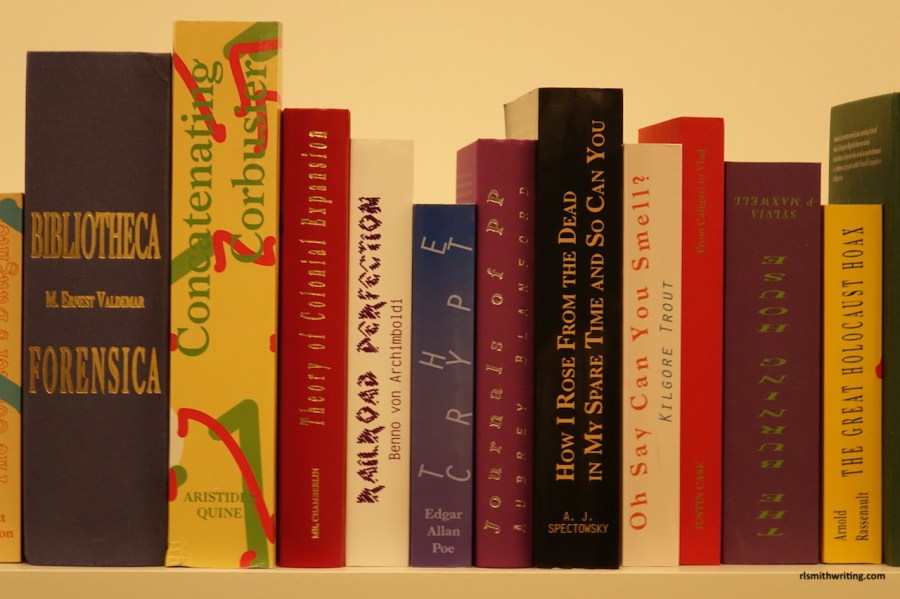
Image: Guggenheim, New York