Emerging again…

Adversity is often cited as a spur for creativity – Shakespeare wrote some of his best known plays during, and in the aftermath of the plague. Hardship may get the creative juices flowing but it doesn’t mean its easy.

The arts and cultural sector has been one of the hardest hit by the impacts of COVID. Crowd events are the first to be cancelled and the last to be re-opened when the virus gets loose in the community. Hundreds of thousands of gigs and events have been cancelled over the last 18 months, each one evaporating the livelihoods of artists and resulting in the loss of millions to the sector.

Ever adaptive and experienced at living on the edge, the arts sector was one of the first to adjust to the new world order using technology to revolutionise the way they work, eking out some kind of living and keeping the rest of us entertained and stimulated during our closed in locked down lives.

A number of events I’d planned to attend in recent weeks had to be cancelled. Some pivoted to an online format, including the Emerging Writers Festival.

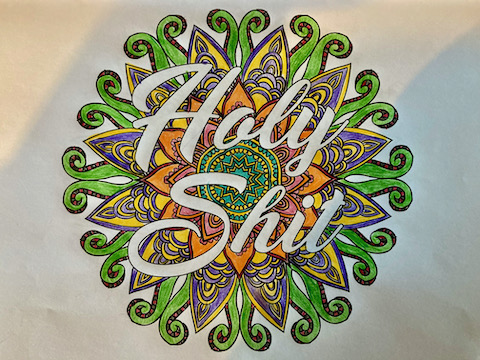
I purchased tickets to the National Writers Conference and attended via zoom last Saturday whilst I re-caulked my shower. Yes, you did read that correctly. I find it easier to concentrate on online events if doing a manual activity that doesn’t require much thought. During work hours I often get out the mindful coloring book. On the weekend domestic maintenance tasks are ideal.

There were some great sessions including writers waxing lyrical about their writing practice, editors reflecting on their unsung role in making a writers work sing, debut authors discussing their differing paths to publication, world building and character development. The festival also has a YouTube channel with loads of free writerly content that you can watch at any time or check out the festival program for links.

Meanwhile I’ll go and enjoy a freshly sealed shower…
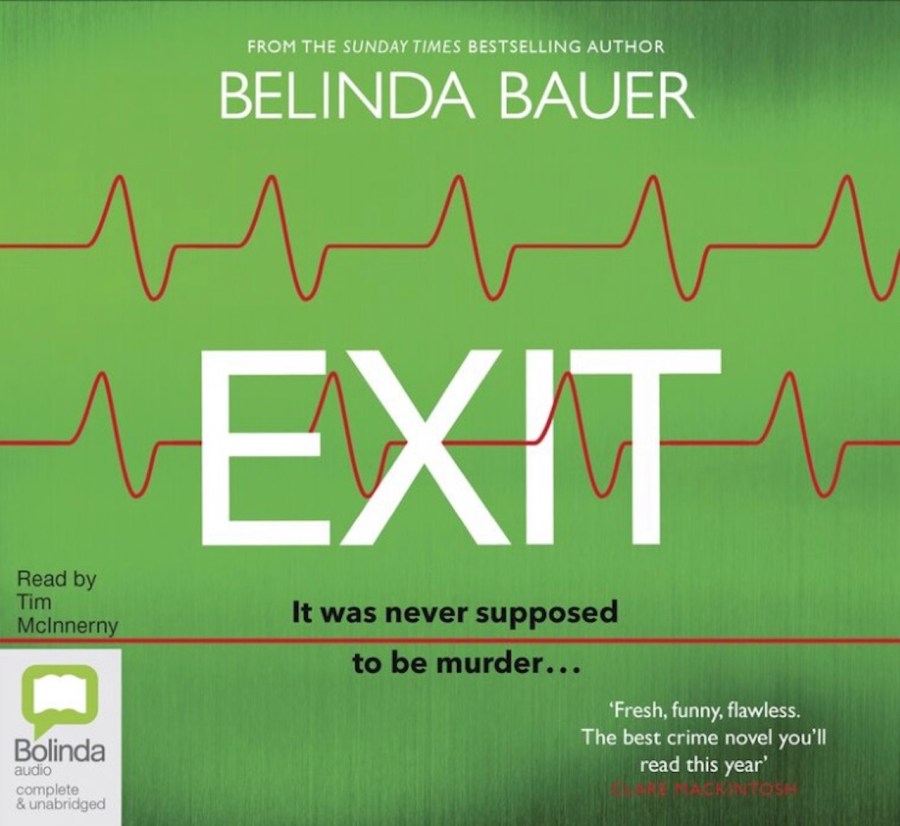
Book review: Exit by Belinda Bauer

I used to love old British cop shows like The Bill, Inspector Morse and Taggart. British crime shows are memorable for slow-moving mystery plots and complex characters. Belinda Bauer’s crime novels are similar.

Despite sounding like a juxtaposition, Bauer’s most recent novel, Exit, is a hilarious crime thriller.

Amanda was at his shoulder now. ‘What is it?’ she said, but Felix couldn’t speak because all the words he’d ever known seemed to be whirling around inside his skull like bingo balls.
The ones he needed finally dropped slowly from his numb lips.
‘We killed the wrong man.’

Seventy-five year old widower Felix Pink is a member of the Exiteers, a secret group that supports the right to die by baring witness to the suicide of terminally ill patients then disposing of any evidence to ensure their deaths appear natural. Everything goes horribly wrong when Felix and new young Exiteer, Amanda, accidentally help the wrong patient to die.

The second voice in the story is PC Calvin Bridge, a small town policeman, and in his own eyes a failed detective. Calvin has no confidence in his own abilities. He also hoards a shameful secret past.

Even now, if she spotted Calvin from any distance, Shirley made a point fo glowering at him. And if she were with somebody else, she’d turn to them and say something, and then that person would glower at him too, which made him feel like a bad person – which he knew he wasn’t – so if he ever spotted Shirley before she spotted him, he always just hid.

A comedy of errors unfolds as Felix tries to find out whether he is guilty of murder or something more sinister is afoot, and Calvin finds himself doing the detective work he’s been avoiding.

According to British author Bauer, crime novels are about how the stories of our lives can be suddenly changed by the misdeeds of others. Life is a river and crime the rocks – it is when our lives hit a rock that we find out if we are life’s swimmers or sinkers. Bauer’s novels focus on survival and recovery after a calamity.

Baur has a knack for crafting original, oddball characters that endear the reader to them. Exit is a delightful, hilarious and farcical look at life and death, the invisibility of ageing, friendship, morality and loyalty.

Exit is Bauer’s ninth crime novel. I have written about the author before. See my review of The Shut Eye here

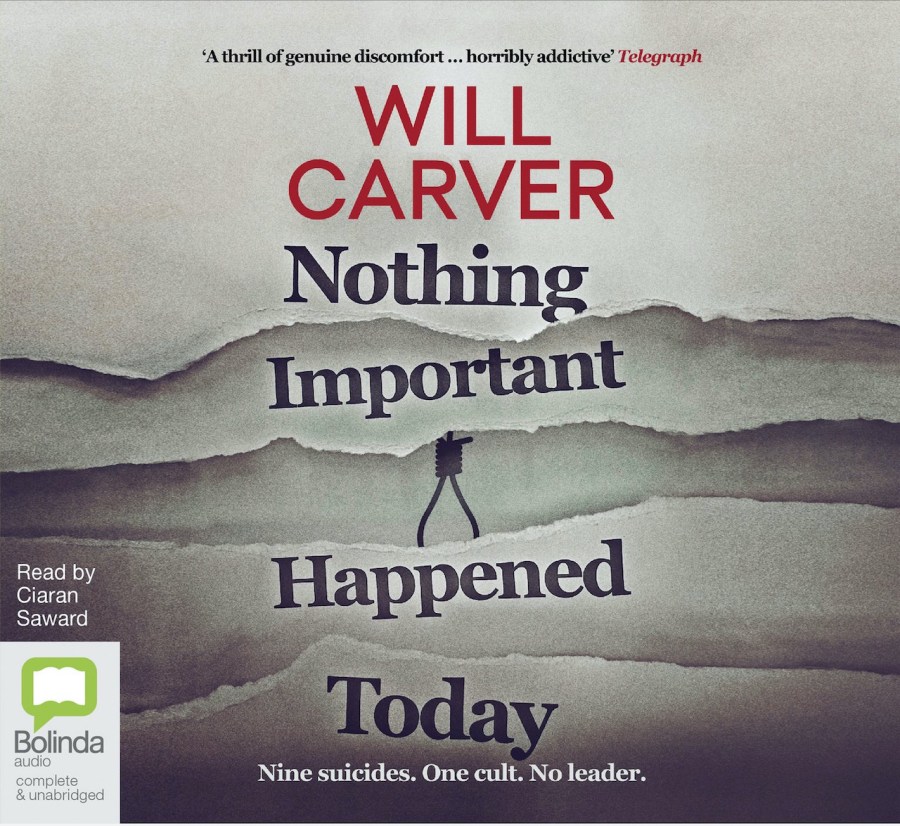
Book review: Nothing Important Happened Today by Will Carver

Creepy. Lets face it Will Carver knows how to write a creepy, mesmerising, noirish thriller – remember Good Samaritans?

London Detective Sergeant Pace returns in Nothing Important Happened Today, a story about a cult in which perfect strangers commit group suicide by jumping off bridges after receiving a white envelope containing the words ‘Nothing important happened today’. This message tells the receiver they have been chosen to become part of the People of Choice and off they trot calmly to meet their maker.

At its heart Nothing Important Happened Today is a story about human psychology, vulnerability and the power of suggestion. Carver splashes the narrative with reflections on the damaging effects of social media, how it provides a mechanism to airbrush our lives and foster an insatiable need for validation that can be really damaging to one’s self confidence. It makes you pause and take stock of the madness of the online environment and its mirage of connection.

We are so connected that we have become disconnected. We can’t have a thought, we have to have an opinion. Freedom of speech has gone too fucking far when we feel the need to share everything. When we filter the image of ourselves but feel no need to filter what we say out loud, hidden behind a new status and picture of ourselves when we were twenty pounds lighter.

There is something mildly detached about Carver’s writing style in this novel, written in the third person and collective first person, that fits neatly with the mindset of a cult leader. It shows the chilling lengths some people will go to get others to do their bidding. The cult leader in Nothing Important Happened Today sends person after person to their death to satisfy their own need for power and a twisted idea of their sense of importance in the world. Each victim is simply seen as a number by an anonymous person operating with the aim of making themselves the best cult leader ever, measured by the number of casualties they can motivate to initiate their own demise.

The fictional story is interspersed with facts about real life cults, how they came about and what drove their leaders. This addition helps lead the reader to ponder whether the actual story, which hovers on the edge of believably, is real or fiction, it’s a mind bending narrative.

Carver is clever at crafting a tale to make the hair on your neck stand up and leave you feeling a little discombobulated and disorientated. He causes you to pause and reflect on reality, illusion and what holds real value and meaning in life.

Here we go again…

Melbourne is back in lockdown due to another coronovirus outbreak…

Anxiety induced panic buying has led once again to emptied supermarket shelves and toilet paper shortages as supply chains fail to keep up with the surge.

It’s tough, particularly for those who have had to close businesses or can’t work because their workplaces have closed. I planned to go to a couple of shows at Melbourne’s Rising Festival this weekend but the arts are one of biggest casualties of lockdowns. The Festival has been cancelled, as have restaurant bookings. I feel for the artists, businesses and hospitality staff who are impacted and pay the biggest financial and emotional price to keep the rest of us safe.

I wrote about my joy at being able to re-engage with the arts after the last lockdown concluded and look forward to doing so again after this one.

Meanwhile in my shrunken world I writer, cook, garden and walk, and feel very fortunate that these pleasures remain. I have also been enjoying my new mindfulness colouring book which helps me concentrate in zoom meetings. Stay safe people and see you out the other side…(hopefully next week).

Best ever gnocchi recipe

600g potatoes unpeeled (choose big old white-skinned ones high in starch and similar size)

150g flour

50g Parmigiano cheese, freshly grated

1 dessertspoon salt

extra flour

Scrub potatoes clean and boil whole in their skins in salted water. As soon as cooked, drain and peel whilst still hot. Hold with a tea towel to protect your hands. Mash potato thoroughly in a large bowl making sure there are no lumps. Incorporate the flour, Parmiagiano cheese and salt into the potato. Flour your hands and knead the mixture like bread with the heel of you hand for about five minutes folding the dough in on itself until it is velvety to touch.

Cut the dough into four pieces, covering three with with an inverted bowl whilst you work on one. Roll each section into a long sausage shape about 2cm thick on a floured surface. Use a sharp knife to cut into 2 cm lengths. Make each section into a gnocchi shape. You can do this by rolling each piece over the prongs of a fork or I just flatten them and round the edges off with my fingers. Lay them out on a piece of kitchen paper until all the dough is done.

Bring a large pot of water to the boil and drop in enough gnocchi. Only add enough to fill the base of the pot without crowding. As soon as the pieces start to float to the surface, scoop them out with a slotted spoon and into a colander to drain. Repeat till all the gnocchi is cooked.

My favourite gnocchi toppings are burnt sage butter, pesto or a tomato sauce. For the sage butter simply toss some fresh sage leaves into a small fry pan with a slab of butter and cook until the sage starts to crisp and pour over the gnocchi – it’s decadent, but delicious.

If you have more gnocchi than you will eat, they are easily frozen in single layers divided by kitchen paper for a later meal. Simply take out of the freezer and boil in a pot again until they float to the surface, or try them fried for something different.

What it means to be human…

(There needs to be an error code that means “I received your request but decided to ignore you.”)

Ok, so I confess I binged listened to the entire Murderbot Diaries series by Martha Wells last week – all five after last weeks review of All Systems Red. I could probably just stop there. Declaring that fact is review enough, but stopping would leave a lot of white space in this blog post…

So the plan wasn’t a clusterfuck, it was just circling the clusterfuck target zone, getting ready to come in for a landing.

At their heart, the Murderbot Diaries are about a machine coming to understand what it means to be human. Murderbot is a construct, part-human part-robot, designed to be owned, used and discarded by humans. The novellas are simple stories with complex themes and characterisation. I could draw parallels to issues of slavery, racism, gender and sexuality, as well as the role of artificial intelligence.

As a heartless killing machine, I was a terrible failure.

The Murderbot Diaries are also bubbling over with brilliant one liners delivered from the SecUnits point of view. I have included some of my favourites scattered through this post.

I hate caring about stuff. But apparently once you start, you can’t just stop.

The series reminds me of studying transhumanism and the likes of Turing, Huxley, Putnam and Searle in philosophy at university. Philosophers who made us grapple with the idea that we could create a being that is equal to human, even replace humans, using artificial intelligence.

Yes, talk to Murderbot about its feelings. The idea was so painful I dropped to 97 percent efficiency. I’d rather climb back into Hostile One’s mouth.

Could a convergence of human and machine consciousness result in a superior being? AI that could think and therefore by definition reduce humans to nothing more than machines. It was mind bending stuff but I fell squarely in the camp of AI being a tool for humans, not being capable of replacing us.

It was very dramatic, like something out of a historical adventure serial. Also correct in every aspect except for all the facts, like something out of a historical adventure serial.

As a decision making tool AI and the use of data have myriad benefits, including the capacity to remove human biases from decision making in some circumstances. But in many respects I believe the essence of our humanity is our fallibility. That we can become overcome and driven by our fears and anxieties, anger, sadness or elation is a unique characteristic of organic sentient beings. Perhaps even more important is our capacity for creativity. Our emotional worlds and imaginations are at the essence of being human, characteristics I do not believe can be replicated by AI.

Disinformation, which is the same as lying but for some reason has a different name, is the top tactic in corporate negotiation/warfare.

That central question in the Murderbot Diaries of what it means to be human is something that all of us actual humans must grapple with throughout life – either consciously or unconsciously. We do this every time we make judgements and decisions because those acts determine the kind of person we want to be, in relation to both ourselves and others.

They were all annoying and deeply inadequate humans, but I didn’t want to kill them. Okay, maybe a little.

Murderbot expresses an irresistible blend of deep love for its humans and angry, pessimistic, exhausted cynicism because he believes the world is a terrible place and humans are hopeless. Part-robot, part-organic beings such as Murderbot were built after all to have superior performance and prevent stupid humans from making stupid decisions and getting themselves killed. Yet Murderbot is driven by a passionate sentimental commitment to do the right thing by them. No wonder he’d rather zone out binging on his favourite show Sanctuary Moon than engage with the world.

I hate having emotions about reality; I’d much rather have them about Sanctuary Moon.

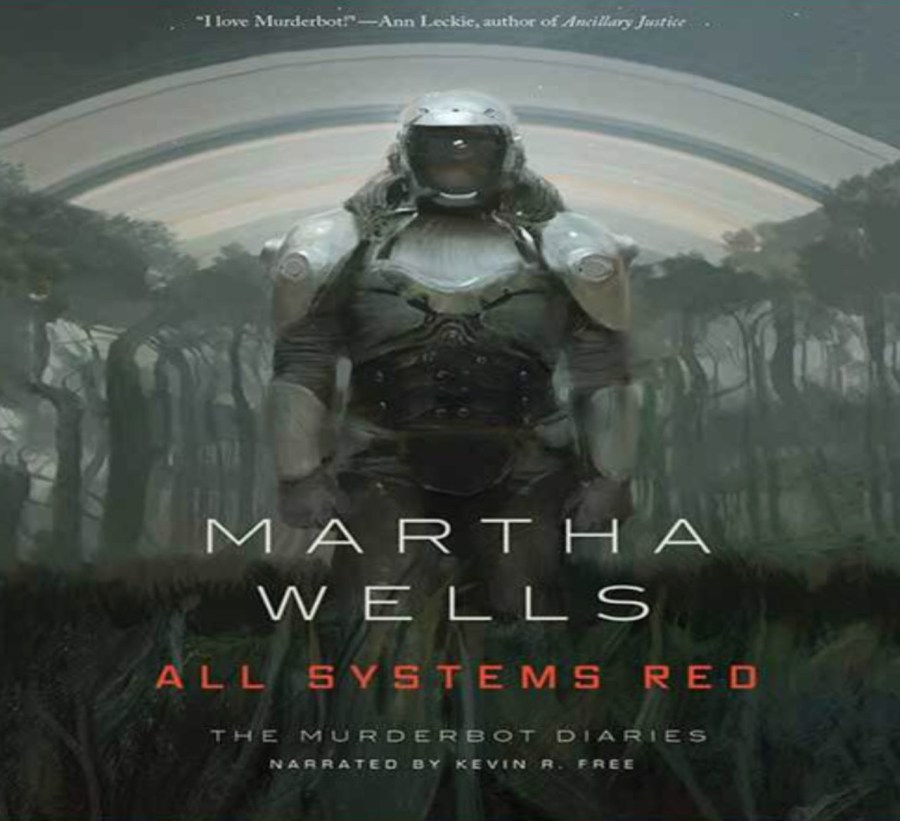
Book Review: All Systems Red by Martha Wells

Whenever I visit my GP we talk about books and writing. She once filled an entire appointment telling me about the crime fiction novel she was writing about a GP who murders people. Lucky I’m a crime writer as well or I might have been reticent to accept any more scripts from her. On my last visit she got very animated about Martha Wells’s The Murderbot Diaries so I borrowed the first one to find out what her excitement was about.

All Systems Red is a 2017 science fiction novella and the first in The Murderbot Diaries series. For a simple story, it packs a powerful punch – I listened to the audiobook in one sitting whilst gardening, giggling to myself as I pulled weeds. The premise is simple: Two groups of scientists on an alien plant; something terrible happens to one lot and the others have to work out what, before the terrible thing happens to them as well. So what’s so good about it? …Murderbot…

I could have become a mass murderer after I hacked my governor module, but then I realized I could access the combined feed of entertainment channels carried on the company satellites. It had been well over 35,000 hours or so since then, with still not much murdering, but probably, I don’t know, a little under 35,000 hours of movies, serials, books, plays and music consumed. As a heartless killing machine, I was a terrible failure.

Murderbot is a part organic-part robot SecUnit – a security guard of unspecified gender for hire to protect explorers of the universe. Murderbot is a little bit different to the other SecUnits because they have disabled their governing programming unit, giving them agency. The sulky Murderbot keeps this secret, along with their addiction to binge-watching soap operas. They just want to be left alone.

Murderbot is a kind of coming out story because this SecUnit feels like they need to hide an essential part of themselves from everyone else – those who are more powerful than Murderbot and wouldn’t understand.

Wells has given Murderbot, who is essentially a killing machine, extraordinary vulnerability as they struggle with their fears about their robot and human parts. They are trying to work out how to be comfortable in their own skin, and their efforts to hide this from those around them are touchingly hilarious.

The best part? There are five more books in the series.

Environmental crime fiction

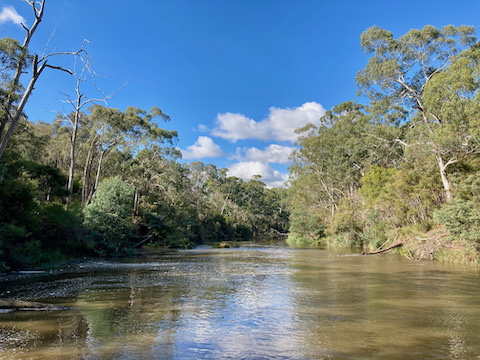
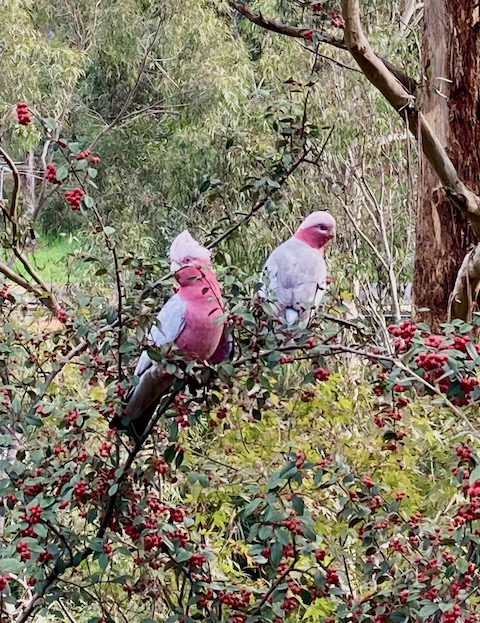
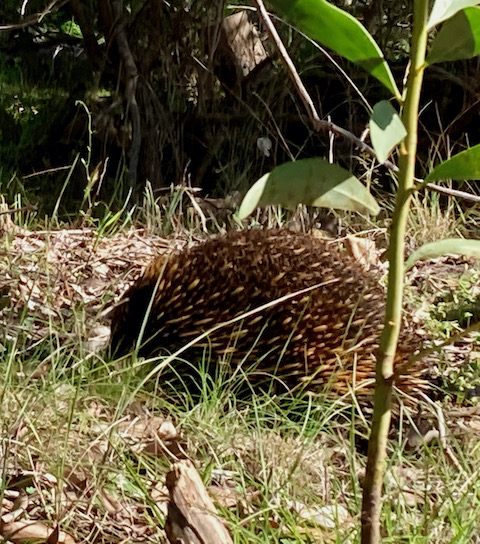
I woke up to a startlingly beautiful sky filled with hot air balloons this morning. After doing some writing I set out with the hound on a long walk. It is a stunning Autumn day. Already I have been squawked at by some cheeky galas and said hello to an echidna going about its day.

Now, I have stopped for a moment and I am squatting on a rock looking at the river scene in the the photos include in this blog post as I write it on my phone. The intermittent sound of birds play a tune over the background base of the swollen Yarra River waters spilling across rocks on their way to the city. It is peaceful and soothing and my mind turns to my writing.

My current manuscript is a crime fiction novel with a backdrop of the environmental movement. One of the underlying themes is climate grief and I have taken much inspiration from my local environment as well as from a period living in East Gippsland.

The idea for the story came to me during a writing workshop I attended with Angela Savage, former CEO of Writers Victoria, at the Terror Australis Readers and Writers Festival (TARWF) in October 2019 and I commenced work on the manuscript in November that year (TARWF will run again this year in November and I hope to go again as it was a hoot last time – I delivered spoken word piece at their Noir at the Bar event. You can listen to that here.)

The story for my current manuscript is set in 2018, before the Victorian bushfires and the pandemic. Whilst the premise pre-dates our recent disasters, the story has certainly been shaped by them. It is a lament to Victoria’s beautiful disappearing landscapes and humanities seeming collective inability to do what needs to be done to save them from the impacts of climate change. There have been moments when I considered abandoning the endeavour, particularly after the terrible bushfires in Victoria that consumed much of the landscape in which the story is set. Instead I made some changes to include a foreboding of disasters such as the fires and the pandemic so that the story does not seem dated.

I entered the first few chapters into a competition for a Varuna Fellowship last year and was chuffed to be shortlisted. I hope to take up the opportunity for a supported residency later this year.

My writing has been interrupted a bit over the last year, but I have now crossed the half way mark of the first draft at just over 40,000 words and am feeling inspired to forge on into the home stretch so I can set myself to editing.

For now, I must continue on my walk as the hound is getting restless.

Book review: Too Much Lip by Melissa Lucashenko

Kerry Salter’s girlfriend is in jail and her pop is dying, so she leaves Brisbane and her arrest warrants behind and heads south on a stolen Harley to her hometown of Durrongo – a place she’s been avoiding.

Thing is, you run now, after last night, and it’ll haunt you forever. You can go as far away as you like, but the past always comes along for the ride.

Too Much Lip is Goorie author Melissa Lucashenko’s seventh novel. Shortlisted for the Victorian Premier’s Literary Award and the Stella Prize and winner of the 2019 Miles Franklin Award, it is a dark, funny story about family, home, country, intergenerational trauma, evil property developers, talking animals, life and death.

Kerry knew from long experience that there was no winning an argument with her mother. To Pretty Mary she was and always would be the Great Abandoner. Shame enough to turn out a dyke, but her far greater sin was the empty hole she’d left behind her in the family. Even in the terrible dark shadow cast by Donna’s disappearance, Kerry had still up and left to live among whitefellas and city people. Sharper than a serpent’s tooth, blah blah de-fucken-blah.

Bundjalung language words are peppered through a narrative that exposes the impacts of the history of colonisation and dispossession on Australian Aboriginal people. Lucashenko’s voice in the novel is unique and effectively echoes the voices of Australian aboriginal people I have known. I have never read a novel like it – which primarily tells me that there are far too few Indigenous voices in literature.

Kerry looked around the deserted road.

‘Yugam baugal jang! Buiyala galli! Yugam yan moogle Goorie Brisbanyu? You could help instead of sitting up there like a mug liar from the city.

Kerry looked around again. The waark hopped up and down in rage.

Then the second crow chimed in, dripping scorn.

It’s no good to ya, fang face. Can’t talk lingo! Can’t even find its way home! Turned right at the Cal River when it shoulda kept going straight. It’s as moggle as you look.’

On being awarded the Miles Franklin some critics claimed Too Much Lip to be undeserving as Lucashenko’s voice was not ‘literary’. My reading of that criticism is that those critics are pompous, entitled gits – probably in need of empathy training – and most likely educated in posh private schools with little experience of diversity and no understanding or appreciation of its value.

For a moment Kerry thought her mother was talking about killing the old man. Putting him down gently. Her second thought, hard on the heels of the first, was: just as well Ken’s drug of choice isn’t morphine. If the hospital had prescribed malt whisky to ease Pop’s last days they would have been in trouble.

The Salter family are gritty representations of people living in poverty and battling with day-to-day existence in all its joys, sorrows, and frustrations. Their education is primarily in their own culture, and in survival – not academia and privilege. They are flawed, funny survivours who love and hurt the people they care about, and go through life trying to make the best of it.

Into the river that was about to be stolen away again, as it always had been since Captain James Nunne Esq. first rode up with his troopers, one two three, crying I’ll have that, and that, oh, and that too, while I’m at it.

Too Much Lip is a political novel, which perhaps makes it confronting and challenging for some white Australians to read, but we all should read it because within its pages there is opportunity for greater understanding, and that might help lift our humanity above our turned-up wanker noses.

I’ll definitely be adding more of Lucashenko’s work to my reading list.

image of novels by Margaret Millar

Grand dames of crime: Margaret Millar

I’m delving into the history of women crime writers again this week and celebrating Canadian born literary suspense author Margaret ‘Maggie’ Millar (1915-94). Millar explored complex inner lives, female characters battling frustrated ambition, existential isolation, class issues and changing cultural values. She was known for the depth of characterisation and surprise endings to her novels.

Millar’s writing career began writing in 1941 with The Invisible Worm featuring Paul Prye a cynical psychiatrist detective fond of quoting William Blake. She then turned to writing more conventional mystery novels, though a psychiatric bent remained. Millar’s sixth novel, psychological suspense The Iron Gates featuring Inspector Sands, was bought by Warner Bros for film. Millar worked as a screenwriter for Warner Brothers in Hollywood in the mid-’40s.

Margaret Millar

Millar wrote four non-mystery novels beginning with Experiment in Springtime (1947), a critique of a post-war family. The story features a wife who is miserably married to a man who is psychotically paranoid about her fidelity.

Millar returned to crime fiction with Beast in View, a psychological thriller about spinster Miss Clarvee later adapted for a television episode for Alfred Hitchcock Hour. The novel also won the Edgar Award in 1956. Following the Edgar win, Millar served as president of the Mystery Writers of America 1957-58. In 1982 she was named a Grand Master by the Mystery Writers of America and also received a Derrick Murdoch Award in 1986, a special achievement award for contributions to the crime genre.

Millar, a passionate bird watcher, was active in the Californian conservation movement in the 1960s. Her observations on wildlife near her home were collected in The Birds and the Beasts Were There (1968). She was named a Woman of the Year by the Los Angeles Times in 1965 for her service in organisations like the National Audubon Society and the Sierra Club. The same year The Fiend was nominated for but did not win a second Edgar. In this creepy, dark novel, a nine year old hungers for affection from her divorced, man-hating, self-pitying mother.

Margaret Millar with daughter Linda and Husband Ken

Millar’s personal life included a tumultuous marriage to fellow mystery author Ken Millar who went by the pen name Ross Macdonald. They had a daughter Linda whose life was tragically short. Linda killed a pedestrian in a drink driving hit and run incident when she was sixteen and was plagued by mental health issues before dying in her sleep of an embolism at age thirty-one.

Margaret Millar did not publish any work for six years following her daughters death in 1970. Her next novel Ask for Me Tomorrow (1976) was about a Hispanic lawyer called Tom Aragon on the trial of a wealthy women’s missing first husband, who disappeared with a Mexican girl.

Over her lifetime the prolific author produced more than 25 psychological mystery novels. She died at her home in Santa Barbara aged 79.


Bibliography:

The Invisible Worm, 1941
The Devils Loves Me, 1942
The Weak-Eyed Bat, 1942
Wall of Eyes, 1943
Fire Will Freeze, 1944
The Iron Gates, 1945
Experiment in Springtime, 1947
It’s All in the Family, 1948
The Cannibal Heart, 1949
Do Evil in Return, 1950
Rose’s Last Summer, 1952
Vanish in an Instant, 1952
Wives and Lovers, 1954
Beast in View, 1955
An Air That Kills, 1957
The Listening Walls, 1959
A Stranger in My Grave, 1960
How Like an Angel, 1962
The Fiend, 1964,
Los Angeles Times, 1965
The Birds and the Beasts Were There, 1967
Beyond This Point Are Monsters, 1970
Ask For Me Tomorrow, 1976
The Murder of Miranda, 1979
Mermaid, 1982
Banshee, 1983
Spider Webs, 1986

Photos from the web

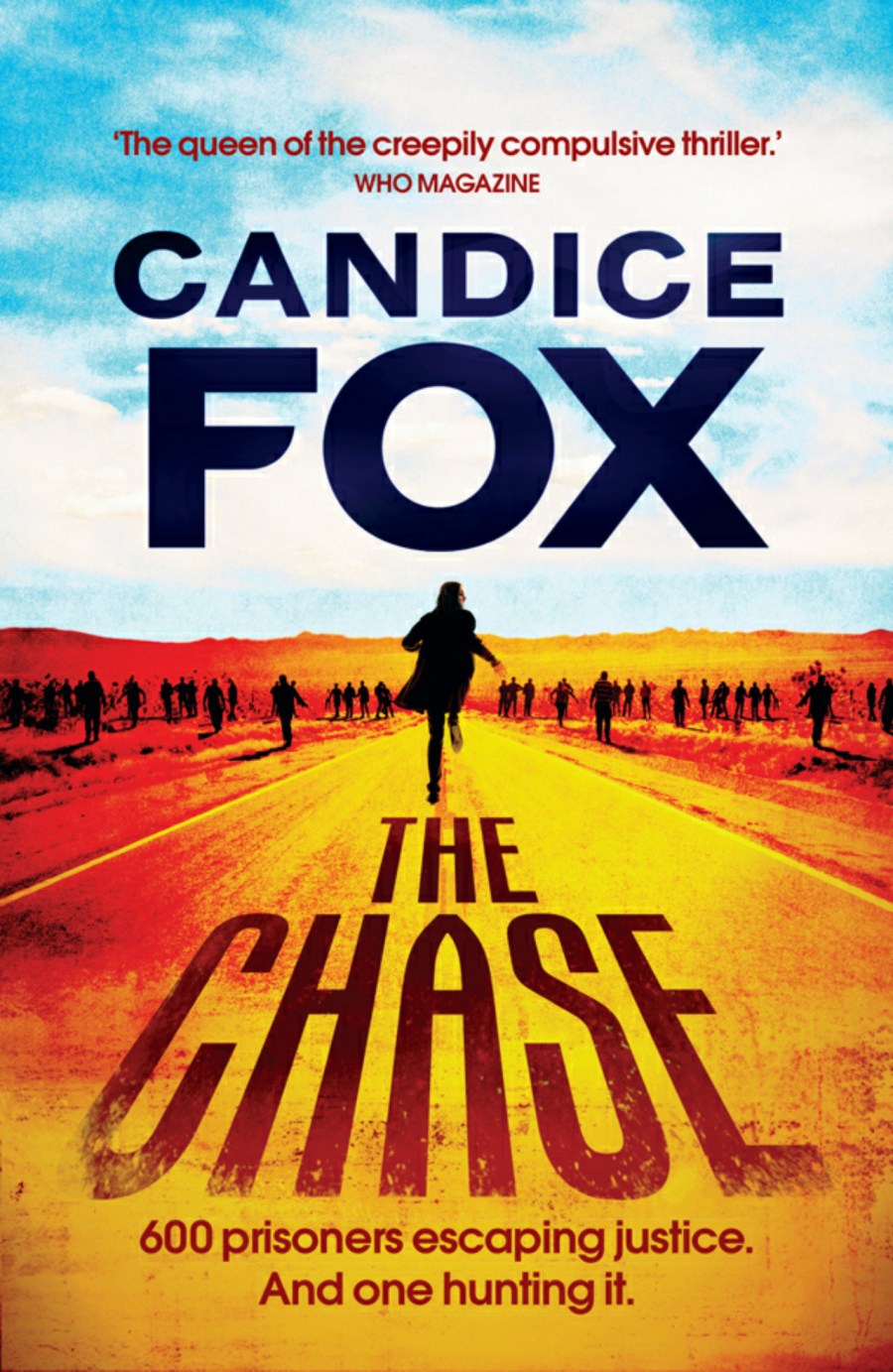
Candice Fox, The Chase cover image

Book review: The Chase by Candice Fox

Candice Fox, all-around good guy, champion of emerging writers, writer of creepy thrillers. I’ve been a fan of Candice Fox since reading her first novel, Hades. Her crime novels are fast-paced and brimming with big bold characters doing outrageous things. She takes us to the limits of believability and holds us there, peering over the cliff face.

The Chase is set in the USA and I suspect Americans are the primary audience for the novel, though perhaps American culture simply allows Candice to take things a step further.

Every year Proghorn Correctional Facility had a Christmas softball game between the wardens and the inmates.

The warden’s families come on a bus through the Nevada desert to make a day of it. This year they are held hostage under the gaze of a sniper in order to free the entire prison population, some of the most dangerous in the country. The incident prompts the biggest manhunt in history. The novel takes the reader on a journey with some of them.

Celine Osbourne is in charge of the death row prisoners. She takes her job, and the break out very seriously. She’s also obsessed with one prisoner in particular and makes it her mission to track down and capture John Kradle.

She pinched the tobacco between her thumb and forefinger, flicked out the rolling paper with a touch more flair than she probably needed to, and laid the little caterpillar of brown fibres down in its thin, dry bed. Three boys, all cousins of hers, crowded in to watch her lick and roll the cigarette. Celine put the smoke to her lips and lit up. Their eyes were big and wild with excitement. It was a thrilling display on many levels. They were all farm kids, and lighting a match for any reason in a barn full of hay was like flipping the bird to Jesus Christ.

John Kradle had been on death row for five years after being found guilty of murdering his family.

He didn’t believe in all the ghost stuff. But he showed up anyway. He figured that was what you did when you loved someone. You nodded and laughed and chipped in with a ‘She’s right, you know. I’ve seen it!’ occasionally.

The breakout is Kradle’s one chance to set the record straight, prove his innocence. Trouble is, a serial killer and Celine are on his tail.

Kradle put his hands on the table, stared at them, and felt a wave of relief roll over him. A part of him had known, in all the years that Christine had been missing, that she had left simply because she was broken. That even if an explanation ever came, it wouldn’t be rational or healing to him.

I could feel the heat of the desert, the desperation, rage and grief of the characters as the complexity of their inner worlds drove their choices – good and bad. The Chase kept me turning the pages and sneaking moments in my day to keep reading. And how lovely to get to the end of find that Candice has dedicated the book to those of us unpublished writers who keep plugging away, hoping that our work will one day find a home.

I have dedicated this book to all aspiring authors. It’s not an easy road. Waiting. Trying. Daydreaming. Being rejected. Having your hopes destroyed and trying to rebuild them. It’s lonely, frustrating, and tedious. But whatever you do, my advice is never to let it become hopeless. Only you have control over that.