I fell of my bike three weeks ago. Well actually I was going too fast around a gravelly corner, lost the back wheel and skidded along the ground like a car on black ice. Except it wasn’t ice, it was gravel and my bare skin. That particular corner had claimed me before, but this time it was different. I sat on the ground until the initial shock passed and then got on and rode the rest of the way to work. I arrived covered in blood and people looked at me, cringed then turned away. The first aid officer at work patched me up and advised medical care, so I went to my doctor. The damage included opening up my knee and elbow and gravel rash down one side of my belly. The knee was stitched, but the elbow was too messy for stitches. The doctor scrubbed out the gravel under local anaesthetic and I had to go back every few days for three weeks to have it cleaned and the bandages changed. It also turned out I cracked the forks on my bike.
I cycle to or from work most days – about 30km. The first part of my route winds along the Yarra river through bushland inhabited by kangaroos and wombats that open up to fields with grazing cows and horses. There is a bridge I cross where I often see a platypus in the Yarra River. I move through the morning bird choral and hear frogs croaking as I cycle past billabongs.
For the second half of the ride I zip past people sitting in traffic in their cars and ride down Brunswick street where people hang out drinking coffee at Marios. I pedal past the housing commission flats and the people congregating outside St Mary’s House of Welcome waiting for breakfast, then past St Paul’s Cathedral and into the city proper. I pass the court precinct where nervous young men, uncomfortable in suits, smoke cigarettes and wait for their hearings, and through the red light district which is always quiet in the morning. I turn the last corner and get the blast of wind coming from the docks that sweeps away any lingering inertia.
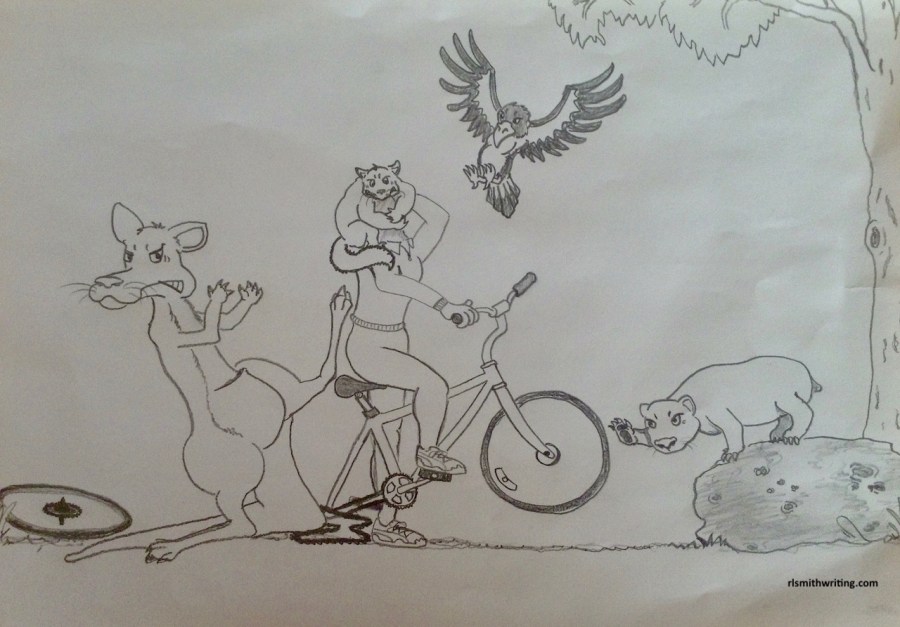
I have had about one accident a year, none of which have involved cars. They have either been due to my own carelessness (recklessness?), or run ins with wildlife. I have been knocked off by a wombat on one occasion and a kangaroo on another.
Tomorrow I go to pick up my new bike. A silver lining after the last few weeks of discomfort, which brings me to what I wanted to write this blog about. Resilience. It was resilience that enabled me to get up and ride to work after the crash and it is resilience that will enable me to mount my new bike, battle scars healed and start riding to work again next week focussed on what I love about it, though perhaps with a little more caution around that tricky corner.
Writing is a practice that requires resilient thinking, particularly if we decide to take up writing novels. Writing is a long haul process and practicing resilience means we need to be in it for the journey, not just the destination. We need to be prepared to challenge and to tame our monkey mind in order to stay the course. Monkey mind is what the Zen Buddhists call the constant internal chatter that creates catastrophic ‘what-if’ scenarios, magnifies our fears and hurts, messes with our concentration and causes us to behave in ways that are less than our ‘best selves’.
Self Doubt is where the monkey mind really comes into play and you need resilience to manage it because it can be extremely persistent and unpredictable. Like when that magical writing fairy becomes elusive. It can be easy to catastrophize that your imagination has dried up never to return. You might as well give up. Self doubt leaves us sitting in front of a blank page or not even sitting down at the page at all. It takes resilience to keep going, even when what you write is crap. But if you push through just on the the other side of the crap is where the good stuff is.
Self doubt is good friends with procrastination. Your writing is not good enough yet – to go onto the next section or to let anyone else read it. Procrastination leaves us stuck in a perpetual loop of starting and never finishing like ground hog day. At some point you have to call it complete. Try entering some short story competitions with deadlines, its a great way to learn to finish. Welcome constructive criticism without being defensive or taking it personally. You will learn the craft of writing faster if you are open to feedback, particularly from those more experienced than you. If you take it personally or get defensive that monkey mind takes over very quickly and will fill you with self doubt. Make failure your friend. Think of it as a learning experience rather than an excuse to collapse into yourself. Remember that he who never made a mistake, never made a discovery.
You need perseverance to keep turning up at the desk and writing. To make writing a habit and sit down (or stand) every day, sometimes for many years, including when you don’t feel like it, to pump out those words. Because doing it day in, day out is the only way to get it done. Even if it’s only fifteen minutes at a time.
Bet you thought you could already write when you came up with your story idea right? Trouble is an idea isn’t a tightly woven plot, well developed characters with layered backstories, realistic dialogue, tension and conflict, and the right balance of description and action. Those are skills that you learn. An idea is a seed that needs to be planted just right, watered, fed, pruned and nurtured. Or it won’t bear good fruit. And you need to know exactly the right time to harvest it. That takes skill. Don’t be afraid of being a novice. Be open to learning and seek out guidance to learn what works and what doesn’t.
It takes perseverance to keep going when you get to the end of the first draft, only to realise that it is just the beginning. If you want to get published, a first draft won’t cut it. Your work has to be the best it can be and that means revising and redrafting over and over. Did I mention ground hog day already?
To try again, and again, and again in the face of rejection requires resilience. We invest so much of ourselves in our stories that rejection can feel like a personal blow. It isn’t. It could be a range of things. Your story isn’t the cup of tea of the reader, they are having a bad day, there were thousands of submissions and some of them were just more suited to the publication than yours, or maybe you still have some learning and polishing of your craft to do. And that is OK. I turned it into a game. I keep a spreadsheet of all my submission (yea, I’m a bit of a geek) and I collect the rejections as well as the acceptances. This is what it tells me. In four years I have made 64 submissions of poetry and short stories (wow that’s 16 per year – more than one a month on average) and I’ve had seven acceptances (that’s just under an 11% success rate). I’m pretty happy with that. It tells me I’ve worked hard and had some recognition for it – and this practice has helped me grow a thicker skin.
Writing is a lonely sport and it’s good to have someone in your corner cheering you on. Connect with other writers. Go to festivals, join a writing group in your town, listen to podcasts or engage with other writers on social media. These interactions, no matter how fleeting, can be motivating, inspiring and contribute to building our skills and our resilience. And you might make some great new friends.
Wow, this post is already much longer than I intended. What tips do you have for being a resilient writer? I’m off to get back on my bike.
Image: sketch by Peter Rode of me being attacked by wildlife