Book Review: This House of Grief by Helen Garner

I don’t read a lot of true crime but just finished Helen Garner’s work, This House of Grief. I know some people find the genre too hard because of the voyeuristic nature of it, or because they cannot bear to hear about the terrible things people are capable of doing to one another. The genre is often criticised for being disrespectful to victims and their families, an argument that primarily revolves around issues of consent, appropriation, representation and concerns when stories are embellished for the purposes of drama.

Those who do like true crime reference its value in providing insight into, and an understanding of, the inner workings of the legal system and human behaviour. There have been instances of true crime pieces shining a light on forgotten cases and having an extraordinary impact, such as facilitating the resolution of unsolved crimes or the reopening of cold case investigations. Rachael Brown’s, Trace, a true crime podcast series about the cold case of the murder of single mother Maria James at the back of her bookshop in 1980 resulted in a new coronial investigation. Katherine Kovacic’s historical fiction novel, The Portrait of Molly Dean, based on a 1930 unsolved murder delivers a sensitive remembrance for a largely unknown young woman who’s life might otherwise have been forgotten.

This House of Grief by Helen Garner is a non fiction true crime story about the murder trial of Robert Farquharson. Farquharson was charged after the car he was driving left the road and crashed into a dam outside of Winchelsea, Victoria and resulted in the death of his three children on Father’s Day. Farquharson was convicted to three terms of life imprisonment without parole in 2007. The original conviction was overturned in 2009 but a retrial again found him guilty of murder and he was sentenced to life imprisonment with a 33 year minimum.

Garner never interviewed Farquharson but did attend both trials as part of her process of writing the book. The trial and re-trial form the narrative spine of the novel in which Garner herself is both a witness to events, and a character within the text. The story blends Garner’s personal experience of the harrowing trial with the procedural formality of the legal system. Her her own emotional responses to the unfolding evidence, and the mundanities of her everyday life run along side the factual reporting of the trials. It is written with the calm eloquent voice of an observer equipped with the exceptional skills of a fiction author and a fearless honesty. Garner strives for an empathic understanding of the terrible event as the rational, ordered legal system tries to make sense of it and find the truth at the centre of all the swirling grief. She lays her own and others emotions, prejudices, and preconceived notions of human behaviour bare, challenging their intractable nature and unreliability on the page.

As Garner records and critiques the courtroom drama and her own conflicting responses to it, she describes in expressive detail impressions of the people she encounters in appearance, language and tone, the mood of the room, the surreptitious glances and subtle shifts in body language. When the evidence leans toward a guilty verdict Garner clings to the possibility of reasonable doubt because she doesn’t want to believe a father could be capable of intentionally killing his three children. When rebuked by a barrister friend, she reflects on the question of why lawyers always make her feel stupid. It seems to be a comment on gendered views where the legal system is masculine and certain, but she is feminine and tentative.

Garner has received both praised and criticism for this work and other true crime books she has written (Joe Cinque’s Consolation; The First Stone). I found This House of Grief a fascinated and compellingly intimate insight into Garners inner world. In striving to be objective she had to wade through confusion, doubt and sudden flights of compassion or repulsion she felt for the subjects of her study, and her own responses to those feeling.

Ultimately This House of Grief raised more questions for me than it answered – about the fallibility of the legal system and the ambiguity in taking a highly technical procedural process and asking ordinary emotion laden laypeople to make a judgement of certainty about what they hear; about our societies insistence on imposing gender stereotypes that sometimes turn out men so incapable of managing their own emotional turmoil they carry out terrible acts in some misconceived belief it will soothe their own pain; about women unable to reconcile the possibility that love and vengeance can coexist in a way that can make the ones they love capable of both great heroism and of terrible violence; about how our own social conditioning, past experiences and emotional worlds shape how we perceive and interpret what goes on around us; and how our individual prejudices and beliefs shape what we can and cannot bear to hear and believe about the world.
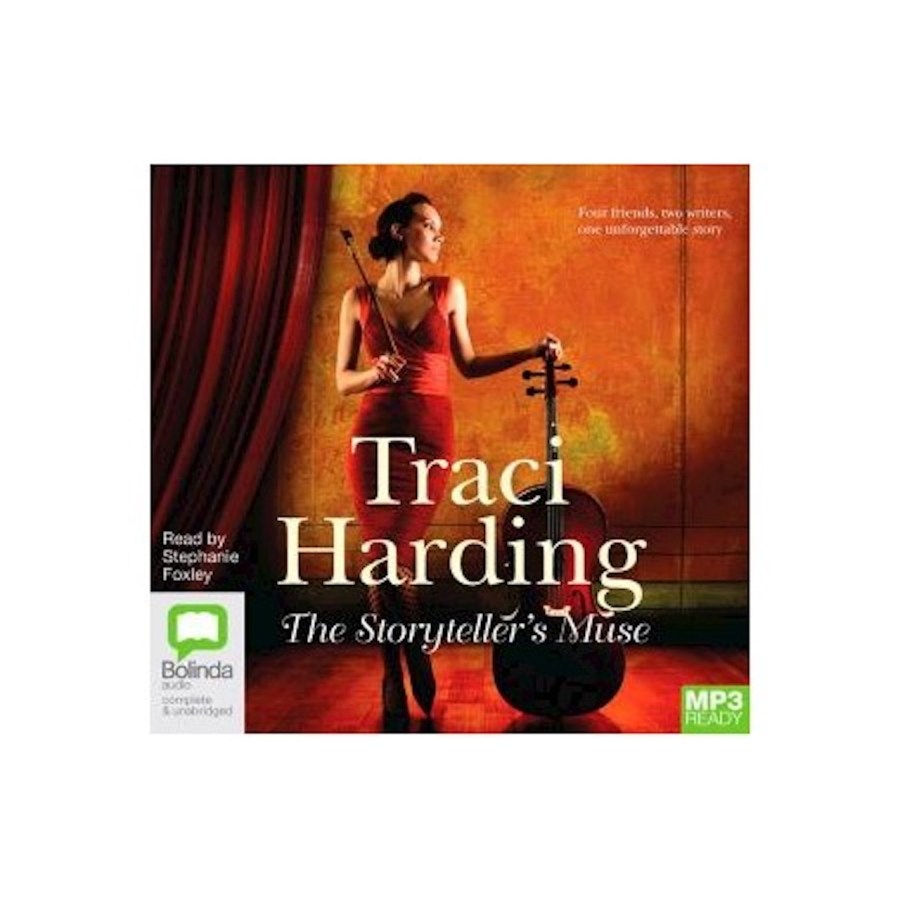
Book Review: The Storytellers Muse by Traci Harding

Peter stifled his ambitions to become a writer and studied nursing in order to meet his parents expectations. Penelope Whitman was a famous author, but now she’s a crabby old woman nearing the end of her life in the nursing home where Peter works. Her eyes are fading and her arthritic hands can’t hold a pen, so she passes the time absorbed in her imagination. There’s one problem, a story in her head that persists in wanting to be told to the world. When Peter discovers who Penelope is, he sets out to befriend her and eventually becomes her protege when she asks him to transcribe her story.

As the telling and transcribing progress it becomes apparent there are other forces lurking. Em Jewel for one. Em is a creative, temperamental and supernatural force with the capacity to both inspire and destroy.

Part way through the telling of Penelope’s story, tragedy strikes and Peter has to find a way to finish the tale without her. What unfolds is a bit Agatha Christie for psychics – part supernatural mystery, part love story, part adventure and part historical intrigue spanning several generations. It’s a story within a story within a story.

The Story Tellers Muse is the first Traci Harding book I’ve read. Most of the works of this Australian author are science/fantasy series. I picked it up because it was in the mystery genre but might dip into some of her other work now I’ve had a taste of her writing. As an artist developing her craft, I particularly enjoyed the theme in the book that explored the relationship between creative artists and their muses. The Story Tellers Muse was also a fun and easy read that had me turning the pages – or rather pressing the play key as I ‘read’ the audio book, rather than the paper version.

Rare crime

Each winter Melbourne hosts Rare Book Week which delivers a program of free talks and events across the city to celebrate the importance of books, literacy and literature. Twice this week I fought my way through the dark, windy and desolate streets of Docklands to Library at the Dock, which is a fabulous library and community hub if you are ever in the area.

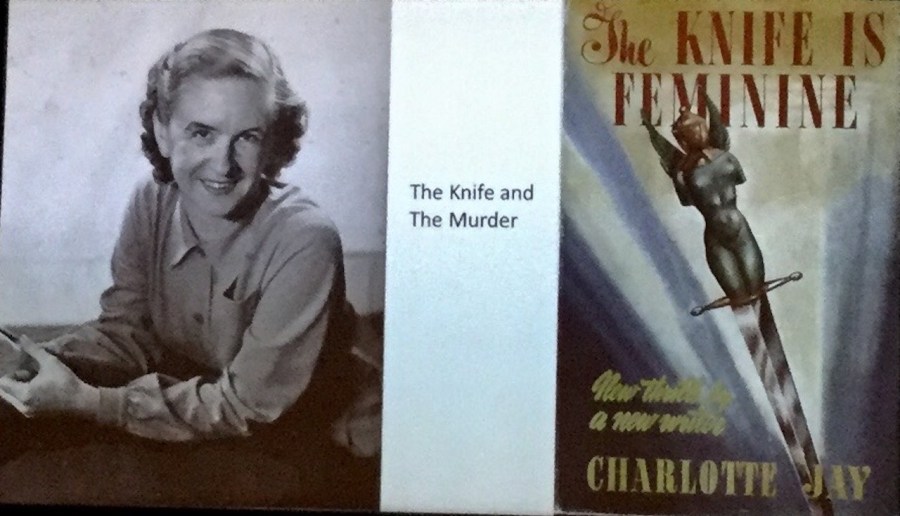
The events I attended were The Knife is Feminine about Australian mystery writer Charlotte Jay, and Portraits of Molly Dean in conversation with author Katherine Kovacic on her true crime book about the murder of Molly Dean in St Kilda in 1930. This blog is about those two events.

The Knife is Feminine

A dagger…it had a curious hilt shaped like a woman’s torso, with wings, only she had no face, just a visor like a knight.

The knife is feminine, Charlotte Jay

I’d never heard of Charlotte Jay, but as it turns out she was one of Australia’s best crime and thriller writers and I will certainly seek out some of her work to read now. Panel members for this event were Carmel Shute (one of the founders and national convener of Sisters in Crime), author Katherine Kovacic (The Portrait of Molly Dean and Painting in the Shadows), Abbe Holmes (actor) and Chris Browne (convener of Rare Book week, former academic and a book collector with 12,000 books and counting).

Charlotte was born Geraldine Mary Jay in Adelaide in December 1919, she chose the author name Charlotte because she thought it sounded literary. She married Albert Halls, an Oriental specialist who worked for UNESCO, and she spent much of her adult life traveling the world with him. Initially she worked as a stenographer for twelve “terrible years,” according to an interview Carmel Shute did with her in 1992. When she realised she had a talent for frightening people and telling a good story so became an author. Carmel observed that in life Jay had a liking for gin and tonic and a habit of snorting when she found others ideas ludicrous.

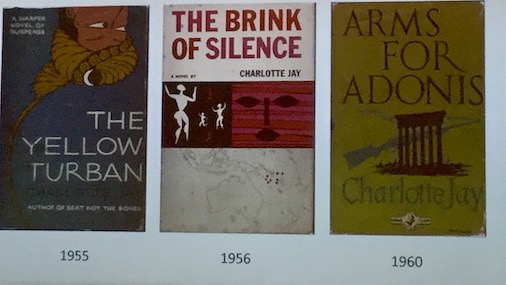
The author wrote seven crime novels as Charlotte Jay between 1951 and 1964, one as Geraldine Mary Jay in 1956, and seven as Geraldine Halls between 1967 and 1995. The stories in her novels included exotic settings like Papua New Guinea, Pakistan, Japan, Thailand, England, Lebanon, India, the Trobriand Islands, as well as Australia.

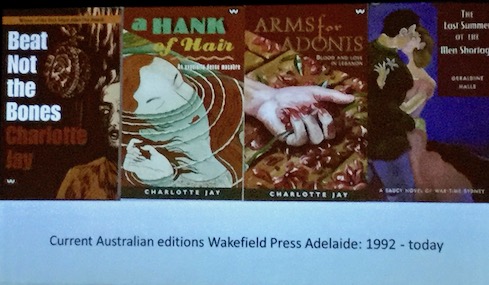
One of her books, A Hank of Hair was so risqué that Harper Collins refused to publisher it. The book was later picked up by Pan Publishing and released in 1964. Another novel, The Fugitive Eye written in 1953 was filmed for television and stared Charlton Heston. Her first novel, The Knife Is Feminine is out of print and there are only a handful of copies still in existence worldwide. We were lucky enough to get a couple of readings from one of those copies.

She wrote in the Gothic tradition and hearing her work, Charlotte Jay had a talent for the weird . She used slow, creepy build ups and detailed observations to tell cracker stories. She was the first winner of the Edgar Allan Poe Mystery Writers of America Award for Beat Not the Bones set in Papua New Guinea, which has some fascinating commentary on racism and colonial power in the 1950s. The following year Raymond Chandler won the award with The Last Goodbye.

The writer eventually returned to Adelaide and her last book was published in 1995, she died in October 1996. I for one shall look forward to reading some of her works, which are listed below.

Charlotte Jay novels

• The Knife Is Feminine (1951)
• Beat Not the Bones (1952)
• The Fugitive Eye (1953)
• The Yellow Turban (1955)
• The Man Who Walked Away (US Title: The Stepfather) (1958)
• Arms for Adonis (1960)
• A Hank of Hair (1964)

Geraldine Mary Jay novels

• The Feast of the Dead (US Title: The Brink of Silence) (1956)

Geraldine Halls novels

• The Cats of Benares (1967)
• Cobra Kite (1971)
• The Voice of the Crab (1974)
• The Last Summer of the Men Shortage (1977)
• The Felling of Thawle : a novel (1979)
• Talking to strangers : a novel (1982)
• This is My Friend’s Chair (1995)

Portraits of Molly Dean

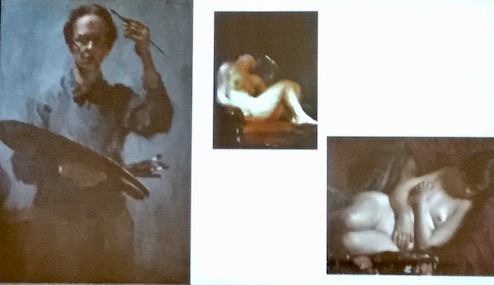
Mary (Molly) Winifred Dean (1905–1930) was brutally murdered in Elwood on 21 November 1930 near her home after walking home late one night. Author of The Portrait of Molly Dean, Katherine Kovacic first came across Molly when studying the art of painter and sculptor Colin Colahan and became fascinated by her life which seemed to have been reduced to a single sentence in a Colahan’s biography. Molly had been Colahan’s lover and one of his models.

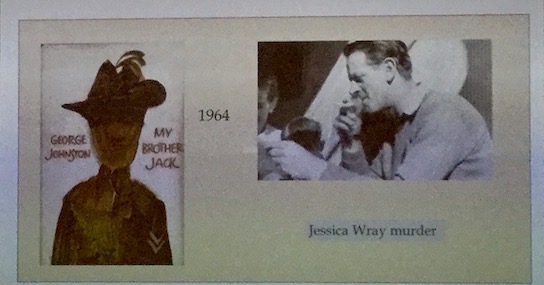
The historical mystery fiction, The Portrait of Molly Dean, was written to shine a light on Molly’s life, which along with her death feature in a number of other works. She was the subject of non-fiction A Scandal in Bohemia: The Life and Death of Mollie Dean by Gideon Haigh, and appeared in fiction works My brother Jack by George Johnston, and The Eye of the Beholder by Betty Roland, as well as the play Solitude in Blue, written and directed by Melita Rowston.

Molly Dean trained as a primary teacher and showed great promise for the profession but aspired for journalism and writing. She had had one long blank-verse poem titled Merlin published in a Melbourne publication called Verse.

Young Molly had a strained relationship with her widowed mother, Ethel Dean, who didn’t approve of Molly’s involvement with the Bohemians – the Meldrumites (followers of painter Max Meldrum) who Molly met when she became intimately involved with Colin Colahan, a well-known sculptor and painter of nudes.

On 20 November 1930 Molly went to the theatre to see Pygmalion with friends. She arrived at StKilda station on the way home, but missed the last tram, apparently due to stopping to make two phone calls to Colin from a phone box, so walked the two kilometers to Elwood along the tram route to the corner of Mitford and Dickens Streets. There were a number of sightings of her as she walked, but no witnesses to her attack. She was discovered early on Friday 21 November severely injured in a laneway less than two hundred meters from her home. She was rushed to hospital but she died of her injuries.

The police believed that due to the nature of the crime, Molly probably knew her attacker and the motive was most likely jealousy. An intense and exhaustive police investigation followed her death. A family friend, who was suspected of having an affair with Ethel Dean was investigated then dismissed. A man called Arnold Karl Sodeman, who confessed to four other killings, was also considered. His involvement was dismissed primarily due to his other attacks having very different profiles, and that he swore he wasn’t Molly’s killer. Sodeman was executed in Pentridge Prison in 1936 for the crimes he admitted.

The Crown Prosecutor did not proceed with the case and conspiracy theories abounded about Molly’s unsolved murder over the years. One theory suggested it wasn’t solved because she’d crossed paths with very powerful people in Melbourne, and they had shut down the investigation.

Artist Colin Colahan

Katherine Kovacic’s fictionalised account of Molly’s story is a fascinating tale of art, intrigue and murder, and Melbourne’s history. Her melding of fact and fiction patches together a coherent and sensitive narrative to re-tell a victim’s story and shine a light on her young life. It’s told from the perspective of a fictional art dealer called Alex who buys a painting in 1999 believed to be the last portrait of Molly Dean. Kovacic has released a second book Painting in the Shadows that also revolves around Alex, and a third is due out next year.

For the section of this blog on Molly Dean I have drawn on Kovacic’s talk at Rare Books Week and a piece published on the Public Records Office website by Dr Eric J Frazer about her murder.

Main image: Charlotte Jay and The Knife is Feminine

Hit List: Australian Crime Writings

The Wheeler Centre are running a mini series to spotlight Australian genre writers. This weeks discussion focussed on crime writing and hosted an impressive line up of guests:

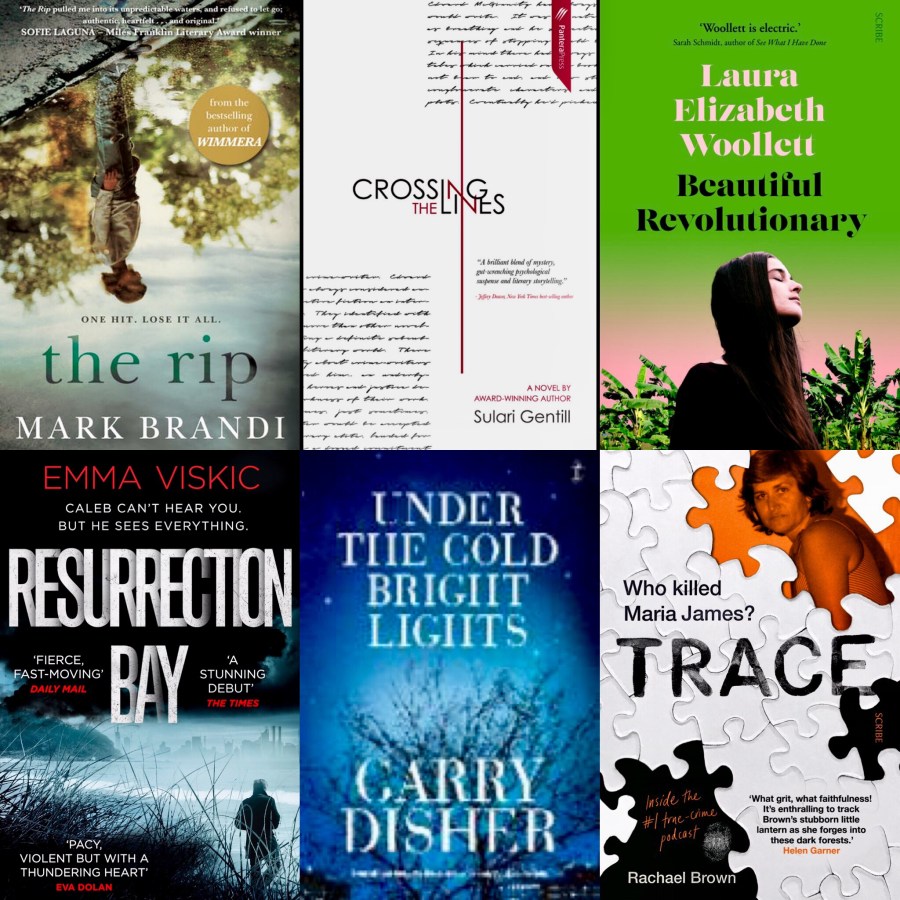
  • Emma Viskic, author of the Caleb Zelig series Resurection Bay, Fire Came Down and Darkness for Light (due out this year). Her debut novel won the 2016 Ned Kelly Award for best debut, as well as three David Awards.
  • Garry Disher has written two crime series (The Whyatt novels and The Challis and Destry Novels) as well as a number of stand alone crime novels (including Bitter Wash Road and Under the Cold Bright Lights), and a significant number of young adult, children’s, non fiction and short story works.
  • Sulari Gentill, author of historical crime series the Rowland Sinclair Mysteries, and fantasy adventure series, The Hero Trilogy and her most recent novel Crossing the Lines.
  • Rachael Brown, ABC journalist and creator of Trace, a true crime podcast about the cold case of the murder of single mother Maria James at the back of her bookshop in 1980. The series resulted in a new coronial investigation. Brown has also written a book of the same name
  • Laura Elizabeth Woollett, author of The Wood of Suicides, short story collection The Love of a Bad Man (shortlisted for the Victorian Premier’s Literary Award for Fiction and the Ned Kelly Award for Best First Fiction) and her latest novel, Beautiful Revolutionary.
  • Mark Brandi, author of Wimmera (winner of the Debut Dagger, UK) and The Rip.

The night opened with Emma Viskic speaking about the history of crime in Australia, that our map is a map of massacres and because of white mans beginnings we are a country of outsiders. It was pointed out that the outsider trying to decipher a crime and a place is a common trope in the genre.

Mark Brandi reflected that humans like to ask what it means to be a good person, and how to live a good life. We like crime stories, and they matter, because they are all about what it means to be good, and what it means to be bad. He wrote The Rip to help him make sense of his time spent working in the justice system.

Crime fiction is about the restoration of order, not the murders themselves. The authors discussed how crime fiction shines a light on the murky business of being human and can offer an understanding of why people do what they do to one another. These stories allow readers to sit at the shoulder of a evildoers and scoundrels from a safe distance and strive to understand. Readers are comforted that criminals are punished, or at least understand in noir and that when it all goes to hell, no matter how bad things get, someone will stand up and resist.

The best crime writing requires empathy, and for writers to see the world differently. A theme can drive a book and tell us something about human frailty and the world we live in, and we can delve into the political and social dimensions of crime in a deep way to foster understand, if we write with compassion.

Australian crime writing has the appeal of the different and dangerous, partly because of our landscape. There have been whispers around for some time that an Australian crime wave would replace Nordic noir in popularity, maybe it’s our time? The speakers thought Australian crime writing was of a good quality because authors don’t write for the money, it’s almost impossible to make a living just from writing, so they write because they have something to say – perhaps that makes it better.

There were some funny moments as well at the event, like when Sulari Gentill claimed crime writers as the cool kids of fiction and that she imagined they would be of more use than a poet if she ever need to fight her way out of a situation.

During question time one audience member asked who the authors favourite crime writers were (other than each other) and we got the following responses:

Peter Temple, Jock Serong, Harper Lee, Joyce Carol Oates, Helen Garner, John Sandford and Michael Connelly

Can you guess which favourite goes with which guest?

Main image: guest author book covers