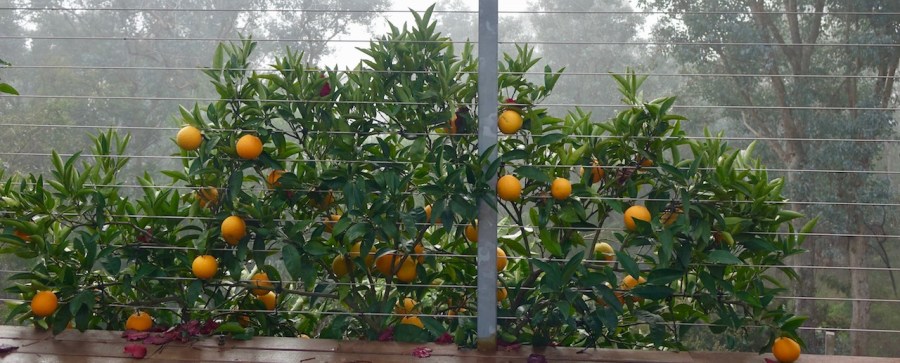
Espaliered oranges

Sailing Stones

Death Valley is located at the lowest altitude in the USA and is known for its extreme heat and cold. There’s a phenomena in Death Valley where black dolomite rocks as heavy as 140 kilos mysteriously hydroplane across the desert lake bed leaving trails in their wake. The occurrences confounded scientists since the 1940’s. Some believed that electromagnetic fields generated by UFO’s were responsible. There are even records of the happenings in Native American rock art depicting something unexplained up in the sky.

Modern technology enabled a couple of determined geologist to solve the mystery in 2014. The geologists set up a weather station and recorded the moving stones on camera after attaching GPS trackers to them. It took two years, a lot of patience, and perfect DSC05553winter conditions before they witnessed the rocks move. A day after rain the pond was covered with a thin layer of sheet ice.  The ice formed around the rocks lifting them clear of the lake bed. When the ice started to thaw and break up during the day some of it clung to the rocks forming a floating seat and the wind was enough to move them across the surface.

Winter carries with it a sense of slowing and contracting. There’s a temptation to curl up on the coach with a cuppa and a book. Mornings are crisp and cold and I often wake up in the clouds. Plant growth slows and aside from a little weeding not much happens in the patch. There are of course those ‘other jobs’. The ones I’ve been avoiding as they are as boring as waiting for stones to levitate across the ground. In fact one of them does require moving stones. Hundreds of them.

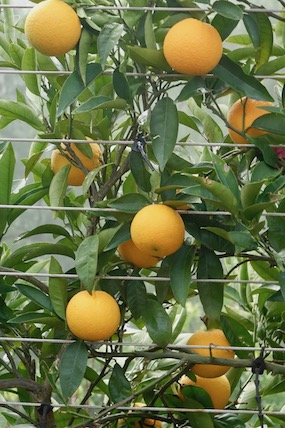
I have espaliered citrus trees in front of the house that enable me to step out onto the deck DSC05548in winter and pluck oranges and tangelos for breakfast. The trees are mulched using stone mulch as we live in a high fire risk area and I didn’t want to put flammable material right next to the house. It does make maintenance labor intensive however. I’ve been contemplating for over a year the task of taking up all the stones to give the trees a really good feed and compost to boost production. The rock wall surrounding the citrus also needed some repairs where it had subsided.   I finally attended to the tedious task this week. It’s quite meditative but it did make me wish for UFO’s or ice sheets to lend some assistance. Just imagine getting up one morning to find all those stones moved to one side without any effort from me.
Speaking of tedious we are still working our way through all those pumpkins, not to mention the kale. I did grow our first edible pomegranates this year which add a bit of zing and variety to a dish…

Kale and roast pumpkin salad with pomegranate molasses and almonds

Ingredients:

  • Pumpkin peeled, seeded and cut into small wedges
  • Bunch of kale
  • Handful of chopped almonds
  • 2 spring onions
  • 1/2 lemon juiced
  • 2 tbsp olive oil
  • 2 tbsp pomegranate molasses
  • 1 small pomegranate – seeds removed. The easiest way to do this is slice off the crown and expose the white membrane. Score around the pomegranate from top to bottom making four quarters. The score should reach the white membrane without cutting the fruit open. Soak the pomegranate in a bowls of cold water for a few minutes then gently pull it apart and remove the seeds which will sink to the bottom of the water.

Method:

  • Heat oven to 180C (fan forced)
  • Toss the pumpkin pieces with 1 tbsp oil and 1 tbsp pomegranate molasses to season then tip onto baking tray and roast for 25 minutes until the pumpkin is tender.
  • Blanch the kale in boiling water for a few minutes then run under cold water to stop it cooking. Drain and dry in a salad spinner or with kitchen paper.
  • Toast the almonds in a dry fry pan.
  • Whisk 1 tbsp oil and 1 tbsp pomegranate molasses with lemon juice and season with salt and pepper. Mix the kale with the dressing and stir in the spring onions.
  • To serve, tip the dressed kale onto plates, place the roast pumpkin on the kale and sprinkle with almonds and pomegranate seeds.

Image: espaliered oranges
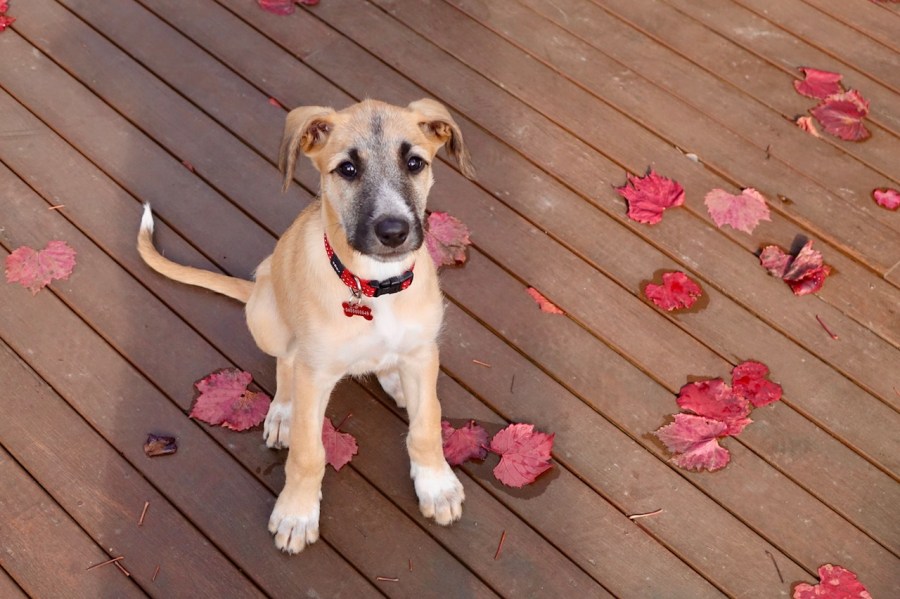
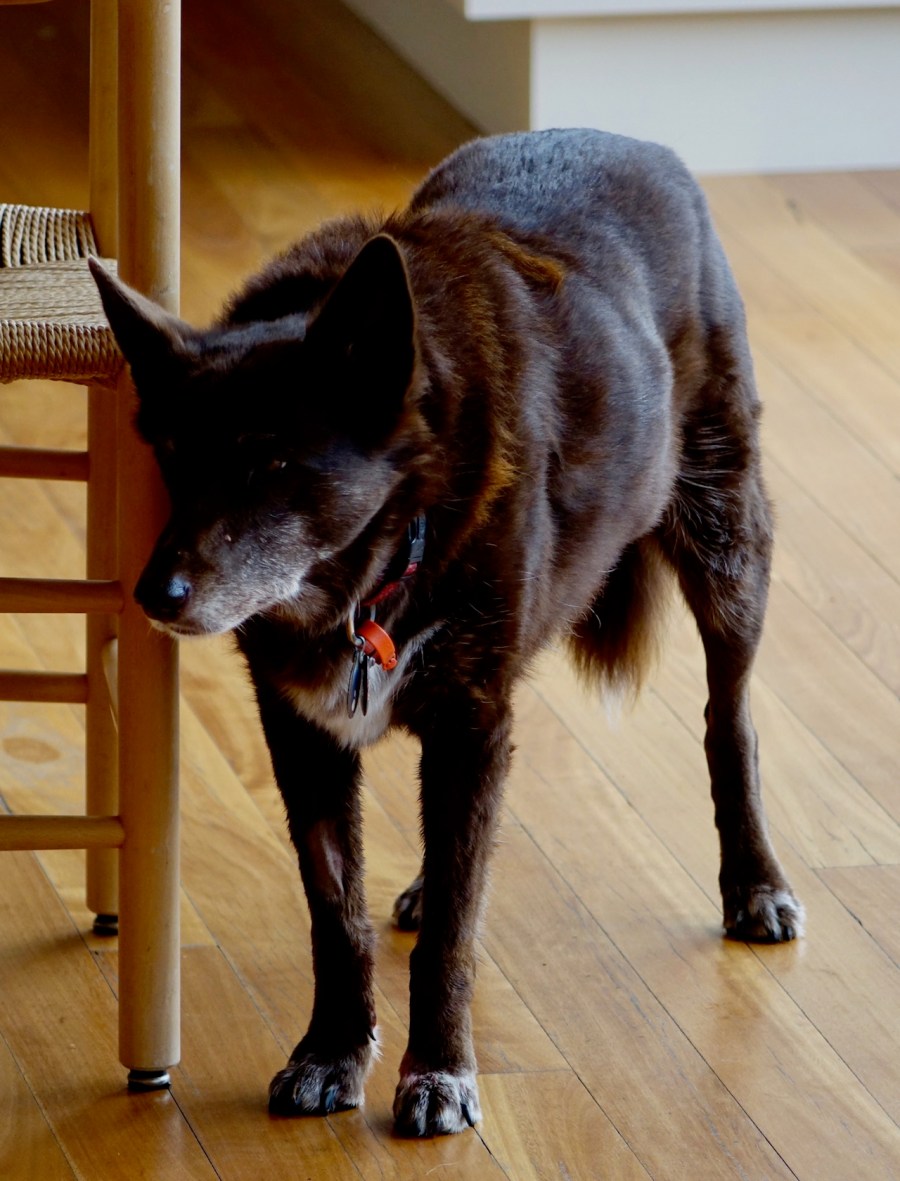
staghound cross puppy with autumn leaves

Animal Farm

Animal characters have had central roles in well known fictional stories. A personal favorite was the 1877 novel Black Beauty by Anna Sewell about the life, Harper 1tribulations and adventures of a sleek black horse. Black Beauty highlighted the issue of animal welfare and the importance of treating others with kindness, respect and sympathy. Important lessons for any child. Roald Dahl bought garden bugs to life in his 1961 novel James and the Giant Peach that explored the themes of friendship, death, hope, fear, abandonment, rebellion and transformation. I remember being fascinated by the giant caterpillar who had to tie the shoe laces on his many pairs of boots every morning. The book is still on my shelves and I pull it out and re-read it every now and then.

Stories with animals are not only for kids either. The epic 1851 classic Moby Dick by Herman Melville explores the 19th Century whaling industry in all its brutal glory and has the giant sperm whale as a central character representing nature’s wildness.  At times Melville takes on the non-human perspective imagining how appalling the whaling fleet must appear to a surrounded wounded whale.

There’s also George Orwell’s 1945 classic Animal Farm about the lead up to the 1971 Russian Revolution and the Stalinist era of the Soviet Union. The themes of corruption, class and abuse of power play out using the Harper 5allegory of the Manor Farm ruled by pigs. As power goes to their heads the pigs start to run the place on the premise that “All animals are equal but some animals are more equal than others.” They become so much like the humans they overthrew that eventually they transform into humans themselves.

Like any character, an animal in a story needs a reason to be there, and a reason why the writer chose an animal rather than a human character. It needs to have a place in the plot of the story whether it’s idealistic, political, satirical, comedic, allegorical or fun. Will the animal character appear clearly as an animal or take on human characteristics; will it be a pet or wild; what is the message it will convey?

My own ability to write fell in a hole recently. It was not due to a lack of motivation, enthusiasm or ideas. There was no writer’s block and I did not fall ill. In fact it would be Harper 3fair to stay things were going swimmingly. I had established a great routine of writing early, doing some exercise then either writing again, reading or heading out into the garden depending on the weather.  Then along came Harper.

I was missing my old dogs company and started thinking about getting another one so I signed up to a rescue site called Petrescue. It’s like a dating site connecting up animal rescue organizations with people wanting to adopt a pet. Pictures of cute furry animals can be distracting and the real thing is a whole other level of disturbance.

Harper came from somewhere around Wagga Wagga via Seymour. The advertisement on Petrescue had very little information. Sweet little female mixed breed dog. Sleepy, playful and cute.   Several emails and a phone call to the foster home led to filling out the adoption papers and agreeing to meet.

Harper 6Many country dogs get adopted in Melbourne, and Seymour is a liaison point apparently. The industry is quite mysterious and I think there could be a great fiction story written about the rescue, movement and adoption of animals.

We drove to the rendezvous point in Kings Park and met a lady there with a car full of rescue dogs. I didn’t want another dog like Jarrah (my old kelpie), as it would have felt like I was being unfaithful to my old friend. The puppy was a leggy, sandy colored thing with a slightly worried look. An Australian Staghound crossed with something of unknown origin – probably some kind of cattle dog like a kelpie.

We weren’t sure about whether to take her or not. Then this guy from Pakenham turned up to look at Harpers brother. He picked up the puppy without hesitation, threw it over his shoulder and started filling out the necessary paperwork. He said he had a Harper 7Staghound-kelpie cross at home. “Best dog he’d ever had,” he said, “affectionate, trainable and not as energetic as a kelpie. Likes to lie around on the couch and watch TV.” Sounded like an ideal writing companion.

It does of course take some time to get from puppy to writing companion and after puppy Saturday all writing stopped and novel reading was replaced by books and blogs and videos on puppy wrangling and several days of utter chaos as we got to know Harper and visa-versa. Within three days she had gotten the hang of going outside to the toilet and would come, sit and drop as long as there weren’t too many other distractions. We had also introduced her to ceiling fans, hair dryers, vacuum cleaners, steel and wooden stairs, the shower, collars, coats, leads, a frisbee, tennis balls, new Harper 2people who dropped by and Bunning’s. Believe it or not Bunning’s has a very detailed dog positive policy and we were able to take Harper around the store introducing her to the weird and wonderful world of the great Aussie tradition of a trip to the hardware store.
We had our first day at puppy school to start our long learning adventure together. Each day consists of a cycle of eat, sleep, play, starting at about 6am. I’m particularly fond of the sleeping part and I am hopeful we will settle into a new routine soon so I can get back to some writing. My book does have two dogs in it so I look forward to Harper becoming an inspiration rather than a distraction.

What’s your favorite fictional animal character?

Image: Harper and autumn leaves

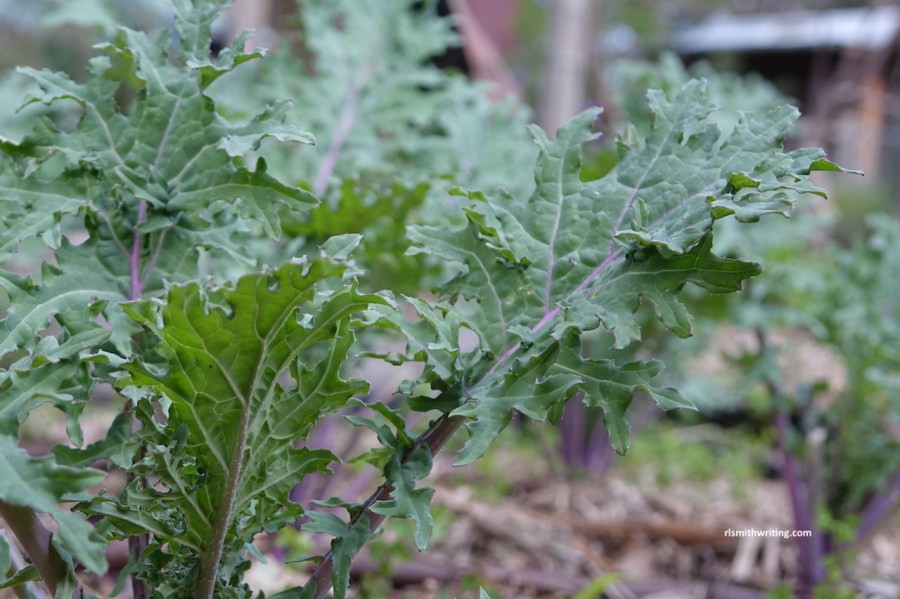
Kale leaves

Food fads

A few years ago kale became a ‘thing’. There’s even a cookbook called 50 Shades of Kale that apparently makes kale sexy. Personally I’ve never been a fan of cabbage. Kale is an older relative of the cabbage from the Brassica family and a close relative of my least favorite vegetable, the brussel sprout.

I resisted kale for a long time. I thought it looked like a chewy bitter, fibrous and indigestible green that would leave splinters in my mouth if I ate it. Cellulose on steroids. It wasn’t until a friend offered me some kale chips he’d made that my curiosity was tweaked. What doesn’t taste good with oil and salt after all?

I wouldn’t say I’ve climbed onboard the fad train. You certainly wouldn’t catch me having kale smoothies for breakfast, but I do grow it now. It’s easy to grow and it tough. It loves the cold and survives just about anything. A few plants I grew last year lasted right through the summer and were the only thing still standing after I’d cleaned out the summer garden. That means the only home grown produce I have ready to eat at the moment are kale, the pumpkins I picked a few weeks ago, kiwi fruit and preserved figs and quinces. Luckily there’s supermarket I can go to.

Melbourne has turned cold all of a sudden and it will take a little getting used to. It’s great to have some rain though. The garlic has popped as have the peas I planted a few weeks ago, but it will be a while till I have some to eat.

I do need to wade through all those pumpkins and like to eat from the garden as much as possible so I wanted to find something I could do with kale and pumpkin. Kale chips are easy but preparing kale for other things can be a bit of a pain. If you want to eat it raw you really need to massage it. Maybe that’s where the 50 Shades of Kale book came from. It’s a vegetable that improves with a bit of rough and tumble. Massaging breaks down the cellulose and the kale becomes more easily digestible. I prefer it cooked myself and I think its particularly good in soups. Here’s the recipe for a pumpkin, kale and broccoli soup I made this week. It’s got loads of garlic as well to keep the vampires at bay.

Pumpkin, kale and broccoli soup

Ingredients:
• 5 Garlic Cloves, crushed
• 1 large bunch Kale – cut out the woody stems and chop roughly
• 1 tablespoon Olive Oil
• 2kg Pumpkin, peel and cut into pieces
• 1 head of broccoli
• 1.25L Stock or well seasoned water
• 1/2 teaspoon ground Nutmeg
• Season with salt and pepper to taste

Method:
• saute garlic and kale in olive oil for 3-4 minutes in a large pot.
• Add pumpkin, broccoli, stock, nutmeg, salt and pepper and bring to a boil.
• Reduce to a simmer and cook for 20 minutes or until pumpkin is tender.
• Blend ingredients until smooth.

Image: curly kale in the patch

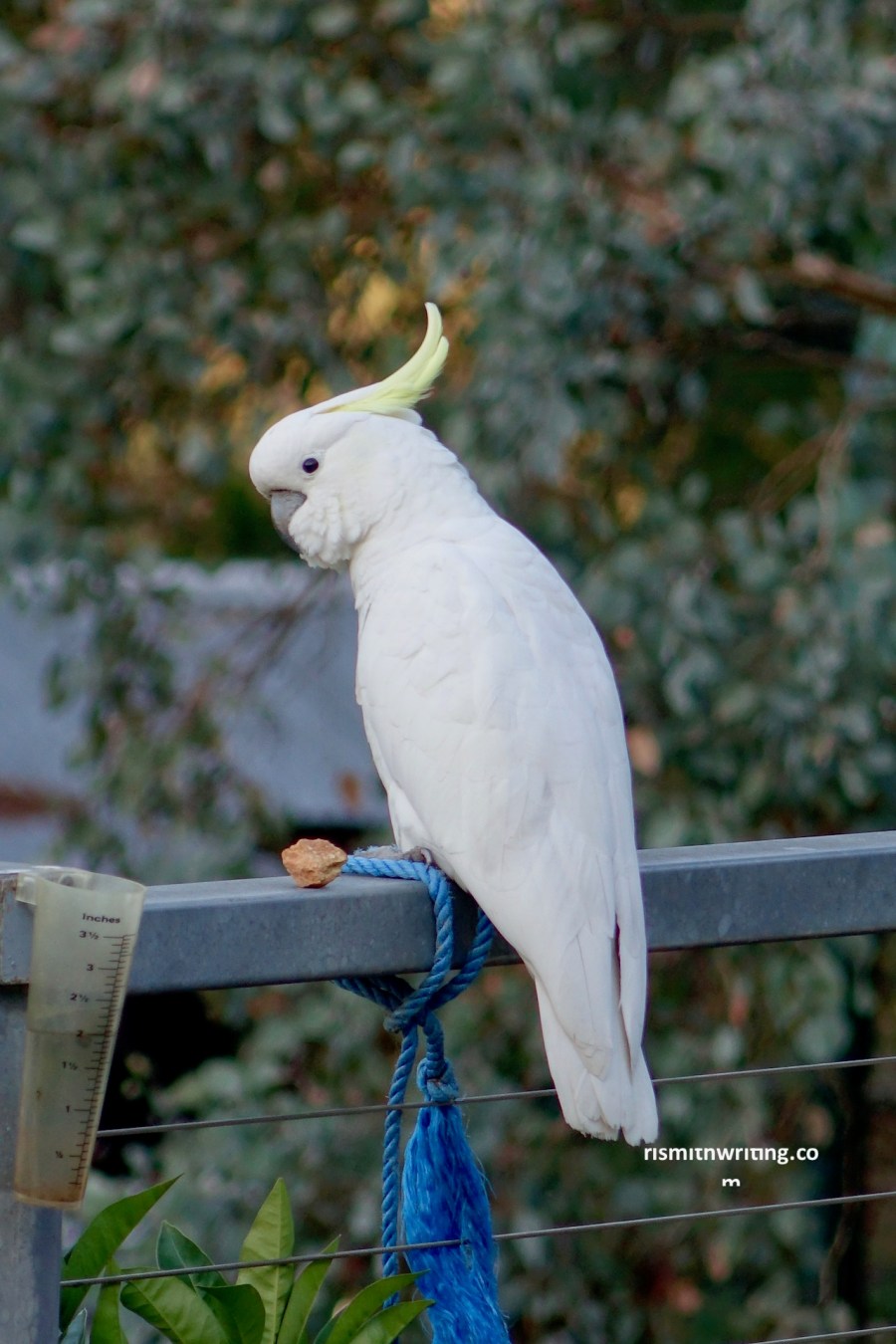
sulpher crested cockatoo

What a galah!

Oh, don’t you hate it when you get it wrong? Galahs are the pink and grey cockatoos. That is not the same as a sulphur-chested cockatoo like the marauder in the picture. He is not a galah, even though they are both cockatoos. And while a cockatoo is not a galah, it is a parrot. And those green and red ones we think of as parrots, like the king parrot, are not cockatoos or galahs even though all of these birds are parrots. Confused yet? It’s a hierarchical classification thing. I remember learning it in zoology.

The word cockatoo doesn’t just mean our white and yellow feathered friends either. In Australian slang a person who keeps watch whilst their mates undertake clandestine activities like gambling is sometimes referred to as a ‘cockatoo’. Probably because they’re expected to squawk if they see the coppers coming. And completely unrelated to birds or illegal activities, small-hold farmer are often referred to as ‘cocky farmers’ on account of real farmers not taking them seriously. Come to think of it I’m probably a bit of a cocky farmer myself. And lets face it, we can all get a bit cocky sometimes.

A couple of weeks ago, I found one of ‘those’ errors whilst working on my third draft. I’m not talking about spelling errors here. I’ve talking about the kind of error that makes you kick yourself for not picking it up in your very early research.  Because it’s the kind of blindingly obvious thing you should have checked. And it’s the kind of error that once seen, cannot be unseen. It demands a major rewrite of the start of your book. The kind of error that results in a dummy spit and self flagellation for your own stupidity. You consider giving the whole project up. Taking your bat and ball and going home.

We all have them. Those moments when we just want to throw in the towel and give up. After a good run and a few days of wrestling with my inner five year old demon I started pulling up my bootstraps. I couldn’t actually bring myself to return to the work immediately. Sulking does not after all produce good creative output. So I did the only thing I could and worked on something else completely unrelated to try and get my mojo back.

The short story format is wonderful for so many reasons. It can break the back of writers block and bad moods, give you a sense of accomplishment and remind you that you can actually finish things. And they are a great place to pump out all that animosity about an error. I went for a noirish mystery of the type where no one is spared. I killed off all the characters except for the opponent by poisoning them. It did a ripper job of getting the poison out of my own system too. Then I settled down and got back to the main game.

I re-plotted the first 9 chapters. It’s not entirely different. I just needed to find a different way into the story to deal with the error. And what do you know, the rewrite is actually going to be a better story than the original I think! Now there’s a good lesson for me: Never get too attached to what you’re writing, you may have to do a slash and burn – it won’t be the end of the world. The work I had already done won’t be wasted. I’ll cut and sort and paste and recycle the good parts that still work. The parts that I can’t use weren’t wasted either as they helped me develop the characters and the story which contributed to the improved rewrite. What a Galah hey?

What strategies do you use to deal with, and get over the discovery of major flaws in your work?


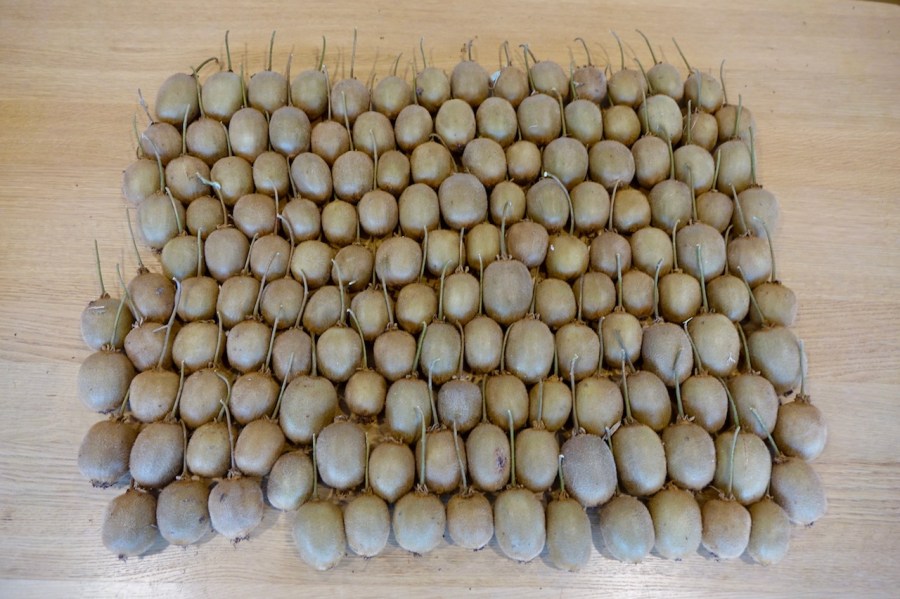
kiwifruit

Autumn fruit

Clunes is a tiny book town in the central goldfields region of Victoria with a main street wide enough to turn a horse and cart, and a colonial streetscape ripe for a gold rush era movie set. Once a year Clunes tiny population of about 1,700 punches above its weight and hosts the Clunes Booktown Festival. As many as 18,000 book lovers, sellers and writers swarm to Clunes to celebrate the book and listen to author talks.

We took our sadness about losing our old dog and decamped to nearby Yandoit which has an even smaller population of only 154 and spent the weekend staying in a beautifully converted old dairy.  It was originally built in the 1860s and set on 21 hectares of pasture occupied by Lola the cow and a mob of kangaroos. At the Dairy we relaxed and, yes, read books in front of the wood fire in between visits to the festival at Clunes. The Italian heritage of Yandoit is evident in the old stone farmhouses and I could imagine myself toiling away in the terraced vegetable gardens. It was a perfect antidote to a difficult week.

Back in Melbourne it was time (a bit overdue really) to get my winter seedlings and seeds in. We removed the large net that covers the summer garden and fruit trees so the parrots don’t eat everything and I harvested about 100 kiwifruit.  I left the smaller, less ripe ones for my colorful feathered friends. Into the beds I prepared a couple of weeks ago I planted garlic, broad beans, peas, snow peas, broccoli, spinach, chard, coriander, lettuce, leeks, spring onions and shallots. Now I just have to keep them safe from snails, cleared of weeds and watch them grow while I focus on getting some other garden jobs done over the colder months.

The name kiwifruit, also known as the Chinese gooseberry, is neither a native of New Zealand nor a relative of the Grossulariaceae family to which gooseberries belong. The fruit was bought to New Zealand from China in 1904 and people thought the flavor resembled a gooseberry.  New Zealand started exporting the fruit in the 1950s at the height of the Cold War when the name Chinese gooseberry would have been a marketing catastrophe and kiwifruit was eventually born in 1959.

This emerald green gem is best fresh and stores quite well in the fridge. Kiwifruit loses some of its great color and sweet flavor when bottled but it’s good for freezing, drying, pickles and jams. I’m partial to a kiwifruit smoothie with some well ripened fruit myself.

Ingredients:
• 2 kiwi , peeled and halved
• 1/2 banana , peeled
• 1 Apple juiced
• 1 cup baby spinach
• 1/2 cup vanilla Greek yogurt

Place all the ingredients in a blender and blend till smooth.

Do you have any suggestions for kiwifruit?

old brown kelpie

Writing for the love of a dog

As Queen Elizabeth II said, “Grief is the price we pay for love.” Lets face it the love of a dog is unique, as is their loss. If you’ve owned a dog you will appreciate the uplifting IMG_0450 (2)flutter of joy that comes with having a wet nose shoved in your face followed closely by a slobbery kiss and the crashing sound as a wagging tail knocks something off the coffee table. The bond is intense and unconditional.
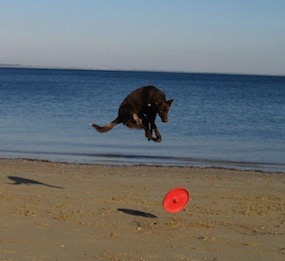
I met the ‘brown dog’ in February 2003.  She was the flea infested runt of a litter we were told were labrador boarder collie crosses. A timid small brown moppet with a white waist coat, white tips on her paws and tail, and a look of surprise.

The labrador never did arrive, but luckily I loved kelpies and had owned one of these intelligent and tireless working dogs with the almond shaped watchful eyes before.

IMG_0088She came to be known as Jarrah due to her coat being the same color as the timber of that name with the hues of a Western Australian landscape. I did eventually suspect she may be a Western Red kelpie as that is the dog she most resembled.
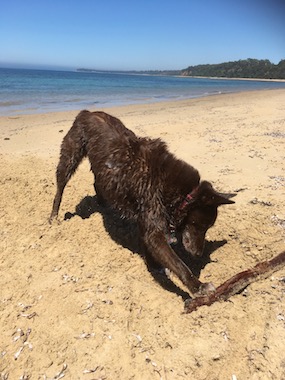
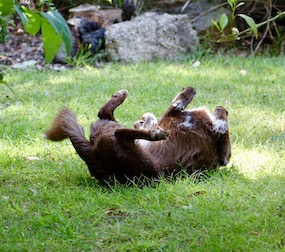
The thing kelpies need most is a job. Jarrah and I went to dog training and practiced what were learned. She became my exercise coach, running or cycling with me daily and nipping at my toes to try and get me to go faster. At 15 years she was still running about four kilometres a day, if at a more leisurely pace. Playing with the frisbee was her favorite game as a young dog and she could snatch a frisbee out of the air two metres above the ground returning it again and again andIMG_0425
again. She was also fond of ‘helping in the garden’ and would test the depth of holes I was digging by dropping her frisbee into them to get my attention.

The intensity of kelpie energy is matched by the intensity of their loyalty and Jarrah followed me everywhere, making friends along the way by demanding opportunistic pats from passing strangers. Car rides were exciting adventures, especially when the destination was the beach. The ground where we live is to too hard to dig but the beach is perfect and Jarrah dug as if she was making up for lost opportunities.

I sweated through fifteen summers, refusing to turn on the ceiling fans because Jarrah was afraid of them. I went for a run on days I DSC00563didn’t feel like it not wanting to disappoint that pleading face. I missed her on long holidays even though I knew my friend was taking great care of her. As she got older and wanted to go out in the night I got up as many times as she needed me to, knowing I would wake up tired in the morning. All for the love of that dog.
As the vigor of youth dimmed into old age Jarrah maintained her desire to help out by supervising my work in the garden.  She no longer wanted to chase the frisbee but would interrupt me for a cuddle or to let me know she thought it was time to go inside and lie on the couch. IMG_0656

Sadly this week, as the fine autumn weather gave way to the first signs of winter that beautiful vibrant girl succumbed to old age. This afternoon the vet came and euthanized her and we buried her with her frisbee in a hole in the front yard where she loved to potter around. I will miss my old friend.


Images: the brown dog

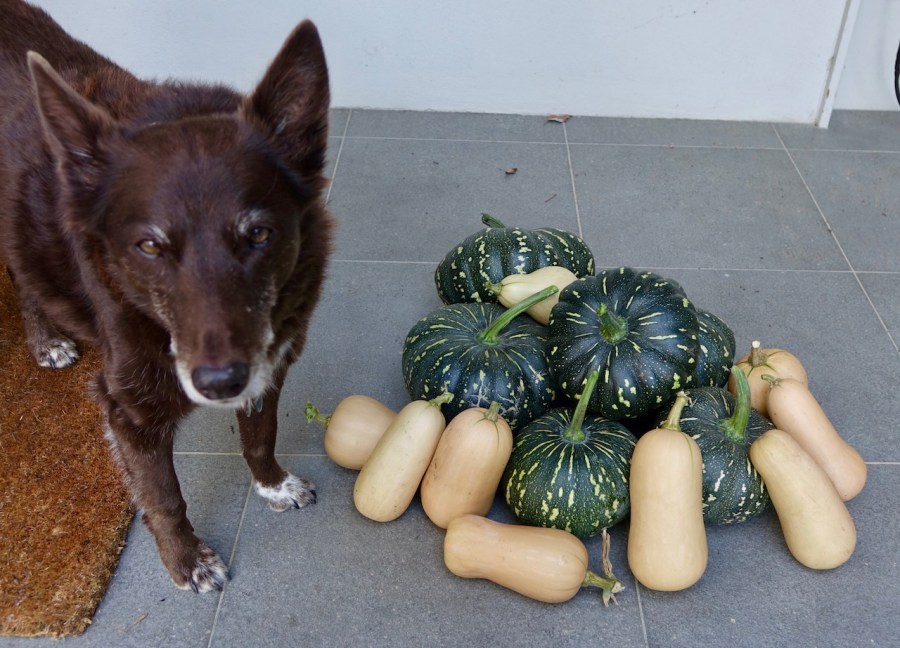
Old brown kelpie standing next to a pile of japla and butternut pumpkins

Smashing pumpkins

It was time to clean out the remnants of the summer vegetable garden this week. The patch had descended into a variety of browned off, shriveling plants and an infestation of weeds. Its quite cathartic bringing order to chaos in the garden. Under the supervision of the brown dog (pictured) I ripped out the dried out corn plants standing sentry, the shriveled tomato plants that will no doubt self seed again next year, and the exhausted zucchini. I picked the dried beans off their vines to plant next year crop and foraged for pumpkins. I compost all the waste.

Once I’d cleaned out the weeds I raked over the beds with a three pronged cultivar to loosen and aerate the top few inches of soil, fertilized with some manure and blood and bone, added a load of compost then covered the beds with pea straw to leave for a week or two.

This year I got a bumper crop of butternuts and kent pumpkins. You need to harvest them when the stem goes woody and preserve about 5cm of stem as it helps to keep them longer. You can store pumpkins in a cool dry place for about 30-90 days. So I’ll be making loads of soup in the next few months. Here is the recipe for the first soup I’m making this season – Pumpkin and roast red capsicum.

Ingredients:

  • 4 red capsicums halved and de-seeded
  • 1/2 large butternut pumpkin, peeled and diced
  • 1 onion diced
  • 1 tbsp olive oil
  • 1 litre vegetable stock
  • 1/2 red chilli, de-seeded and chopped or 1/2 tsp chilli flakes
  • Handful of chopped parsley or coriander

Method:

  • Preheat oven to 180 C
  • Spread capsicums, onion and pumpkin on a large oven tray, season and drizzle the tablespoon of oil over them
  • Bake the vegetables in the over for about 20 minutes until the edges start to blacken to give the soup that nice roasted flavour
  • When the capsicums have cooled remove most of the blackened skin and chop roughly
  • Heat the rest of the oil in a large saucepan and add the baked vegetables
  • Add the stock and chilli, bring it to boil them simmer for about 20 minutes until all the veggies are soft
  • Blend the soup with a hand blender or food processor

Re-heat and serve with a handful of coriander or parsley. You can also add fried diced haloumi and/or roasted nuts if you want a richer flavor.

Image: Jarrah the brown dog showing off the pumpkin harvest

Jacqui Stockdale, Mann of Quinn from the series The Boho - 2015, Adelaide Biennial of Art, 2016. Art Gallery of South Australia.

Finding inspiration in the heart garden

We slipped past the Shrine of Remembrance and crossed Birdwood Avenue in the dark to Jardin Tan. A waxing crescent moon hung low over the Aloe barberae tree illuminating the observatory dome like an Istanbul mosque. The theme of the nights soiree hosted by Melbourne Writers Festival was the heart garden and is one of the monthly events around Melbourne leading up to the festival.

Approaching seven o’clock an array of exotic creatures began to arrive. They included a garden gnome, Aphrodite, and people wearing an variety of flower decorated costumes and head dresses. The guests wandered into the space and settled at tables decorated with leaves, flowers, fruit and vegetables.

The question was asked, what grows in the heart garden? On reflection my answer would have to be inspiration. Writing is a solitary pursuit, but the imagination needs stimulation and for that we must get out and feed our curiosity away from the keyboard or pen.

The practice of ekphrasis, creating another art form from one that already exists, is quite common in poetry writing. The creative act of subjectively reflecting on and narrating a story from another art work such as a painting expands and renews the meaning of the original work. Ekpharasis is an ancient Greek term. An early example is Homer providing a narrative description of the elaborate scenes embossed on the shield of Achilles in The Iliad.

The practice of ekphrasis can equally be used to inspire the narrative form of writing as it can poetry. And inspiration can come from animated as well as static art forms. Pay close attention with curiosity to the sight, sound, light, color, movement and feeling of an object or event. Then allowing yourself to experience it through your senses rather than your analytical mind. This enables us to recreate what we experience in new ways in our writing. In the performance arts, inspiration can be drawn from the performance piece itself, the artists presentation, or the feeling the act gives us as the observer.

The heart garden treated us to an evening of music, poetry and even a botanical drawing class. Whimsical events like the Book of Fete lend themselves to opening up my imagination in new ways and leave me with a sense of creative sustenance, ready to return to the solitude of the keyboard.

My main sources of inspiration are in nature, immersion in the arts and the complexity of everyday interactions. What inspires you?

Image: Jacqui Stockdale, Mann of Quinn from the series The Boho – 2015, Adelaide Biennial of Art, 2016. Art Gallery of South Australia.

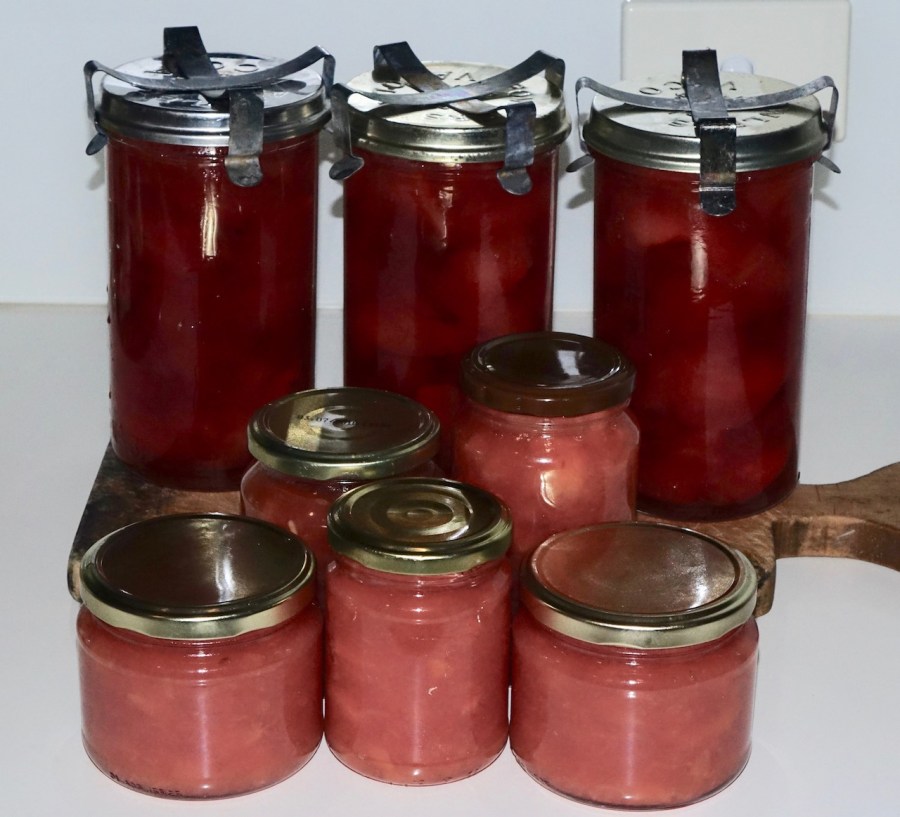
Three large jars of preserved quinces and five small jars of quince jam. Home made

Preserving my sanity

It’s blowing a gale this morning. I live atop a north facing hill surrounded by bush land. I listened to the sound of the wind screaming through the treetops and rattling everything not tied down in the night until I could take it no more and closed the windows against the noise. It’s unseasonal for autumn in Melbourne which is usually characterized by morning fog clearing to fine, sunny days. A good day to stay indoors and deal with that pile of quinces in the fruit bowl.

I provided a commentary on poaching quinces in my Easter post. This time I’m going to move onto preserving. I currently have 22 fruit and nut trees in the garden as well as a sizeable vegetable patch. My mother in-law dusted off and donated her Vacola kit to me when it became evident that my frenetic gardening was going to produce more produce than we could possibly eat.

The Fowler’s Vacola system uses glass jars, rubber sealing rings and metal lids secured by tension clips to vacuum seal the contents. The Australian system was developed in 1915 – and looks like it. Whenever I get it out I feel like I should be wearing a hobble skirt or harem pants a’la Paul Poiret (who made a great contribution to freeing women from corsets). The fashion of the time was heavily influenced by World War I and the women’s suffrage movement and was a pivotal moment in the emergence of modern fashion.

George Fowler was a soldier who served in the British Royal Army Medical Corp as well as the Regular Army.  George clearly didn’t think much of the battle field quzine offerings and invented field cooking stoves and registered new patents for a food bottling and preserving system. His nephew Joseph Fowler came to Australia in 1912 to set up his own bottling business that grew to become the iconic Fowler’s Vacola Pty Ltd.  Fowlers  advertised ‘bring progress to your home by installing a Vacola bottling outfit‘. I can attest that despite feeling like I’ve gone back in time when I wheel out my Vacola, it has actually driven progress. I can now have home grown fruit and vegetables all year round and have almost no waste.

While the wind was blowing I preserved quinces. I used Fowlers preserving jars for this, but you don’t need to have a Vacola itself, just the jars.

Ingredients:

  • 3 large quinces (multiply the recipe if you have more)
  • 300 ml white sugar
  • 300m warm water to dissolve the sugar

Method:

  • Place the whole quinces in an oven dish and bake at 160 C for 2.5-3 hours until the skins blister. Remove from the oven to cool.
  • Wash and sterilize preserving jars and lids
    To make the syrup dissolve the sugar in the water in a large saucepan and boil it until it thickens
  • Cut open the quinces and discard the peel, core and seeds and cut into large slices
  • Add the quince slices to the syrup and simmer for 10-20 minutes
  • Fill the warm sterilized jars with fruit and syrup, seal and keep somewhere cool for a delicious winter dish with porridge or yogurt.

Image: Preserved quinces and quince jam

Sign for second hand store "objects of desire" Istanbul

The writing odyssey begins

Odyssey: a long and eventful or adventurous journey or experience
– Oxford Dictionary

And so it begins. The ancient Greeks spoke of a time when heroes walked the earth performing superhuman endeavors, fighting monsters and consorting with the gods. They made up stories of men and women – neither gods nor humans – who became the heroes of Greek mythology.

Odysseus, the hero of Homer’s epic poem Odyssey, tricked the Trojans into bringing a giant wooden horse inside the walls of Troy. His army defeated the enemy and ended the Trojan War. In the epic Greek poem Odysseus spent many years traveling home from the Trojan war encountering monsters, cannibals, drugs, alluring women and he even visited the afterlife.

I have twelve months off work and I have noticed among friends and colleagues a hint of  expectation that like Odysseus I will set out an an epic adventure. Each year my annual leave has taken me on some new adventure around the world so surely a long break is the perfect opportunity for an extended trip. When I told people about my leave the immediate response has most commonly been where are you going? When I announced I was mainly staying home their faces often folded into confusion and disappointment. Who takes all that time off work to stay home right?

Yesterday was my last day of work for the year. I have decided to spend my time at home to focus on writing (try to finish that crime fiction novel I started two years ago) and my garden (finish all those half completed landscaping projects) – two of my passions. Other than a few short breaks this time will be an internal journey to learn new skills, flex and build my writing muscle and discover where my imagination can take me. That decision feels just right at this point in time. Building and launching this website and writing a weekly blog is also part of the plan. Follow me if you dare…

Image: Istanbul, Turkey