
As the southern hemisphere tilted further and further away from the sun I was beginning to wonder whether the celestial machinery might break down entirely and the sun disappear over the horizon, never to return. The winter solstice is a reason to rejoice as it marks the journey toward the emergence of spring, but it’s cold enough to freeze the (insert your preferred body part) off a brass monkey at the moment.
The words ‘emerge’ and ‘spring’ make me think of a butterfly as it emerges from its chrysalis and bursts into the air to entertain the spring flowers. Last week I experienced a different kind of emergence when I went along to the Emerging Writers Festival National Writers Conference. What is an ‘emerging writer’ you ask? I love the image of a soft moist writer breaking out of a chrysalis, pen in hand, ready to flutter about enlightening the world with their words. But it’s a bit more complicated and contentious than that.
Humans love a hierarchy of power and it turns out the industry for introverts is no different. The world of writing has its own meritocracy designed around the utopia of publication. We are categorized as early, emerging or established depending on how much, and how, we have published. Early writers have not published, emerging have published in journals or anthologies and established writers have published a full manuscript. The last category excludes self-publishing. Publishing and self-publishing is a whole other hierarchical discussion. These writer categories relate to peer recognition and the politics of power tied to that. They completely overlook the effort an individual may have put in to produce their work and discount that there are some excellent self-published books on the market.
The writer status must apply to the development of ones ‘craft’ in the public domain rather than a lucrative career given that most published authors still need a day job to sustain them. The terms also serve a purpose in the funding arena to determine who can and cannot apply for grants. For example, the Richell Prize is for early and emerging writers (publication in anthologies and journals or self-publishing do not exclude you from entry).
I recall when one of my earliest poems (judged blind) had been selected for publication. The organization sponsoring the prize contacted me and said, “I don’t know why they selected that one,” as if being unknown should have excluded me from the privilege of selection. It does highlight the importance of not taking yourself or what other says about you too seriously, something I waxed lyrical about in an earlier post about writing resilience. As the saying goes what other people think of you is none of your business.
Anyway, I digress. The National Writers Conference was an opportunity to hear a range of established authors reflect on their emergent journeys. One common theme was that the angst of recognition is almost immediately replaced by a different kind of angst once established. Many of the established writers who spoke wished for the lack of expectation that existed before they were published. They suffered from fear of the blank page. Will I be able to do it again? Perhaps writers and artists in general are an inherently anxious bunch due to the mysterious and sometimes illusive muse, aka imagination.
The festival was a great opportunity to hear writers and publishers reflect on their craft and the industry. The thing I love most about music and writing festivals is coming across an artist you find inspiring but have never heard or read before. I was particularly taken by Melissa Lucashenko’s reflections to inspire writers. She also shared her eloquent insights on writing and colonization and how we, as Australian writers, think about land, place, people and out history when writing. I’ll be adding her novel Mullumbimby to my reading list and she has another one, Too Much Lip, coming out in September. Rajith Savanadasa, author of Ruins, a novel about a family living in Colombo and grappling with the changes brought about by the Sri Lankan civil war, gave a poetic lecture about nourishing yourself and your creative practice. I will also add his book to my reading list.
What are you reading now?
Image: Dainty Swallowtail Butterfly checking out the grapefruit
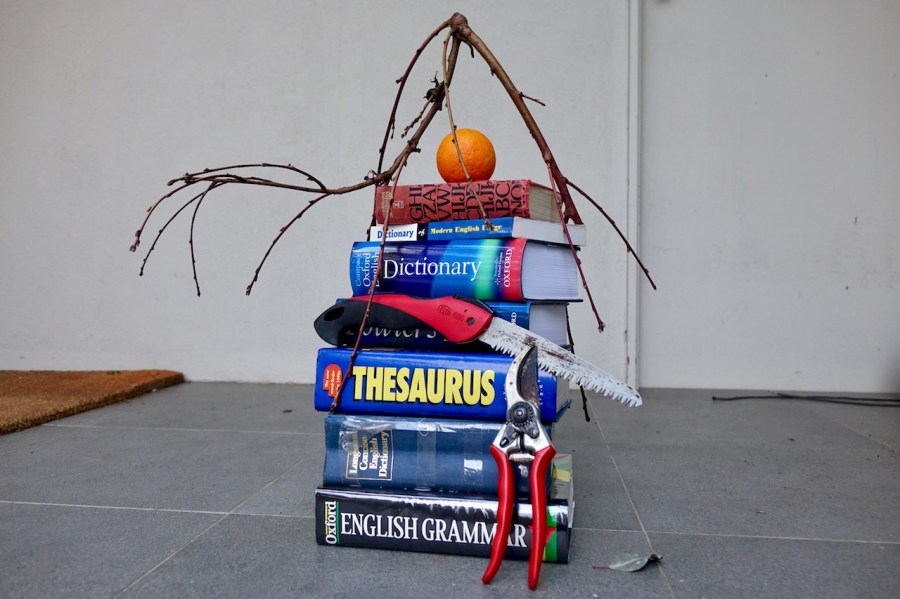
 to the artist as their muse. In reality sometimes the subject itself acts as the muse and when you give a group of creatives the same task you will get very different outcomes – as many as the number of artists involved.
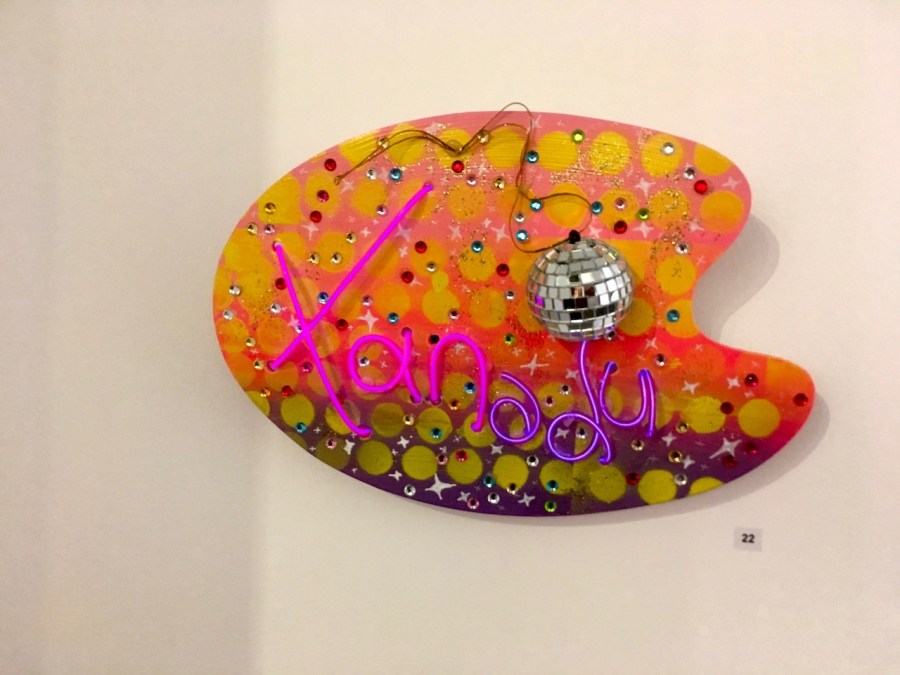
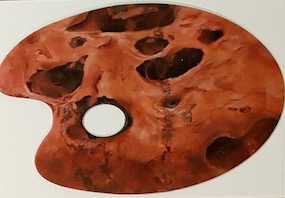
 Hundreds of artists took a simple blank plywood artists palette to use to create an artwork. The palette’s became a playground for the imagination of the participants, and were indeed exquisite. No two palettes were alike but all shone with the passion and inspiration of the artists. One palette was untouched except for a pencil sketch of a cats head stuck to it with masking tape. It was as if the artist had mocked the process itself. Some were painted with scenes that inspired the creators and incorporated the palette hole into the design. Others were completely deconstructed and no longer recognizable from their original form. Palettes ranged from playful, through elegant, novel and disturbing and used a range of materials from paint to pewter to blood, glass, shells and feathers.
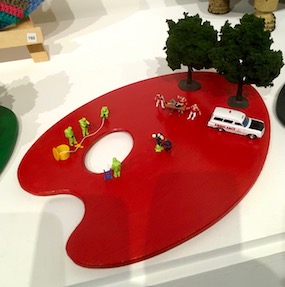 artists themselves across all art forms. Regardless of whether the creative output is painting, sculpture, writing or design within industry the process begins with a seeding incident, something that inspires curiosity and exploration.
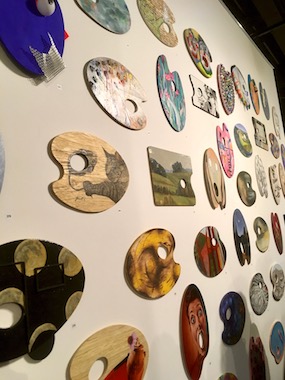 conversation with a work colleague. I let the story take me in the first draft and expect that the end product (if I ever get there) will only contain a shadow of the original spark as development of ideas themselves change and evolve as they progress. Someone else who had the exact same two experiences might have written a romance or science fiction novel. I was drawn to crime fiction.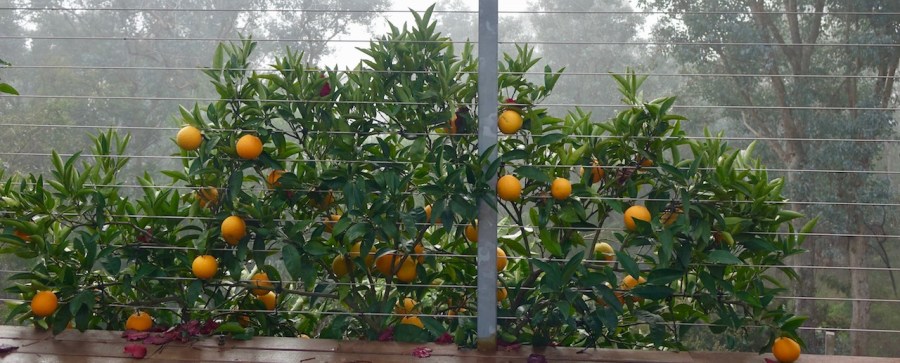
 winter conditions before they witnessed the rocks move. A day after rain the pond was covered with a thin layer of sheet ice. The ice formed around the rocks lifting them clear of the lake bed. When the ice started to thaw and break up during the day some of it clung to the rocks forming a floating seat and the wind was enough to move them across the surface.
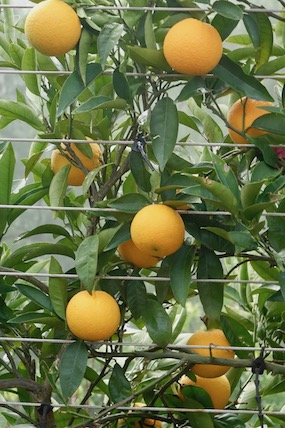 in winter and pluck oranges and tangelos for breakfast. The trees are mulched using stone mulch as we live in a high fire risk area and I didn’t want to put flammable material right next to the house. It does make maintenance labor intensive however. I’ve been contemplating for over a year the task of taking up all the stones to give the trees a really good feed and compost to boost production. The rock wall surrounding the citrus also needed some repairs where it had subsided. I finally attended to the tedious task this week. It’s quite meditative but it did make me wish for UFO’s or ice sheets to lend some assistance. Just imagine getting up one morning to find all those stones moved to one side without any effort from me.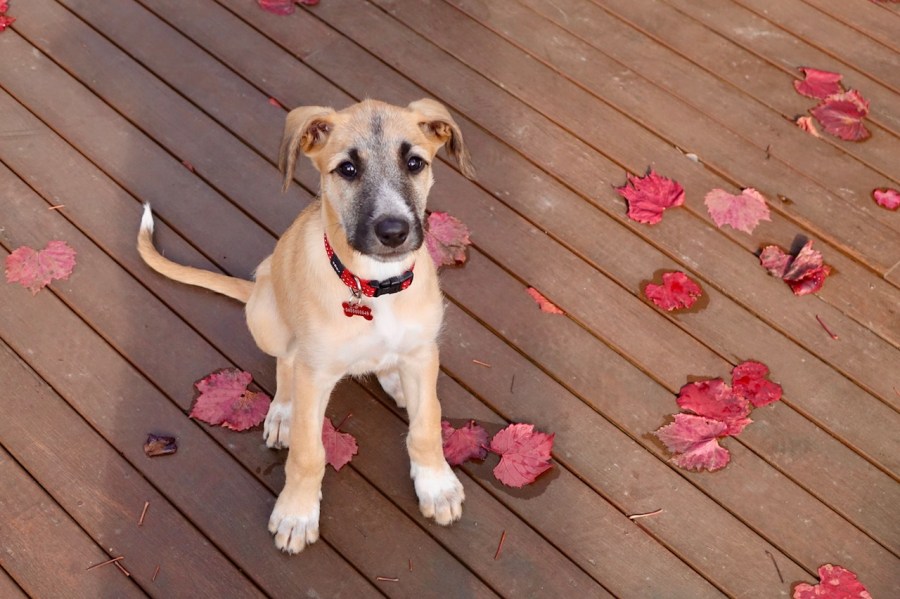
 tribulations and adventures of a sleek black horse. Black Beauty highlighted the issue of animal welfare and the importance of treating others with kindness, respect and sympathy. Important lessons for any child. Roald Dahl bought garden bugs to life in his 1961 novel James and the Giant Peach that explored the themes of friendship, death, hope, fear, abandonment, rebellion and transformation. I remember being fascinated by the giant caterpillar who had to tie the shoe laces on his many pairs of boots every morning. The book is still on my shelves and I pull it out and re-read it every now and then.
 allegory of the Manor Farm ruled by pigs. As power goes to their heads the pigs start to run the place on the premise that “All animals are equal but some animals are more equal than others.” They become so much like the humans they overthrew that eventually they transform into humans themselves.
 fair to stay things were going swimmingly. I had established a great routine of writing early, doing some exercise then either writing again, reading or heading out into the garden depending on the weather. Then along came Harper.
 Many country dogs get adopted in Melbourne, and Seymour is a liaison point apparently. The industry is quite mysterious and I think there could be a great fiction story written about the rescue, movement and adoption of animals.
 Staghound-kelpie cross at home. “Best dog he’d ever had,” he said, “affectionate, trainable and not as energetic as a kelpie. Likes to lie around on the couch and watch TV.” Sounded like an ideal writing companion.
 people who dropped by and Bunning’s. Believe it or not Bunning’s has a very detailed dog positive policy and we were able to take Harper around the store introducing her to the weird and wonderful world of the great Aussie tradition of a trip to the hardware store.
 R L Smith